
The question arrives just as the room begins to relax. It is precise, relevant, and one step beyond the evidence you prepared. Everyone looks at you. In that moment, many speakers feel they have only two choices: produce an answer immediately or admit defeat.
There is a better option. A capable presenter can be useful without pretending to know more than the facts support. The goal is not to win a memory test. It is to help the audience understand what is known, where the boundary lies, and what should happen next.
That approach is not a weakness disguised as confidence. It is part of clear communication. Research on uncertainty communication suggests that acknowledging uncertainty can slightly affect how certain people feel about a number without necessarily destroying trust in the source. The practical lesson is not to announce doubt about everything. It is to be exact about the limit instead of hiding it behind a confident guess.
First, work out what kind of question you have been asked
“I don’t know” can describe several very different situations. Before answering, identify which one you are facing. That small diagnosis prevents you from using the wrong response.
- A clarification question asks you to explain something that was already in the presentation. You may know the answer but need a clearer example or a different wording.
- A missing-fact question asks for a detail you could verify, such as an exact figure, date, source, or product specification.
- A prediction question asks what will happen under conditions that have not been tested. No one in the room may know with confidence.
- A scope question moves into a subject that is valid but outside your work, authority, or purpose for the session.
- A challenge questions your method, premise, or conclusion. You may need to examine the claim rather than retrieve a fact.
- A loaded question contains an assumption you do not accept. Answering it as asked may accidentally endorse that assumption.
A few seconds of classification are worth taking. A deliberate thinking pause tells the room that you are considering the question. A stream of “um,” “probably,” and “I guess” tells the room that you are constructing an answer while speaking.
Use a four-part answer when the facts stop
A useful response to an unanswerable question usually has four parts: acknowledge the question, state what you do know, mark the limit, and give a concrete next step. The order matters. It keeps an honest boundary from sounding dismissive.
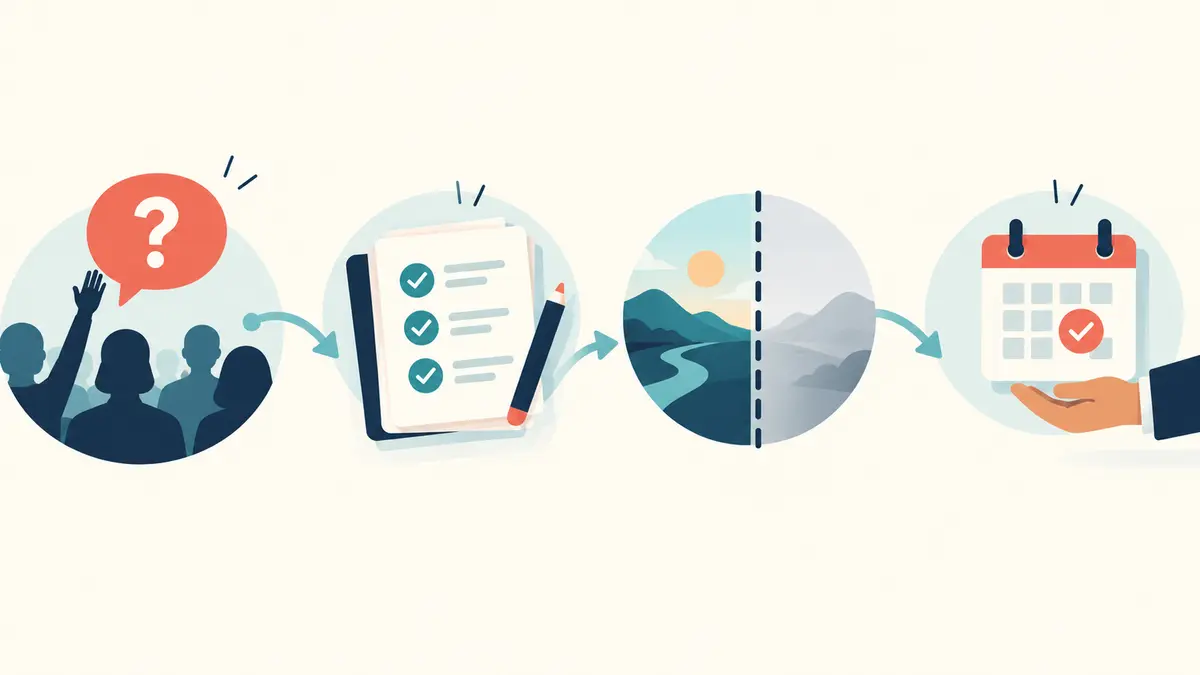
1. Acknowledge the real question
Begin by showing that you heard what the person is trying to learn. A short restatement is often enough: “You’re asking whether the result would still hold for a much smaller team.” This helps the questioner correct you if you have misunderstood, and it gives the rest of the audience a clean version of the question.
Do not spend a minute praising every question as “great.” Routine flattery can sound automatic, especially when the question is difficult. A neutral acknowledgment is more credible: “That distinction matters,” or “We did not test that condition, so let me separate what we know from what we would be estimating.”
2. State the nearest verified fact
Not knowing the final answer does not mean you know nothing useful. Give the closest fact that is both relevant and supported.
Suppose someone asks whether a pilot program will save money when expanded nationwide. You may not have a defensible national estimate, but you can say: “In the 12-week pilot, support requests fell by 18 percent across three locations. We have not yet modeled nationwide staffing and training costs.” The audience receives real information without being invited to mistake a pilot result for a forecast.
This is different from circling the question with everything you remember. Select only the evidence that helps locate the boundary.
3. Name the exact limit
“I’m not sure” is honest but incomplete. What are you unsure about? Is the figure unavailable, the evidence mixed, the scenario untested, or the decision outside your role?
Specific limits sound more competent because they show that you understand the shape of the problem:
- “I don’t have the regional breakdown with me, so I would rather verify that number.”
- “Our study included first-year students, not experienced managers, so I cannot claim the same effect for that group.”
- “That depends on next quarter’s pricing, which has not been approved.”
- “I can explain the technical trade-off, but the final policy decision belongs to the compliance team.”
The boundary should be no wider than necessary. Do not say “We have no idea” when you mean “We do not yet know the size of the effect.” Equally, do not shrink a serious unknown into “a minor detail.” Accurate scope is what makes the statement trustworthy.
4. Offer a next step you can actually complete
A next step turns a limit into useful direction. It might be a source already available, a person in the room with the relevant expertise, a calculation that needs checking, or a follow-up after the session.
Avoid the reflexive promise, “I’ll get back to you,” unless you create a way for that to happen. Capture the person’s name and contact method, name the owner of the follow-up, and give a realistic time. “Please leave your email on the sign-up sheet; I will check the regional table and send the exact figure by Thursday” is a commitment. “I’ll look into it” is atmosphere.
What an honest answer can sound like
You do not need to memorize a polished speech. In fact, relying on one rigid sentence can make you sound evasive when the situation changes. Prepare a few adaptable structures instead.
“The short answer is that I don’t have enough evidence to say yet. We know X from the pilot, but Y was outside its scope. I can check the follow-up data and send the result tomorrow.”
“I can answer the first part. On the second, I would be speculating, and I don’t want to present a guess as a result.”
“That decision is outside my role. What I can explain is the evidence the decision-makers will use.”
“I have not seen that source. If you share the citation, I’m happy to compare its method with ours rather than react to it from memory.”
These answers work because the language is plain. The same principle that helps you speak clearly during a presentation also helps during Q&A: one claim at a time, concrete nouns, and no unnecessary defensive language.
Do not confuse confidence with speed
Pressure makes speakers answer too quickly. A fast response can feel decisive from behind the lectern, yet it may prevent you from noticing that the question contains two parts or rests on a false premise.
Pause, breathe out, and look at the questioner. If needed, say, “Let me think about the most accurate way to answer that.” Five seconds usually feels longer to the speaker than to the audience. It is still shorter than correcting a careless five-minute answer.
If the question is long, take a note or divide it aloud: “I heard two issues: whether the measure is reliable, and whether the result applies outside this sample. I can answer the first; the second is still open.” That move makes your answer easier for everyone to follow and prevents the second issue from disappearing.
How to respond to a challenge without becoming defensive
Some hard questions are not requests for a missing fact. They challenge the work itself: “Isn’t this sample far too small?” or “Why should anyone trust a model that failed last year?” Treat the substance seriously even if the delivery is sharp.
First, lower the temperature without scolding the questioner. Then identify the valid concern. “You’re right that sample size affects how confidently we can generalize. The result is strong for these 86 participants; it is not evidence about every customer.” If the criticism reveals a real weakness, say so. You can defend the value of a study while naming its limits.
When a question contains a premise you reject, separate the premise from the useful issue: “I would not describe the earlier trial as a failure, because it met its safety target. But your underlying question—why the adoption rate stayed low—is important.” You have not accepted inaccurate framing, and you have not used the disagreement as an excuse to avoid the question.
If someone wants a debate unrelated to the session, give a brief boundary and redirect: “That is a wider policy question than today’s analysis can settle. For this presentation, I can show how the two options differ on cost and access.” The moderator can help if one person keeps consuming the room.
Bring in another expert without handing away responsibility
A teammate may know the answer. Invite them with a defined handoff: “Maya led the accessibility testing. Maya, could you explain what we found with screen-reader navigation?” This is cleaner than looking around and asking, “Does anyone know?”
Do not use a colleague as a shield for a question you simply dislike. Answer the part that belongs to you, then pass the specialist part. If nobody present owns it, state the follow-up rather than starting a group brainstorm in front of the audience.
Prepare for questions by mapping boundaries, not scripting everything
You cannot predict every question, but you can prepare the edges of your knowledge. During rehearsal, create a simple Q&A boundary map with four columns:
- questions the evidence answers directly;
- likely questions that require a supporting figure or source;
- important unknowns and untested conditions;
- issues owned by another person or outside the session.
Place the precise numbers, source names, and definitions you are likely to need in your presenter notes. Record which claims are estimates. Agree in advance who will answer legal, technical, financial, or operational questions. This preparation is more useful than trying to memorize paragraphs.
Your overall structure also shapes the questions you receive. A presentation with a clear claim, evidence, limitations, and decision point leaves less room for basic confusion. If the main argument is still loose, revisit the structure from opening to closing before building an elaborate Q&A script.
Rehearse with someone who did not help create the presentation. Ask them to find hidden assumptions, undefined terms, and claims that sound broader than the evidence. The questions that make you uncomfortable are especially valuable; they reveal where a boundary needs a clearer explanation.
Correct the record when your answer turns out to be wrong
Sometimes you answer in good faith and later discover that you were mistaken. Do not wait for the error to surface on its own. Correct it through the same channel used for any promised follow-up, and make the correction easy to understand.
A useful correction says what you stated, what is accurate, and whether the change affects the conclusion: “During today’s Q&A I said the survey included 640 responses. The verified total is 604. The percentages shown on slide 12 were calculated from the correct total, so the conclusion does not change.” That is more helpful than “Sorry for any confusion.”
If the error changes the recommendation, say that plainly too. Protecting an earlier impression is less important than leaving the audience with accurate information.
Keep Q&A from ending on uncertainty alone
The final question often becomes the audience’s last memory of the session. If it opens a large unresolved issue, answer honestly and then close by restating the main point that still stands.
For example: “We do not yet have the six-month retention data, and that will determine whether we expand the program. What today’s results do establish is that the new process reduced waiting time without increasing errors.” This is not an attempt to erase the unknown. It places the unknown beside the verified conclusion.
A difficult question does not expose you merely because you cannot produce a fact on command. The real test is whether you can preserve the line between evidence and invention while continuing to help the room. A calm pause, an exact limit, and a real next step will usually earn more confidence than a fluent answer that should never have been given.
Sources
- Proceedings of the National Academy of Sciences: The effects of communicating uncertainty on public trust in facts and numbers
- National Academies of Sciences, Engineering, and Medicine: Communicating Science Effectively
- U.S. Food and Drug Administration: Communicating Risks and Benefits—An Evidence-Based User’s Guide
- MIT Communication Lab: resources for clear scientific and technical communication