Public Speaking and Presentation Skills Training: A Four-Week Practice Plan
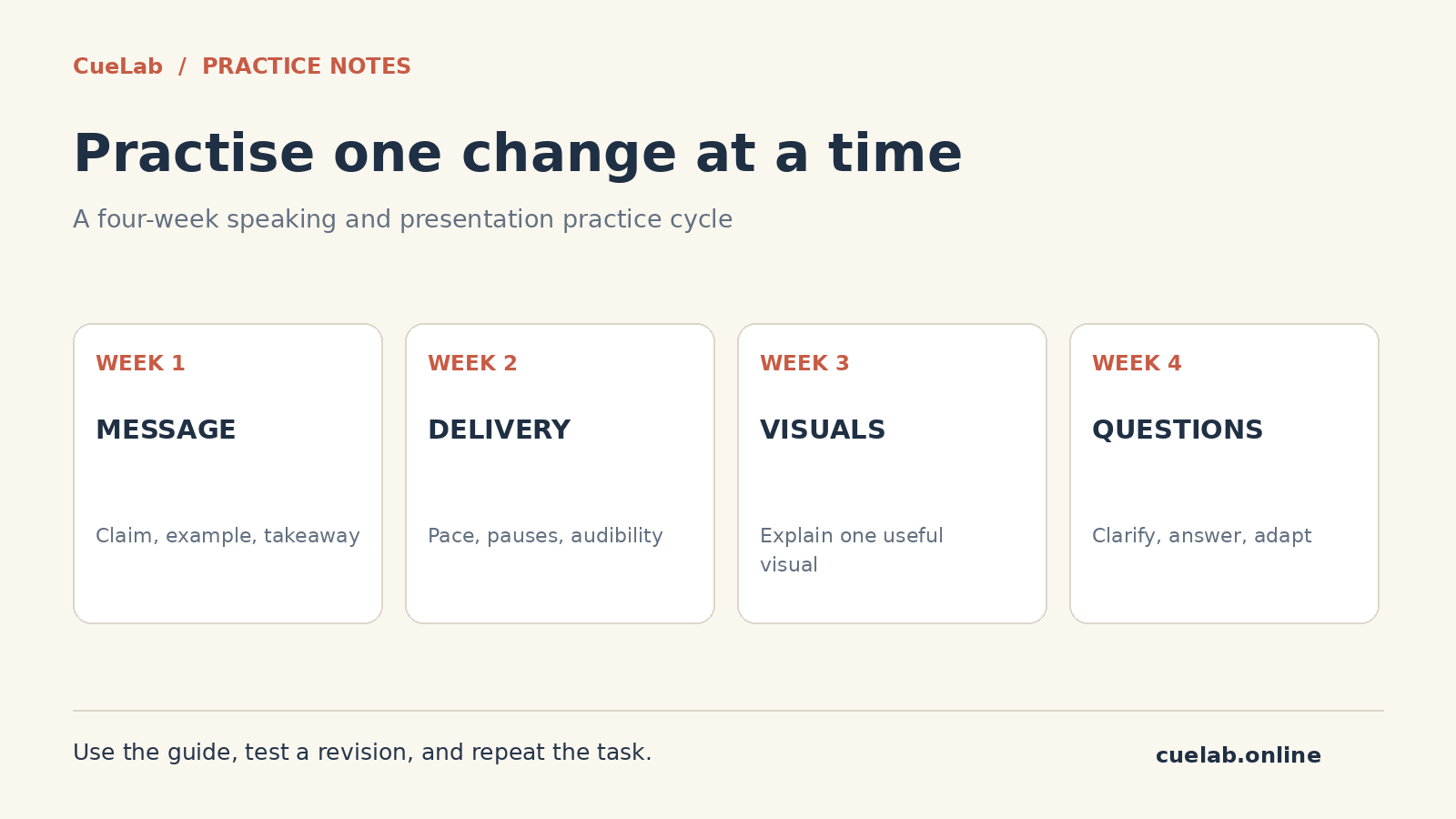
Public speaking and presentation skills training works best when every session changes a specific part of your next talk. A session on “confidence” can leave you with encouragement but no clear action. A session that helps you state the main point, explain one example and finish within the limit gives you something you can practise and assess.
This is a free self-guided training plan for students, colleagues and small groups. It includes a four-week sequence, a 60-minute workshop format, a worked revision and an editable practice tracker. It is educational practice material rather than an accredited course, a certificate programme or a promise to eliminate speaking anxiety.
What should speaking and presentation training cover?
Public speaking focuses on reaching listeners through spoken delivery. Presentations also involve choosing and organising information, using visual material when it helps, managing time and responding to questions. The skills overlap, but a polished voice cannot compensate for an unclear argument or an unreadable chart.
| Skill | Useful practice task | Observable result |
|---|---|---|
| Message | State one audience takeaway | A listener can restate it accurately |
| Structure | Build an opening, example and conclusion | Each section answers a necessary question |
| Delivery | Rehearse pace, pauses and audibility | Listeners can follow complete thoughts |
| Visual explanation | Explain one slide or object | The visual supports a named point |
| Interaction | Answer a question and check understanding | The reply addresses the actual question |
| Adaptation | Deliver a shorter or equipment-free version | The essential message survives a change |
Choose the practice task that matches your actual speaking situation. A student explaining a science model needs different examples from a team leader recommending a process change. Both can practise a clear claim, supporting evidence and a useful response to questions.
Begin with a short baseline recording
Before looking for a public speaking and presentation skills course, record a two-minute explanation of something you already understand. Use a phone or another available device only if you are comfortable doing so. A live listener can take notes instead. Obtain permission before recording anyone else, and do not record confidential material.
Give your listener three questions: What was my main point? Where did you need more explanation? What one change would help you follow the talk? Record the total duration and the moment the main point became clear. These observations provide a baseline. They do not diagnose your personality or create a universal speaking score.
Choose one goal for the next session. “State the recommendation in the first 20 seconds” is testable. “Become a natural speaker” is too broad to guide a rehearsal. A narrow goal also makes feedback easier: your partner knows what to listen for.
Week 1: Make the message and structure clear
Practice aim: Explain one useful idea without making the audience guess why it matters.
- Write the audience and the question they need answered.
- Complete the sentence “After listening, they should understand or do ____.”
- Choose one claim, one example and one implication.
- Prepare a two-minute outline using short prompts.
- Deliver it, collect a listener’s restatement and revise the weakest link.
A useful three-session sequence is 15 minutes to plan, 15 minutes to rehearse and revise, and 15 minutes to explain the same point to a different listener. The times are suggestions. Make sessions shorter if fatigue or access needs require it.
For example, a student might begin with “Today I will talk about libraries.” A clearer main point is “Our class should test a shared book-request list before buying more revision guides.” The revised sentence gives the talk a decision. The body can then explain the unmet need, the proposed trial and how the class would judge its usefulness.
Use CueLab’s presentation structure guide when you need more help deciding what belongs in each section. Do not add sections merely because a template contains them.
Week 2: Improve delivery without acting a personality
Practice aim: Make complete thoughts audible and easy to follow.
Keep the Week 1 content and change one delivery feature at a time. Mark a pause before the main claim. Practise one difficult sentence in shorter thought groups. Check audibility from a realistic listening distance. Ask whether the listener could follow the explanation, rather than whether you looked charismatic.
Record the duration of a full run. If you exceed the limit, identify material to cut instead of accelerating the final minute. A planned pause may help the audience inspect a diagram or consider a consequence. It does not need to be a dramatic silence.
Do not make sustained eye contact, standing still or suppressing all movement into universal standards. Speakers differ in culture, disability, neurotype and comfort. Useful delivery supports understanding in that setting. A speaker can use notes, sit, use a communication aid or look away while thinking and still communicate effectively.
Toastmasters’ preparation advice supports organised content and repeated timed rehearsal. This four-week sequence and its practice measures are CueLab’s own design. Treat them as a flexible routine you can adapt.
Week 3: Use visuals and examples that earn their place
Practice aim: Explain one visual without reading every word or making listeners divide their attention unnecessarily.
Choose a slide, chart, physical object or short written example. State why you are showing it before pointing to details. Name the comparison or relationship the audience should notice. Keep necessary labels close to the relevant content and make text readable in the real room or video window.
Try a simple test. Deliver the explanation once with the visual and once without it. Ask what became easier with the visual. If the answer is only “It looked more professional,” reconsider its purpose. A photograph might make an unfamiliar object concrete. A table might let the audience compare exact values. A diagram might show a process that is difficult to describe in sequence.
Now test the fallback. If the projector fails, can you still explain the main idea in a minute? You may need a handout or spoken description for an essential comparison. CueLab’s table-or-chart guide helps match the format to the audience’s task.
Week 4: Practise questions and changes of plan
Practice aim: Respond usefully when the talk becomes a conversation.
Ask a partner to prepare three questions: one request for clarification, one reasonable objection and one question outside your knowledge. Listen to the complete question. Clarify its scope if necessary. Answer the part you can support and make any limit explicit.
“If you mean the cost of the one-month trial, I can explain the items we included. I do not yet have a confirmed supplier quote. I would check that before recommending a purchase.”
This answer separates current knowledge from a necessary next step. It avoids inventing a figure merely to keep speaking. Practise returning to the main point after a question, and practise ending if the chair reduces your remaining time.
For your final comparison, deliver a new two-minute explanation and use the same listener questions as at baseline. Compare the clarity of the takeaway, the point where explanation was needed and your response to one objection. Improvement in one context does not prove mastery of every speaking situation, but it gives you evidence for choosing the next goal.
A 60-minute public speaking and presentation skills workshop
| Minutes | Activity | Output |
|---|---|---|
| 0–5 | Set one audience and task | A specific takeaway sentence |
| 5–12 | Baseline explanations in pairs | A listener’s restatement |
| 12–22 | Rebuild the outline | Claim, example and implication |
| 22–32 | Timed rehearsal | Duration and one observation |
| 32–42 | Revise and explain one visual | A clearer supporting example |
| 42–52 | Repeat with a question | A supported reply |
| 52–60 | Compare and plan | One change for the next session |
The workshop works without slides if learners use a paragraph, an object or a sketched process. Give participants the option to practise with a partner before speaking to a larger group. Avoid surprise recordings, compulsory personal disclosures and public judgements about confidence.
A worked before-and-after revision
Before: “Good morning. My presentation is on teamwork. Teamwork is very important in our life. There are many advantages of teamwork. Today I will explain all of them.”
After: “Our last group project had four contributors but no agreed handover. Two people revised the same slide while one important source was never checked. For the next project, I propose a five-minute planning conversation that names each task, owner and deadline.”
The revision gives listeners a recognisable problem and a proposal. It is more useful because it creates a route for the rest of the talk. The speaker can show the planning conversation, answer an objection about extra time and explain how the group will check that the handover worked.
A second revision could shorten the scenario if the audience already knows the project. Training should teach the reason for a change, not turn one attractive opening into a phrase everyone repeats.
How to give feedback that changes the next attempt
Use a specific moment, its effect on you and one possible revision. For example: “At 45 seconds, the example introduced a second problem before I understood the first. Could you finish the first example before moving on?” Let the speaker decide which change to test.
Toastmasters’ evaluation guidance emphasises the speaker’s goals and observable performance rather than judgements about the person. In your practice group, avoid turning every session into a long list of faults. Choose the feedback that most directly affects the intended message.
Ask the speaker to repeat the changed section. This closes the loop between comment and practice. Otherwise, a helpful suggestion can remain an abstract note that never affects delivery.
How to choose a paid course or local programme
If you are comparing a public speaking and presentation skills training programme near you, ask how much live practice each learner receives, how feedback is given, whether class size limits speaking time, and whether the activities resemble your actual needs. Ask about access arrangements, recording policies, missed sessions and the meaning of any certificate.
A certificate may record attendance or completion. It does not automatically show that a programme is accredited or that it measures a recognised proficiency level. Request the provider’s actual criteria. You can also use this free plan to identify the specific help you want before paying for a course.
Keep a practice record that explains the change
A useful log records the task, the observation and the revision. “Practised for 20 minutes” tells you that time was spent, but it does not explain what improved. A more useful entry is: “The listener thought my example was the recommendation. I moved the recommendation before the example and repeated the explanation.” The next entry can record what the listener understood after that change.
Use the tracker to distinguish a session you have completed from a revision you have actually tested. A note marked “revised” should lead to another delivery, even if you repeat only the affected section. If you cannot arrange a listener, compare your recording with the specific goal you chose. Avoid treating your own impression as independent audience feedback.
At the end of the four weeks, choose a task that differs slightly from the rehearsed one. You might explain a new example, address a smaller audience or answer an unfamiliar question. This checks whether you can apply the skill rather than merely reproduce a familiar script. Use the result to set the next manageable practice goal.
Common questions
Can I use the training plan for free?
Yes. The exercises can be used for individual and classroom practice. You can complete the routine with a partner and a timer; a paid tool is not required.
How often should I practise?
Start with a few short sessions you can sustain. Track the change made and what happened in the next attempt. Repeating an unchanged speech many times is less informative than testing a clear revision.
What if I still feel nervous?
Judge the session by whether the audience can follow the message and whether your chosen skill improves. Feeling nervous does not automatically mean the presentation is ineffective. Reduce the audience size or task difficulty when that makes practice more workable.
For focused next steps, use the clear delivery guide and the guide to questions you cannot yet answer. Choose one skill for the next run.