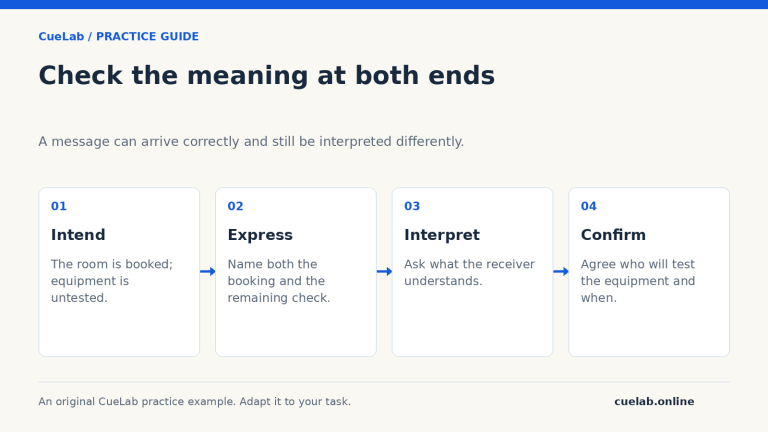
Interpersonal Communication Skills Examples: 10 Conversations and Better Responses
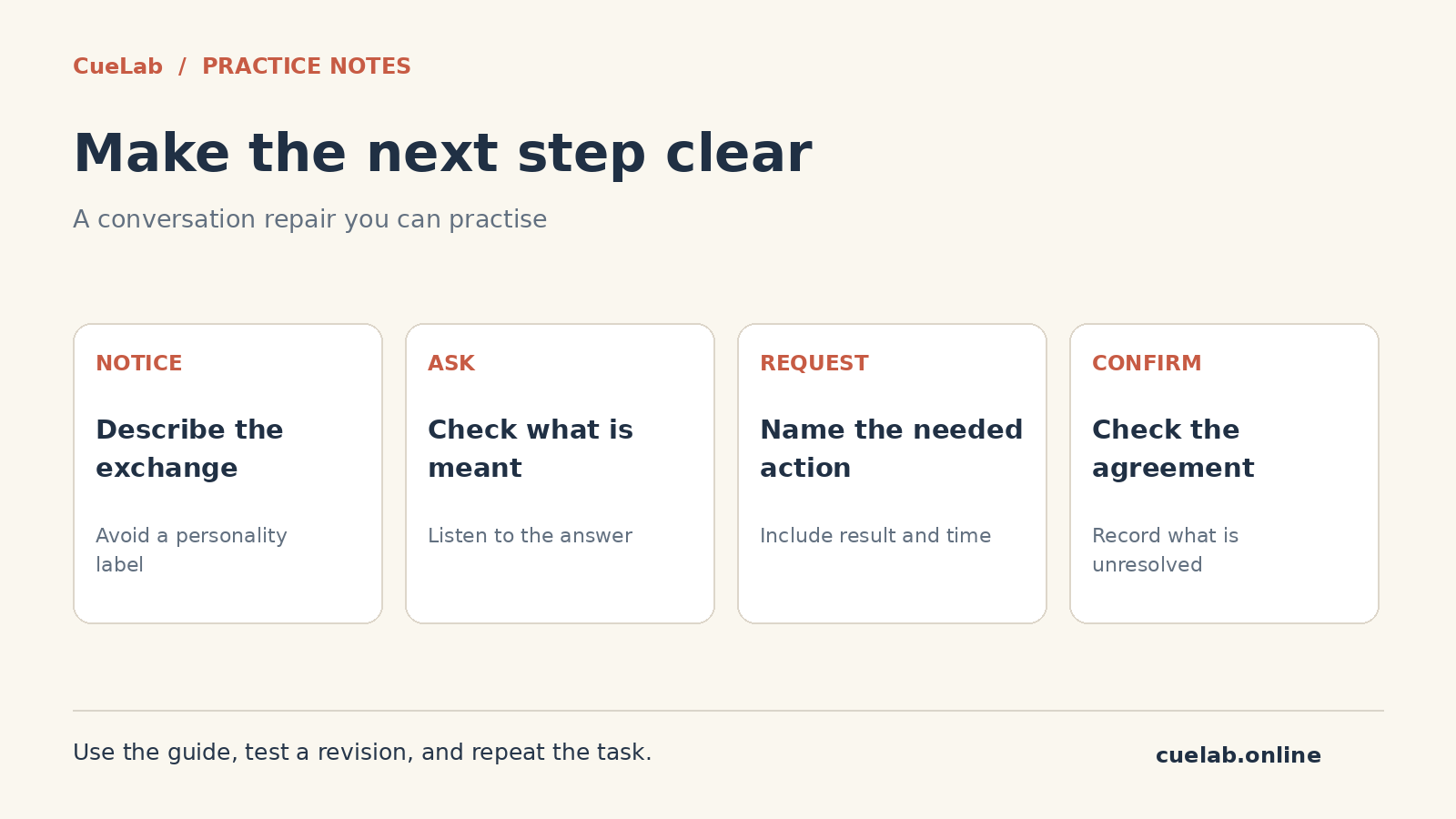
Interpersonal communication skills examples are most useful when they show a specific exchange: what someone said, how the other person understood it, and what a better response makes possible. A list of words such as empathy, teamwork and listening does not show how to use those skills when a conversation becomes difficult.
This guide gives ten original scenarios from school, work and everyday life. Each includes a weak response, a more useful alternative and a short explanation. The wording is adaptable practice material. Real people may respond differently, so treat the examples as options to test rather than scripts that guarantee agreement.
What are interpersonal communication skills?
Interpersonal communication is the exchange of meaning between people, shaped by their relationship, purpose and setting. Useful skills include listening, asking clear questions, explaining expectations, acknowledging another perspective, making respectful requests, managing disagreement and confirming the next action.
Communication skills also include activities such as writing a report or addressing a large audience. Interpersonal skills describe how you work with people more broadly. The categories overlap: negotiating a deadline uses both clear communication and relationship awareness. You do not need to force every workplace behaviour into only one label.
OpenStax’s discussion of communication context explains why audience, timing and setting matter and treats listening as an active part of communication. The scenarios and response framework below are CueLab’s original teaching applications.
A practical interpersonal communication skills list
| Skill | What someone can observe |
|---|---|
| Clarification | You ask what an ambiguous instruction means |
| Active listening | You check the other person’s main concern |
| Perspective-taking | You acknowledge a constraint without assuming agreement |
| Specific requests | You name the action, result and time |
| Respectful disagreement | You address the proposal and explain your reason |
| Feedback | You describe behaviour and its effect |
| Repair | You acknowledge an error and correct the next step |
| Confirmation | You check that everyone shares the same understanding |
The observable behaviour matters more than a label. “I am a good communicator” is difficult to assess. “I summarised the request and confirmed the delivery date before starting” describes an action another person can recognise.
1. Clarifying a vague deadline at work
Situation: A colleague asks you to send a report “as soon as possible.” You have two other tasks due today.
Weak response: “Fine, I will do it.”
Better response: “What decision will the report support, and when do you need it? I can send the checked summary by 3 pm or the full version tomorrow morning. Which would be more useful?”
Skill: Clarification and expectation-setting. The revised response makes the deadline and required level of detail negotiable before a misunderstanding develops. It does not promise two incompatible outcomes. If the request is urgent, you can also ask which current task should move.
2. Listening before offering a solution
Situation: A friend says a group project is becoming frustrating.
Weak response: “Just leave the group. That is what I would do.”
Better response: “It sounds as though the uneven workload is the main problem. Have I understood that? Would you like help thinking through what to say, or do you mainly want me to listen?”
Skill: Active listening and checking the purpose of the conversation. You identify a concern and invite correction. You also avoid treating your preferred solution as the answer before hearing what the person needs. For more detailed practice, see CueLab’s active listening examples.
3. Disagreeing with a proposal without attacking a colleague
Situation: A teammate proposes removing the final review to meet a deadline.
Weak response: “That is careless. You never think about quality.”
Better response: “I am concerned that removing the review leaves the figures unchecked. Could we shorten the report and keep a focused check of the calculations and source links?”
Skill: Reasoned disagreement. The revised response names a consequence and offers a workable alternative. It avoids turning one proposal into a claim about someone’s character. The teammate can now address the risk or suggest a different trade-off.
4. Giving feedback on an unclear presentation
Situation: A classmate asks how their practice talk went.
Weak response: “It was confusing. You need confidence.”
Better response: “I understood the problem in your opening. At the second example, I lost the link to your recommendation. Could you add a sentence explaining how that example supports the proposal?”
Skill: Specific feedback. You identify both a useful part and a precise difficulty. The suggested revision can be tested in the next run. Avoid assuming that the difficulty comes from nervousness; it might be a missing explanation in the outline.
5. Making a request in a shared living space
Situation: Music from a shared room makes it difficult for you to study.
Weak response: “You are always inconsiderate.”
Better response: “I am working on an assignment until 8 pm, and the music is making it hard for me to concentrate. Could you use headphones during that period? After 8, I can move to the other room.”
Skill: A specific request and a clear boundary. The response describes the current situation rather than using “always.” It includes a defined period and a possible arrangement. A request allows an answer; it is not a guarantee that the other person will agree.
6. Repairing a message that sounded abrupt
Situation: Your short message, “Send it now,” has upset a colleague.
Weak response: “You are too sensitive. It was only a message.”
Better response: “My message sounded abrupt. I should have explained the urgency. The meeting starts at 2 pm, and I need the latest file to check one figure. Can you send it by 1:30, or should I use yesterday’s version and label it?”
Skill: Acknowledging impact and repairing the task. You take responsibility for the wording without claiming to know everything the other person felt. You also supply the context the original message omitted.
7. Inviting a quieter participant into a discussion
Situation: Two people have dominated a project meeting.
Weak response: “Why are you so quiet? Say something.”
Better response: “We have heard several views on cost. Sam, you checked access arrangements. Is there anything we should consider? You can add a note afterwards if you need more time.”
Skill: Inclusive turn-taking. The invitation relates to the person’s contribution and provides another route to participate. It avoids making public speaking style into a personality judgement. Some people need thinking time, a written channel or an accessible meeting format.
8. Checking an assumption about nonverbal behaviour
Situation: A teammate looks away while you explain a new task.
Weak response: “You are not interested.”
Better response: “I have covered several steps. Would it help if I paused or put the instructions in writing? What part should we clarify before you begin?”
Skill: Checking understanding without mind-reading. Looking away can have many explanations. The revised response addresses the communication task and lets the person tell you what would help. Sustained eye contact is not a reliable universal test of listening.
9. Saying no while preserving a clear next step
Situation: A classmate asks you to complete their part of a project tonight.
Weak response: “Maybe. I will see.” You already know you cannot do it.
Better response: “I cannot take on that section tonight. I can spend ten minutes helping you choose the next step, or we can tell the group now that the deadline needs review.”
Skill: A clear boundary with a realistic option. A vague answer may postpone disappointment while making planning harder. Offer an alternative only if you can actually provide it. You do not have to invent an excuse or promise help beyond your capacity.
10. Closing a conversation with shared understanding
Situation: A meeting ends with several possible actions.
Weak response: “Great, everyone knows what to do.”
Better response: “Let me check our agreement: Priya will revise the introduction by Tuesday, I will verify the data, and Omar will combine the file on Wednesday. The unresolved issue is permission for the photograph. Is that everyone’s understanding?”
Skill: Summarising and confirming. The closing names ownership, sequence and an unresolved dependency. It invites correction while there is still time to make one. A written follow-up can then preserve the agreement for anyone who needs it.
How to practise these conversations
Choose one situation and give each partner a different piece of context. For example, the person requesting a report needs only one table for a meeting; the person receiving the request assumes a ten-page report. Practise asking questions until both understand the task. This creates a real information gap rather than a performance in which everyone already knows the answer.
Run the exchange twice. In the first attempt, use your usual wording. In the second, change only one feature: the question, request, acknowledgement or closing summary. Ask your partner what became clearer. If nothing changed, revise the intervention rather than declaring the practice unsuccessful.
Keep feedback focused on what happened. “You interrupted before I finished the deadline” is more useful than “You are impatient.” When practising a disagreement, let the other person give a reasonable objection. A communication technique has not succeeded merely because the partner has been instructed to agree.
Interpersonal communication skills examples for a resume
Translate a skill into an accurate account of work you actually did. Instead of “excellent interpersonal skills,” you might write, “Coordinated weekly handovers across a four-person project team, recorded decisions and confirmed task owners.” Use numbers only when they are true and relevant.
A second example is, “Explained revised instructions to classmates and collected questions before the group began the task.” This describes communication behaviour without claiming that you transformed everyone’s performance. If an interview asks for a competency example, explain the situation, your action and the observable result. Be honest about what you cannot measure.
Common mistakes to avoid
- Using a polite phrase without listening. “I understand” means little if the next sentence ignores the concern.
- Confusing acknowledgement with agreement. You can recognise why an issue matters while disagreeing with a proposed solution.
- Making every disagreement personal. Address the claim, action or consequence you can discuss.
- Overloading a request. Separate the essential action from optional background.
- Assuming a technique guarantees cooperation. The other person has their own needs and choices.
- Using practice to pressure someone. Clear communication does not remove the need to respect a refusal or boundary.
Use a conversation repair sheet without over-scripting
Before a difficult exchange, write the purpose, the facts you can describe and the question you genuinely need answered. Prepare a short opening, but leave space for information you do not yet have. A fully scripted argument can make it harder to listen because you may be waiting to deliver your next line.
For example, if a classmate missed a handover, your starting point might be: “The file was not in the shared folder at the agreed time, so I could not combine the slides. What happened, and what can we agree for the next handover?” This wording names an event and its consequence without assuming laziness or bad intent. Their answer may reveal a missing permission, an unclear deadline or an unfulfilled commitment. Each calls for a different response.
After the conversation, record the action actually agreed and anything still unresolved. Do not rewrite the exchange as though a polite opening solved every problem. Sometimes the useful result is a clearer disagreement or an explicit boundary. That is still more informative than a vague impression that the conversation went well.
Common questions
What are basic interpersonal communication skills examples?
Checking what an instruction means, summarising a concern, making a specific request and confirming a next step are useful starting points. Practise them in a manageable conversation before applying them in a more complex disagreement.
Are interpersonal skills and communication skills the same?
They overlap. Communication concerns exchanging meaning; interpersonal skills also include how people cooperate, handle differences and maintain working relationships. A well-managed handover can demonstrate both.
How do I know whether I improved?
Look for a task-specific change: fewer unclear instructions, a more accurate summary or a request that includes the necessary action and time. Ask the other person what they understood rather than relying only on how smooth the conversation felt.
For another useful check, read how to identify barriers to communication. A noisy room, missing context or an inaccessible format may require a practical change alongside better wording.