Communication in Teamwork and Collaboration: A Practical Team Agreement
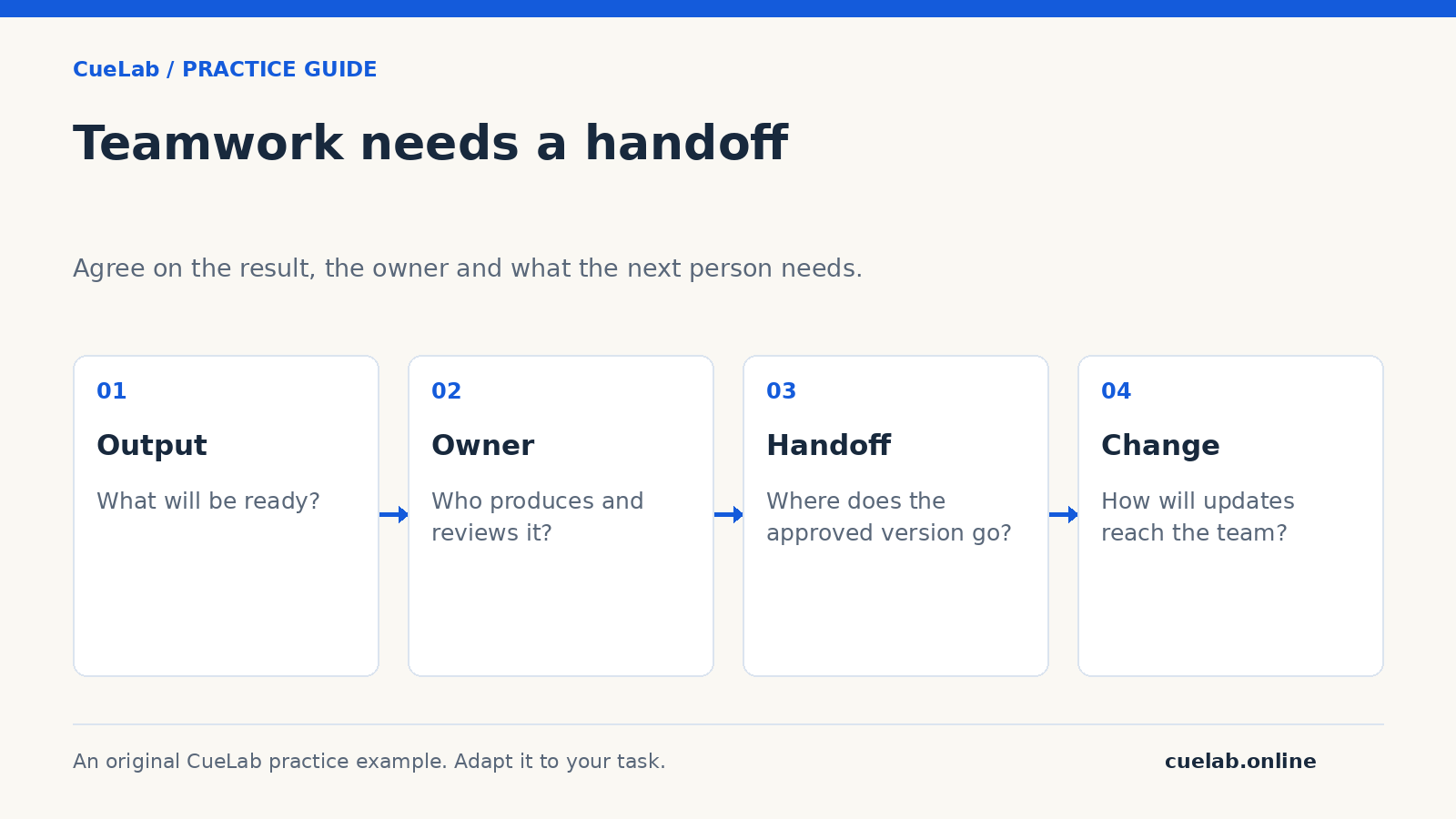
Communication in teamwork and collaboration helps people coordinate work that depends on one another. A friendly group can still miss a deadline when its members use different meanings for “finished,” send changes to different places, or assume that silence means agreement. The practical question is whether each person knows what to produce, who needs it next, and what to do when the plan changes.
This guide builds a small team agreement around those questions. The book-drive example is fictional, and the message templates are original practice material. Adapt the arrangements to your project rather than treat them as universal rules for every workplace.
What effective team communication makes possible
Teamwork combines separate contributions into an outcome. Collaboration also involves developing or revising something together. In either case, communication needs to connect people’s decisions. A designer cannot prepare a readable poster if the venue is still uncertain. A teacher cannot explain a group activity clearly if the team has not agreed what learners should submit.
Useful communication makes dependencies visible. It lets a person say, “My part is ready for review, but it is not approved for printing.” That distinction prevents another person from treating a draft as a final product. It also gives disagreement a practical purpose: finding a condition that would make the plan workable, rather than deciding which teammate has the best personality.
Agree on four things before dividing the work
| Agreement | A usable example | What it prevents |
|---|---|---|
| Output | A one-page invitation with date, location and contact | Different interpretations of the task |
| Owner and reviewer | Mina drafts; Joel checks the event details | Everyone assuming someone else will check |
| Handoff | Post the approved PDF in the shared folder by Thursday noon | A finished file sitting in a private message |
| Change rule | Flag a changed venue in the project thread and update the master brief | Old and new versions circulating together |
Add a response expectation that fits real availability. “Check project messages once each school day” may suit a class assignment; an urgent event may need a different arrangement. Do not assume that every member can monitor messages continuously. Decide which channel carries urgent changes and which channel is simply a record.
Worked example: a book drive with a missing handoff
Four volunteers are organising a book collection. Amir asks for a poster “by Friday.” Bea makes a draft on Wednesday. Chen prints an older version on Thursday because it is the only file he can find. The collection point changes on Friday, but the update appears in a separate chat. Everyone did some work; the coordination failed.
The group repairs the agreement: Bea owns the poster file, Amir confirms the location, and Chen prints only the version labelled “approved.” They use one project thread for decisions and a shared folder for final files. A change to the location must appear in both places. This is a proposed repair, not a reported result from a real project.
Bea: “The layout is ready. I still need the confirmed collection point before I mark it approved.”
Amir: “Use the library entrance. I will confirm access with the librarian by 10 tomorrow.”
Chen: “I will print after that confirmation. Please put the approved PDF in the final folder.”
The improvement is the connection between messages and actions. Acknowledging the update includes saying what changes in the next person’s work. A thumbs-up alone would not establish whether Chen has the correct file or knows the printing condition.
Replace vague updates with information others can use
| Vague message | More useful update |
|---|---|
| “Almost done.” | “The text is drafted. The date still needs checking. I can send the review copy at 3.” |
| “Someone should contact them.” | “Can Rina confirm the room booking by Tuesday? If unavailable, please say so today.” |
| “That will not work.” | “The current plan requires a printer we cannot access. Could we use a digital invitation?” |
| “I thought you knew.” | “I changed the time in the brief but missed the thread. The new time is 11; please confirm your handoff.” |
An update does not need to be long. A compact pattern is completed output → remaining condition → next handoff. Use a longer conversation when a short message would hide an important disagreement. Choose the format according to what the next person needs to do.
Make room for disagreement and quieter contributions
Before a meeting, share the decision question and the material needed to answer it. During the meeting, allow a short written response before asking for discussion. This gives people time to formulate a point and creates a route for someone who does not want to compete for a speaking turn. It does not guarantee equal influence, so the chair still needs to notice whose concerns remain unanswered.
Ask, “Which condition would make this option difficult to use?” rather than, “Does everyone agree?” Record a specific concern and the response to it. If the team cannot resolve the issue, name who has authority to decide. Do not describe a decision as unanimous when a member has explicitly disagreed.
Review the agreement without monitoring people constantly
After a milestone, examine a small sample of handoffs. Was the required file available? Did the receiver know its status? Was a change recorded where the group had agreed? These observations are more useful than counting messages or ranking members by how quickly they reply. A high message count can reflect confusion rather than good collaboration.
Choose one adjustment for the next milestone, such as adding an approval label or moving decisions out of private messages. A simple team agreement records the output, responsibility, handoff and change rule. Review it when the project changes; an agreement that no longer fits the work needs revision.
Common questions
What are the benefits of communication in teamwork?
It can clarify responsibilities, expose dependencies and help people respond to changes. Benefits depend on how the arrangements are used; sending more messages alone does not establish better teamwork.
How do we handle poor communication in teamwork?
Locate one concrete failure, such as an unclear output or an unconfirmed handoff. Repair the arrangement and check the next occurrence before assigning a general label to the team.
Is collaboration possible without meetings?
Some collaborative work can happen asynchronously through drafts, comments and recorded decisions. Use a conversation when uncertainty or disagreement is difficult to resolve in the written exchange.
Related guides: interpersonal conversation examples; an example of active listening.