Why “Any Questions?” Often Gets Silence—and What to Ask Instead
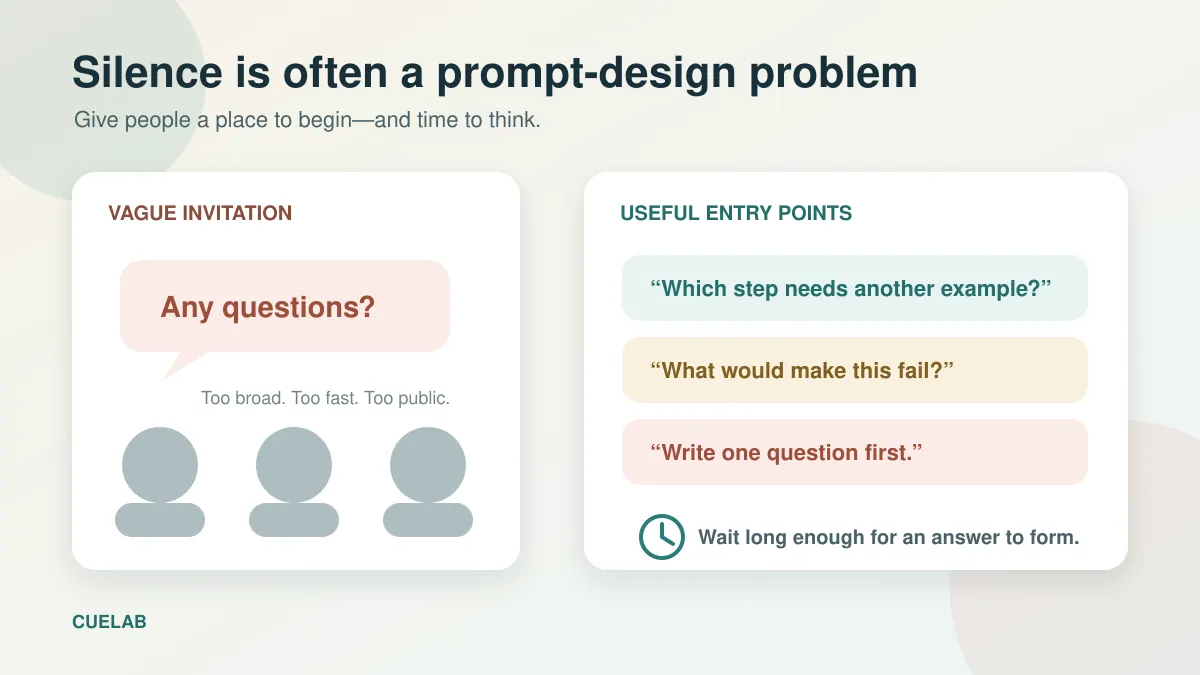
Why a polite invitation can produce a silent room—and how focused prompts, wait time, and lower-pressure response routes lead to better questions.
Practical guides to presenting, speaking, and communicating clearly
Why a polite invitation can produce a silent room—and how focused prompts, wait time, and lower-pressure response routes lead to better questions.

“Good job” is easy to say and pleasant to hear. It can mark a warm moment between a teacher and student, a manager and employee, or a coach and speaker. The trouble begins when those two words are expected to do the work of feedback. They usually cannot. The listener may know that you approve, … Read more

A lesson feels clear while the teacher is explaining it. The example makes sense, the steps seem connected, and the student can follow the answer as it develops. The next day, faced with a similar problem alone, the student does not know where to begin. This gap is frustrating, but it is not necessarily evidence … Read more

A teacher says, “This part is important,” while standing beside a diagram. From the teacher’s position, the intended part is obvious. From a student’s seat, “this” might refer to a label, a line, a shaded region, or the whole diagram. Pointing can close that gap. A clear gesture connects the spoken reference to a visible … Read more

Students can follow an explanation, nod at the right moments, and still struggle to use the idea without help. To tell whether they actually understand, ask them to make a small decision, explain their reasoning, or apply the idea to a different example. Their response gives you evidence that a general question such as “Does … Read more

To explain a difficult idea without oversimplifying it, make the route into the idea easier while keeping the conditions that make it true. You can use plain language, a small example, and a clear sequence without pretending the subject has no exceptions. The important distinction is between removing an obstacle to understanding and removing part … Read more

A teaching video can feel pleasant from the first minute. The instructor smiles, speaks naturally, uses familiar examples, and never sounds stiff or distant. Students may even describe the video as clear or easy to watch. Then they try to explain the lesson afterward and realize surprisingly little has stayed with them. There is no … Read more