30 Expository Speech Topics, with Clear Explanation Outlines
Good expository speech topics begin with a question the audience would like to understand: how a process works, what a term means, why something happens, or how two things differ. The speaker’s job is to make that question easier to answer. A useful topic is therefore more specific than a broad subject such as technology, education, or communication.
This guide gives you 30 focused explanation questions, ways to organize them, and a worked outline for a short speech. The examples are designed to help you choose a manageable scope. You still need to check the facts for your chosen subject and follow your teacher’s definition of an expository assignment.
What is an expository speech?
An expository speech explains a subject so listeners can understand it more clearly. In many classroom contexts, it is treated as an informative speech. You might explain a concept, trace a process, compare related ideas, or examine causes and effects without making a particular audience action the main goal.
Terms can vary between courses. Some instructors use “expository” broadly for explanation, while others specify a researched format, a particular length, or limits on visual aids. Check those requirements first. A strong explanation can be accurate and interesting while still missing an assignment that asked for a different structure.
Explanation, persuasion, and demonstration have different destinations
Consider three versions of the same subject. “How a school club plans an event” aims at understanding a process. “Our club should publish a planning checklist” argues for a change. “How to fill in this planning checklist” demonstrates a practical task. Their content may overlap, but the main audience outcome helps you decide what belongs in the speech.
An explanation does not become free of judgment simply because it is called informative. Your choices of examples, sources, and omissions can still influence an audience. Make those choices carefully, distinguish established information from interpretation, and avoid presenting your preferred explanation as the only possible one.
Choose one question your speech can answer
Start with the audience’s likely knowledge. A talk about how a school event runs may need to explain what a run sheet is before showing how organizers use it. A more experienced audience may already know the document and want to understand how changes are communicated during the event.
Write a question, then draft a one-sentence answer. If the answer contains several unrelated explanations, narrow it. “How does an event work?” could fill a course, while “How does a run sheet connect each event activity to a person and time?” has a clear boundary.
Ten process-based expository speech topics
Use these when the order of events is the main thing listeners need to understand. Research the actual process you choose, because the same institution or service may work differently in another location. A diagram can show the main stages without forcing you to describe every exception aloud.
- How a club idea becomes an approved event. Trace the proposal, practical checks, approval, and preparation for one specific setting.
- How a library book reaches the correct shelf. Explain the local sorting and shelving process rather than attempt a history of libraries.
- How a short video moves from script to finished edit. Follow one simple example through planning, recording, selection, and assembly.
- How a school notice reaches its intended audience. Map one announcement from its author to its final readers, including a possible correction.
- How a presentation becomes a useful handout. Explain the decisions involved in turning a live explanation into reference material.
- How a lost-property system returns an item. Use a permitted local process and explain identification, storage, and collection.
- How a small event’s run sheet is assembled. Connect activities, people, timing, and the information needed when something changes.
- How a written draft becomes a revised explanation. Follow one original paragraph through feedback, checking, and rewriting.
- How a group-project decision becomes a shared action. Explain the handover from discussion to agreement, ownership, and follow-up.
- How a poster moves from a rough idea to a readable layout. Trace message selection, hierarchy, placement, and a final reading check.
Ten concept-based expository speech topics
A concept talk needs more than a dictionary definition. Give the audience a clear example, a contrasting case, and a boundary that prevents a common misunderstanding. You can often explain one useful distinction more effectively than five loosely connected terms.
- What makes a question open or closed? Compare original question pairs and explain how the possible responses differ.
- What does a chart’s scale tell the reader? Use a small original dataset and show how to read its labeled values.
- What is the difference between an observation and an inference? Separate what can be directly described from the explanation someone draws.
- What makes a source relevant to a claim? Show why a credible source can still fail to answer the particular question being asked.
- What is a presentation’s central message? Distinguish the main idea from the topic label and supporting examples.
- What does “audience” mean when a talk is recorded? Explain the immediate listeners and the possible later viewers as separate contexts.
- What is the difference between a summary and a transcript? Compare two original versions of the same short spoken message.
- What counts as a useful visual cue? Explain a cue’s role using an arrow, a label, and an example where extra decoration does not guide attention.
- What is a fair comparison? Apply the same criteria to two familiar options and identify what remains uncertain.
- What does a deadline actually specify? Unpack the task, time, recipient, and submission condition in a fictional instruction.
Five topics about possible causes and effects
These subjects require particular care. A plausible explanation is not automatically a demonstrated cause. If you cannot establish causation, frame your speech around contributing factors, possible explanations, or what the available evidence can and cannot show.
- Why can a group chat produce different understandings of one plan? Examine message order, unclear references, and missing context using a fictional exchange.
- Why can a correct chart still be misunderstood? Compare labels, scale, context, and the question the audience thinks it is answering.
- Why can a detailed instruction sheet still be difficult to follow? Analyze the order of information and the assumptions made about the reader.
- Why can a speaker finish rehearsing on time and run long on the day? Consider setup, audience reactions, transitions, and changes of pace without promising one universal cause.
- Why do different listeners sometimes remember different parts of a talk? Research the relevant factors and avoid diagnosing an individual listener from a single example.
Five topics built around useful comparisons
- How do an agenda and meeting minutes differ? Compare their purpose, timing, and content using one invented meeting.
- How does rehearsing an explanation differ from memorizing it? Show what a speaker practices in each approach and where they can overlap.
- When does a checklist differ from a process map? Explain what each format makes visible using the same everyday task.
- How do a speech outline and a written essay plan differ? Compare the needs of a listening audience with those of a reader who can look back.
- What changes when an instruction moves from a poster to a short video? Compare sequence, visibility, pacing, and how a user returns to a step.
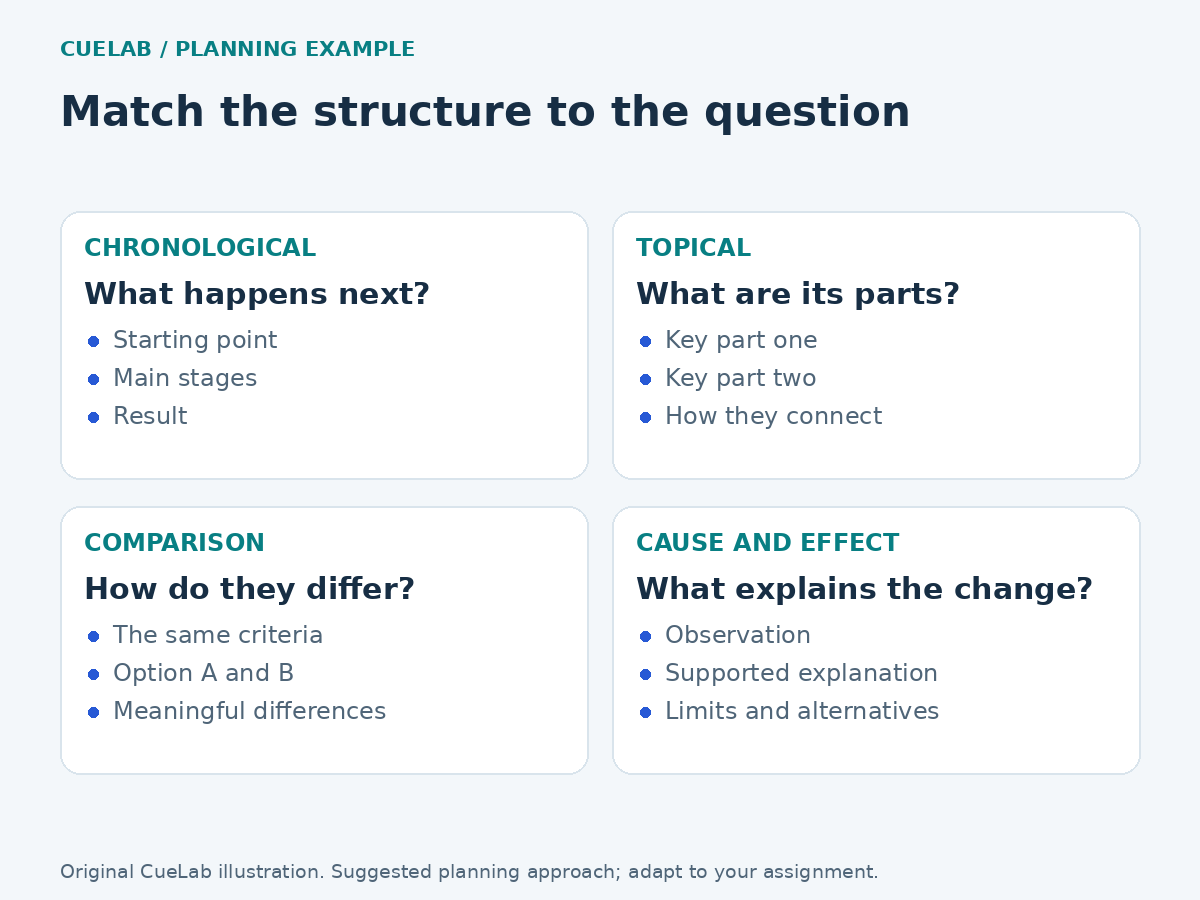
Four structures for an expository speech
Chronological: follow what happens next
Use chronological organization when the sequence is essential, such as a video moving from a script to an edit. State the starting point, group the process into a few stages, and show what each stage produces. Explain an important decision or exception at the point where it occurs instead of saving every complication for the end.
Topical: explain the parts of an idea
Use a topical structure when the audience needs to understand related components rather than a timeline. A talk about a useful deadline could explain the required task, the time, and the delivery condition. Keep the sections at the same level of detail so one does not become a tiny definition beside an enormous discussion.
Compare and contrast: use the same questions twice
For a comparison of agendas and minutes, examine purpose, timing, and content for both. This helps listeners follow the distinction without remembering two separate descriptions and performing the comparison themselves. Avoid deciding that one format is “better” when the real point is that they serve different tasks.
Cause and effect: connect claims carefully
For a talk about misunderstandings in a group chat, separate the observed confusion from possible explanations. Use an original example to show how an unclear “yes” could refer to two different questions. If you make a broader claim about how often this occurs or what causes it, support that claim with suitable research.
Worked outline: how an event plan becomes a run sheet
The following is an invented planning example for a small club event. It explains a process without claiming that every event uses the same document. The audience outcome is to understand how a run sheet coordinates activities, people, and timing; filling in a complete real run sheet would be a separate demonstration task.
Opening: show two versions of the same event
Display a fictional list containing “welcome, activity, break, discussion, close.” Beside it, show a short run sheet with start times and responsibilities. Explain that both describe the same event, but the second also answers coordination questions. Define “run sheet” in plain language before introducing any more specialist terminology.
Stage one: identify the fixed points
Explain that the organizer first identifies the event’s agreed start, finish, and other constraints. In this sample, the room is available for one hour and the guest contribution has an agreed position. Present these as conditions of the invented example, not universal requirements for every venue.
Stage two: connect actions to people
Add a person responsible for each activity and note the cue that tells them to begin. A welcome can have a named host, while a discussion may require someone to collect questions. The lesson is the connection between the event’s content and the coordination needed to deliver it.
Stage three: include transitions and changes
Show where the group needs to move, where materials are introduced, and who communicates an adjustment. A run sheet that lists only the main activities can leave these handovers unexplained. Keep the example short enough that listeners can see the function of each field rather than read a dense page of event detail.
Closing: return to the original question
Place the activity list beside the completed sample again. Summarize what was added: timing, responsibility, and transition information. Finish by asking a comprehension question such as, “Which detail tells the discussion leader when to start?” That checks the explanation without turning the ending into a demand to adopt a particular system.
Use one example throughout the explanation
A continuing example gives the audience something stable to follow while the idea becomes more detailed. If you are explaining observation and inference, keep returning to the same fictional scene. Changing the scene every time can make listeners learn new background information when they should be concentrating on the distinction.
Make the example large enough to see and simple enough to describe aloud. A diagram is useful when it shows a relationship your words are explaining. Decorative pictures that introduce extra objects or unfamiliar labels can create more work for the audience without adding understanding.
Check the facts and the boundaries
For each factual claim, ask what source supports it and whether that source describes the same setting you are discussing. A local library’s procedure establishes how that library works; it does not automatically describe every library. If you use an invented workflow, identify it as an example instead of presenting it as institutional practice.
Check terms that sound interchangeable but may differ in your course or subject. It is reasonable to tell listeners which definition you are using. It is less helpful to insist that a flexible classroom label has one universal meaning when the assignment itself uses it differently.
Rehearse for understanding, not just duration
After a practice run, ask a listener to answer the question in your title without looking at your notes. Their answer will show whether the explanation’s main relationship was clear. Ask where they had to guess, then repair that point with a definition, transition, or better example.
Only then decide what to cut for time. Preserve the information needed to understand the main explanation and remove side paths that require their own background. For a short speech, one well-explained question is a stronger achievement than a tour of a subject that leaves every part half finished.
Choose the question you can explain clearly
Pick one topic, write its answer in a sentence, and sketch the example that would make it visible. Select the structure that best fits that question, gather the relevant sources, and rehearse with someone who is close to your intended audience. Your goal is an explanation they can carry away and use to understand the subject more accurately.
For further practice, use CueLab’s guide to explaining difficult ideas and guide to checking understanding.
Reference: University of Minnesota, Communication in Practice: Purpose and Occasion. The topic questions, diagrams, and run-sheet example above are original CueLab teaching material.