Communication Skills Notes: A Practical Study Guide
Useful communication skills notes help you explain a concept and apply it to an exchange. Memorising a list of terms is not enough if you cannot identify what went wrong in a message or suggest a clearer alternative. These notes combine brief explanations with original practice cases.
The guide is suitable for general revision, including introductory or first-semester study, but it does not claim to follow a particular diploma, university or examination syllabus. Compare the terminology with your course materials. The examples here are original practice material, not official model answers.
1. Start with purpose, audience and the required response
Before evaluating a message, ask what it is meant to accomplish. Informing someone of a changed time is different from persuading them to support a proposal. Next, identify what the audience already knows and what response is needed. A message can be grammatically correct but still omit the action that makes it useful.
Example: “The registration form has changed” provides information. “Please use the new form in the shared folder for registrations from Monday; the old link closes on Sunday” also explains the required action and timing. The second version gives a receiver something specific to do.
2. Know the basic communication terms
| Term | Working meaning | Question to ask |
|---|---|---|
| Message | The words, signs or other form carrying meaning | What did the person actually receive? |
| Encoding | Representing an intended meaning in a message | Did the wording express the intended action? |
| Decoding | Interpreting a received message | What did the receiver understand? |
| Channel | The route or medium used for the exchange | Could the audience access it? |
| Feedback | A response that becomes part of the exchange | Did it clarify meaning, agreement or action? |
| Noise | Interference that can affect communication | Was information missing, distorted or inaccessible? |
These are working definitions for revision. Textbooks may organise the process differently. In a real conversation, people often create meaning together rather than complete one isolated step at a time. Use the model to examine a moment, not to force every interaction into a rigid diagram.
3. Distinguish modes without making a false hierarchy
Spoken and written language can both communicate verbal meaning. Nonverbal communication can involve voice qualities, movement, space and timing. Visual material may combine words, numbers and images. The categories overlap: a labelled diagram contains language as well as spatial relationships.
Choose a mode according to the task. A written checklist can support a procedure that would be difficult to remember from speech alone. A conversation can clarify an ambiguous request quickly. Neither mode is automatically superior. Check what the audience can access, what they need to inspect and whether a record is useful afterward.
4. Practise listening as an observable action
A listener can summarise the main point, ask about an unclear condition or confirm the next step. Those actions give a speaker useful information about what was understood. They do not require constant eye contact or a particular facial expression. Avoid treating appearance as proof of attention.
Practice case: A classmate says, “The group work was difficult because the instructions changed.” A reply such as “You should manage your time better” assumes a cause. A checking response is, “Which instruction changed, and when did the group receive the update?” The question opens a way to understand the actual difficulty.
5. Write with a visible action and enough context
For a practical message, name the purpose near the beginning. Add the information needed to act, then make the next step explicit. Read the draft as someone who was not present when the task was discussed. Would they know which file, date, person or version you mean?
| Draft | Revision | Reason |
|---|---|---|
| “Please check this soon.” | “Please check the dates in the attached invitation by 2 pm.” | Names the object, review task and timing. |
| “The plan is bad.” | “The plan assigns two tasks to the same person at the same time.” | Replaces a broad judgement with an observable problem. |
| “Everyone knows the new room.” | “The session is now in Room 4; please update your invitation.” | Avoids relying on an unverified assumption. |
6. Recognise a barrier before choosing a repair
Different problems need different repairs. If a person did not receive the message, rewriting its tone may not solve the problem. If they received it but interpreted an abbreviation differently, sending it through another app may simply repeat the ambiguity. Locate the gap before choosing the intervention.
Use a short sequence: intended meaning, actual message, received meaning, likely obstacle, revised message and feedback. Keep the explanation modest. One example does not prove that someone has poor communication skills in every setting. Describe the exchange and the evidence available to you.
7. Self-check questions with worked answers
- Question: Why is “okay” weak evidence of a shared plan?
Answer: It may acknowledge receipt without confirming the action, timing or agreement. Ask for the next step when that distinction matters. - Question: Does understanding a request mean accepting it?
Answer: No. A receiver can understand the meaning but disagree, need a change or lack the resources to act. - Question: A chart uses colour alone to identify groups. What should you check?
Answer: Whether the groups remain identifiable without that colour distinction. Add direct labels and an appropriate text or data alternative.
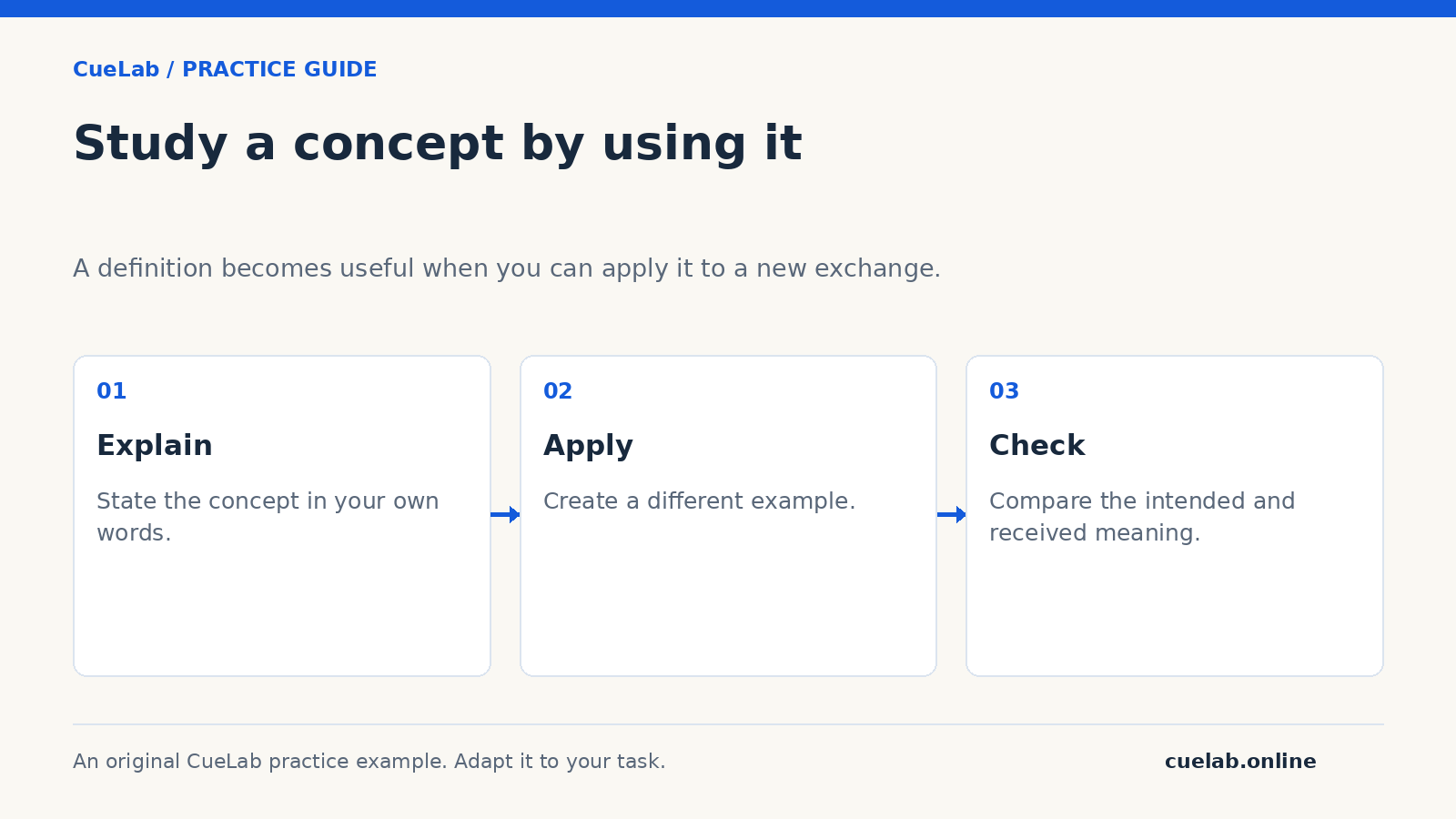
After reading an answer, close the guide and create a different example. Then explain why your revision improves the exchange. This checks application rather than your ability to repeat the wording on the page.
How to use these notes for revision
Choose one heading at a time. Write a one-sentence explanation from memory, add an example and compare it with the guide. Mark the exact part that needs repair: a definition, a missing condition or an unsupported assumption. Return to that part instead of rereading every section without a task.
If you are preparing for an assessed course, use your teacher’s required terms and answer format. Use the definitions and worked cases as a starting point for your own notes, not a substitute for your course instructions.
Related guides: encoding and decoding examples; worked interpersonal conversations.