Types of Questioning Techniques: Choose a Question for Its Purpose

The most useful types of questioning techniques are connected to a purpose. A question can check a fact, reveal reasoning, clarify a term, test an application or invite reflection. The same question may do more than one job, so there is no need to force every prompt into one universal list of four or seven types.
This guide uses original examples from a lesson on clear instructions. It also shows how the techniques can support a workplace discussion or a coaching conversation. The aim is to obtain useful information while giving the other person a fair opportunity to respond.
Match the question to the evidence you need
Before asking, finish the sentence “I need this response to show whether…” If you need to know whether learners can identify a deadline, ask them to locate it in a message. If you need to know whether they can improve a message, ask them to revise a new one and explain the change.
A fluent answer to the wrong question can create false confidence. “Do you understand?” may produce a polite “yes” without showing the intended skill. A more specific task often reveals what needs explanation, but it must remain appropriate to the learner’s preparation and the situation.
A practical comparison of question types
| Technique | Purpose | Original example |
|---|---|---|
| Closed question | Check a defined fact or condition | “Does the message state a date?” |
| Open question | Invite a developed account | “What would a newcomer still need to know?” |
| Probing question | Explore the reason behind an answer | “Which word made you interpret it that way?” |
| Clarifying question | Establish the meaning of a term | “What does ‘ready’ mean in this task?” |
| Application question | Test use in a new situation | “How would you revise the message if the room changed?” |
| Reflective question | Review an action and its consequence | “Which change removed the most uncertainty, and why?” |
Closed questions are not automatically weak, and open questions are not automatically thoughtful. “Is the entrance accessible?” may concern an essential condition. “What do you think?” may be too broad to help a learner who does not yet know which feature to inspect.
Build a short sequence rather than a rapid-fire quiz
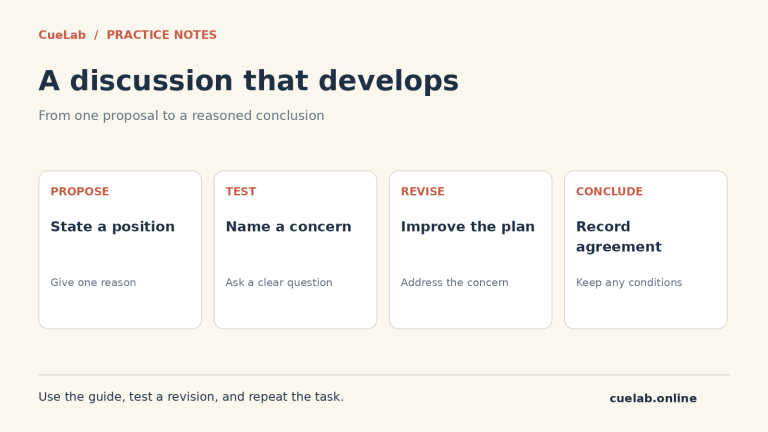
Start with a message: “Meet tomorrow in the usual room.” First ask what information is explicitly available. Next, ask which part a newcomer cannot interpret. Finally, ask learners to rewrite it using a brief that supplies the date, room and purpose.
The sequence moves from noticing to explaining and applying. Each response gives the teacher a reason for the next question. If the first answer shows that the learner cannot identify the time reference, pause and clarify it instead of continuing through a prepared list regardless of the response.
Give thinking time and a usable response route
A person may need time to interpret the question, recall relevant information and formulate an answer. State whether you want immediate recall or considered reasoning. For a more complex question, allow a short written note or pair comparison before inviting a response.
Do not treat a pause as proof that someone does not know. Check whether the question was understood and whether the response mode fits the task. Avoid repeatedly paraphrasing the question so quickly that the learner must process a new version before answering the first one.
Repair questions that contain the preferred answer
| Problematic prompt | Repair | Why it changes the exchange |
|---|---|---|
| “Surely the second message is clearer?” | “Which message gives you enough information to act? Show the part you used.” | Requests evidence rather than agreement with the questioner. |
| “Why were you careless?” | “Which step was missing from your check?” | Examines an action instead of presuming a character flaw. |
| “What is wrong with this?” | “Can a newcomer identify the location from this message?” | Defines the feature to inspect. |
| “Does everyone understand the task?” | “What will you produce first, and where will you put it?” | Checks the next action. |
Use follow-up responses to keep the reasoning visible
When someone answers, respond to the substance. You might ask for an example, invite a correction or compare two interpretations. “Good” alone may leave the group unsure which part of the answer was useful. A specific response can identify the reason without turning the exchange into praise for a personality trait.
If an answer is mistaken, locate the issue and give a path forward. “The message names a day but not a calendar date; how would you remove that ambiguity?” is more actionable than treating the whole answer as a failure. Do not use questioning to keep a learner publicly guessing until they say your preferred word.
A question-planning exercise
- Choose one learning or discussion goal.
- Write the response that would provide useful evidence.
- Draft a question that could elicit that response without supplying it.
- Predict one reasonable misunderstanding.
- Plan a follow-up that clarifies the misunderstanding.
- Decide how people can prepare and respond.
Try the sequence with a partner. Ask them what they believe the question requires, then compare that account with your purpose. Revise the prompt if the task is unclear. In coaching, also check whether the person wants exploration, information or a decision; a series of open questions may be unhelpful when they need a direct factual answer.
Common questions
What are four common questioning techniques?
A simple starting set is closed, open, probing and clarifying questions. Other frameworks add categories or classify questions differently. Choose the label that helps you plan the purpose and follow-up.
Are questioning techniques only for teaching?
No. They can help in project discussions, interviews and coaching. Adapt the wording, authority and purpose to the situation rather than copy a classroom routine unchanged.
How many questions should I ask in a lesson?
There is no useful universal number. Ask questions that provide relevant evidence, allow response time and use the answers to guide what happens next.
Related guides: checking understanding through a task; replacing a vague invitation for questions.