Group Discussion for 12th Class: Format, Examples and Practice
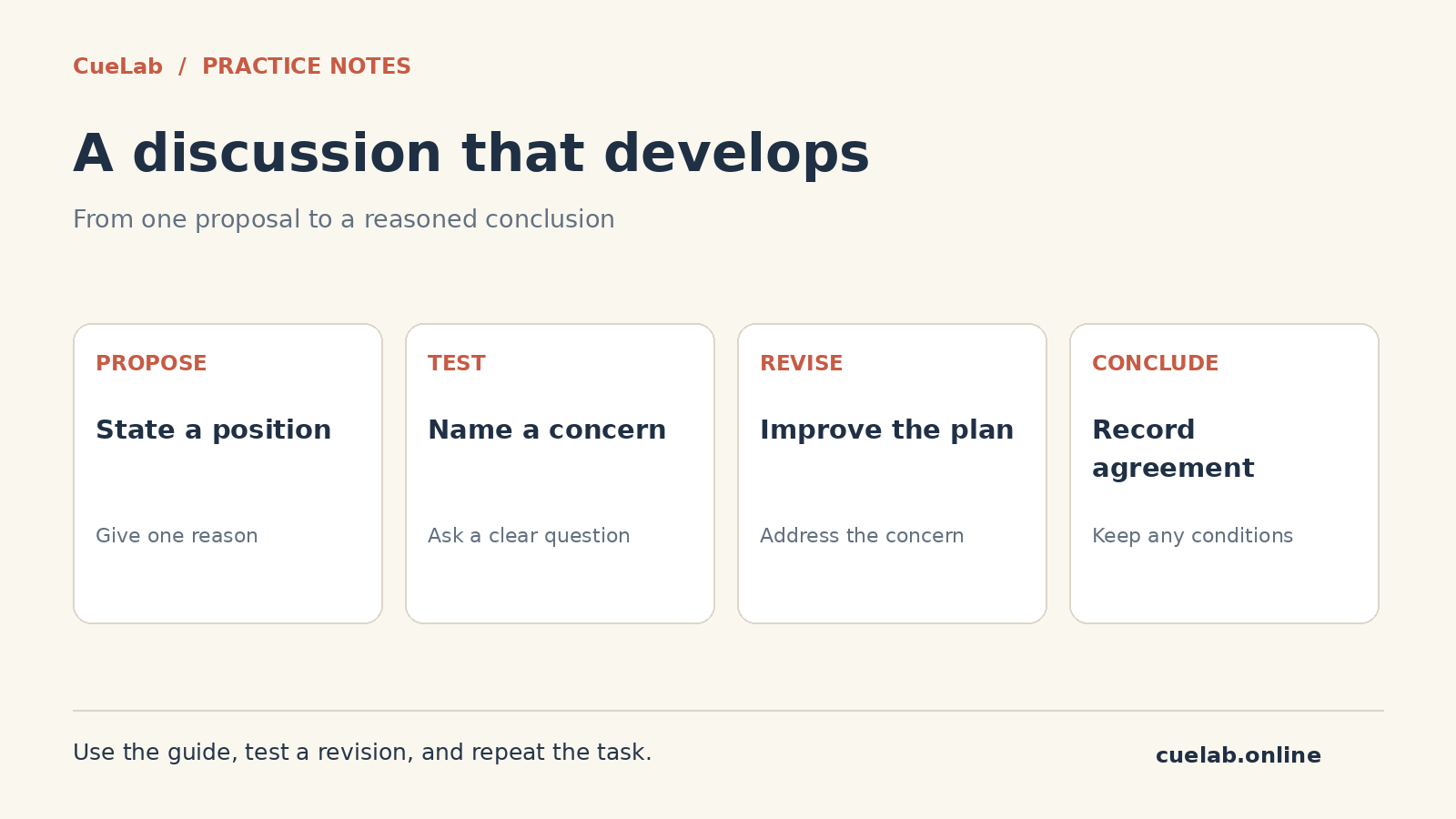
A good group discussion for 12th class shows people working with one another’s ideas. One student proposes a view, another adds evidence, a third questions an assumption, and the group reaches a reasoned conclusion. Writing four unrelated mini-speeches does not show that interaction, even when every sentence is grammatically correct.
This guide explains a usable format, gives three original dialogue examples, and shows how to revise a weak answer. It suits Class 12 English writing skills practice and classroom speaking. If you are preparing for Maharashtra HSC, the official English Yuvakbharati textbook, section 3.6, pages 166–171, is an important starting point. Always follow the names, opening lines, length and instructions in your actual question. This page does not prescribe a universal board mark scheme.
What is the format of a Class 12 group discussion?
Use a brief topic or situation, identify the participants, and write their contributions as labelled dialogue. Let the exchanges progress from an opening to reasons, responses and a conclusion. Include an evaluator or moderator only when the question provides one or your classroom task requires one. You do not need a ceremonial welcome, a vote of thanks or an essay-style introduction before the dialogue.
- Open the issue. Define the decision or question in one or two sentences.
- Give a supported view. Add a reason or a concrete example.
- Respond to that view. Agree with a qualification, question it, or suggest a workable alternative.
- Develop the discussion. Address cost, fairness, practicality or a missing perspective.
- Conclude accurately. State the agreement reached and any concern that remains.
The textbook presents discussion as a two-way activity involving listening as well as speaking. For a written answer, you make listening visible through the next speaker’s response. A phrase such as “Your proposal addresses cost, but what about access?” connects two turns. “I also want to talk about education” usually does not.
A simple group discussion writing skills template
Start with this scaffold, then replace the blanks with reasons specific to the topic. Treat it as a planning device rather than a passage to memorise.
Participant A: Our question is whether we should ____. I suggest ____ because ____.
Participant B: That would help with ____. However, it could create ____.
Participant C: Could we address that concern by ____? For example, ____.
Participant D: Before deciding, we should also consider ____.
Participant A: Then our agreement is ____, provided ____. We still need to check ____.
A real answer can have more turns, and a participant can speak more than once. Equal participation does not require exactly equal word counts. Each turn should contribute something: evidence, clarification, an objection, a repair or a summary. Remove greetings that consume space without doing any of those jobs.
Example 1: Should the school library stay open after classes?
Situation: Four students are discussing a proposal to keep their school library open for an extra hour twice a week. The dialogue below is original practice material, not a model answer issued by a board.
Asha: I support an extra library hour on two afternoons. Some students travel a long way home and cannot easily return for reference books. They could use that time to finish research before leaving.
Bilal: That is useful, but we cannot assume a librarian will work extra hours without an arrangement. We should first ask whether the school can provide supervision and pay for it.
Meera: Could we start with one afternoon instead? A short trial would tell us how many students actually use the library. We could collect requests in advance rather than open an almost empty room.
Rohan: A trial sounds practical. However, students who rely on the school bus may be unable to stay. We should ask whether the chosen afternoon fits existing transport, or provide a borrowing period before classes as another option.
Asha: I agree that access matters. Our suggestion could be a one-month trial on an afternoon when transport is available. The school would confirm supervision before announcing it.
Bilal: We should also record attendance and the kinds of resources requested. That would give the school evidence for continuing or changing the arrangement.
Meera: So we recommend a supervised trial, subject to staff and transport arrangements. After a month, the school can review attendance and student feedback before deciding on a permanent extension.
Why it works: The speakers examine one proposal through access, staffing, evidence and implementation. Nobody claims that a trial has already succeeded. The final turn reflects the conditions raised earlier rather than introducing a new topic.
Example 2: Can students use AI tools while preparing assignments?
Nida: We should distinguish getting help from submitting someone else’s work. An AI tool might help a student list questions about a topic, but the student still needs to check sources and write an answer they understand.
Arjun: I agree, although “getting help” can become an excuse for copying. A teacher cannot assess our learning if a tool supplies the whole response. We need clear limits before using it.
Sana: One limit could be an acknowledgement of the assistance used. A student could note that a tool helped generate initial questions, then show the books or articles used to verify the final claims.
Dev: That helps with transparency, but access is unequal. We should not design compulsory work around a paid tool that some classmates cannot use. The same learning task must be possible with school resources.
Nida: Then our proposal is to follow the teacher’s policy, make any permitted assistance visible, verify information independently and keep the actual reasoning our own.
Arjun: We also agree that an assignment should not require a paid AI account. If the instructions prohibit AI assistance, students should complete that task without it.
This example separates permission, academic honesty, verification and access. It avoids the unsupported extremes that every AI response is accurate or that every use is automatically dishonest. When your topic involves a school rule, refer to the rule supplied in the question instead of inventing a policy.
Example 3: How should a class reduce waste at its annual event?
Farah: I suggest reducing single-use decorations. We can borrow reusable signs and avoid making a new plastic banner for each stall.
Imran: That is sensible, but food packaging may create more waste than decorations. Could we first ask stall teams what they expect to use?
Kavya: Yes. A short materials list would help us choose the largest avoidable items. We should also label collection points clearly; separate bins are ineffective if people do not know what belongs in them.
Omar: We need to check what the local collection service accepts. Otherwise, a bin labelled “recycling” could contain items that will not actually be recycled.
Farah: So our plan has three parts: reuse signs, ask stalls to reduce avoidable packaging, and match bin labels to the collector’s instructions.
Imran: Let us assign one student to confirm collection arrangements and ask each stall to nominate a person responsible for its materials. That makes the proposal easier to carry out.
This discussion reaches an action plan rather than merely stating that waste is bad. The speakers use uncertainty constructively: checking a collection service is a practical next step, not a weakness in the answer.
Useful phrases for agreement, disagreement and clarification
Functional phrases help you show the relationship between ideas. Use a few that fit your purpose; repeating the same polite expression in every turn makes the dialogue mechanical.
| Purpose | Adaptable wording |
|---|---|
| Give a view | “My main reason for suggesting this is…” |
| Build on a point | “That would also help us address…” |
| Disagree with a reason | “I see the benefit, but the plan still leaves…” |
| Ask for clarification | “When you say affordable, whose budget do you mean?” |
| Invite a contribution | “We have discussed cost. What do you think about access?” |
| Summarise | “We agree on the trial, subject to…” |
The British Council’s group discussion skills guidance highlights purposeful language, preparation and feedback. The examples and wording on this page are CueLab’s own applications. They are intended to help you practise those functions rather than reproduce a textbook exchange.
How to revise a weak answer
Suppose four speakers all say that exercise is useful. Even with four names, the answer has only one idea. Revise the sequence so that each speaker addresses a different part of the decision.
Weak turn: “I agree. Exercise is good for everybody.”
Revised turn: “A weekly activity period could help, but the plan should offer options for students with different abilities. Could we include walking, adapted games and quieter movement activities?”
The revised version connects to the proposal, names a condition and asks a question another participant can answer. It does not need a difficult vocabulary word to sound thoughtful. Check every turn by asking, “What can the next speaker do with this?” If the answer is only “agree again,” the turn may need more substance.
A ten-minute classroom practice routine
- Two minutes: Read one prompt and write your position, one reason and one possible objection.
- Four minutes: Discuss in a small group. Respond to a point already made before adding a new one.
- Two minutes: An observer notes one useful connection and one missed opportunity to clarify.
- Two minutes: Rewrite three turns so that the conversation progresses more clearly.
This is a suggested practice routine, not an examination timing rule. Rotate the observer role. Ask observers to record words or actions they actually noticed rather than label a classmate “confident” or “weak.” A student who speaks less may still make a decisive clarification.
Ten practice topics with a decision to make
- Should a class use printed notes, shared digital notes, or both?
- How should a school make its annual event accessible?
- Should students choose some of their reading material?
- What rules would make a class messaging group useful?
- How can a school support students who miss lessons?
- Which one improvement should a limited library budget fund?
- How should group-project work be divided fairly?
- Should a classroom include a quiet work period each week?
- How can students check information before sharing it?
- What should a class consider before organising a trip?
For each topic, identify a real trade-off. A limited budget forces choices; a messaging group needs boundaries; a trip needs access and supervision. These details create more useful dialogue than a topic so broad that everyone can agree without explaining anything.
A short editing exercise with a worked repair
Read this exchange: “We should have a class newsletter.” “I agree because newsletters are good.” “I also agree.” The speakers have not yet considered a reader, a workload or a purpose. Rewrite the second turn as a question: “Who is the newsletter for, and what information would they need that our current announcements do not provide?” That question gives the group a problem it can investigate.
The third speaker could then propose a smaller trial: “We could publish one page each month with dates, opportunities and a student contribution. Before continuing, we could ask readers which sections they actually used.” A fourth speaker might ask who checks accuracy and whether a printed copy is available to students who cannot use the digital version. The discussion now develops through purpose, feasibility and access.
When checking your own answer, underline each link to an earlier idea. If several consecutive turns have no link, revise the sequence. Also circle claims that sound factual. Either support them from information provided in the question, present them honestly as an observation, or turn them into something the group needs to check.
Common questions
How many participants should I include?
Use the number and names in the prompt. For independent practice, four participants make it easy to show a proposal, an objection, a repair and a conclusion. That is a teaching choice, not a requirement for every board.
Does everyone have to agree?
No. A conclusion can record partial agreement and an unresolved issue. It should accurately represent the discussion. Do not force a unanimous conclusion when a participant’s main concern has never been answered.
What should a Class 12 discussion plan include?
Write the topic, two or three evidence-based points, one genuine question for the group and a short closing summary. Practise listening and building on a peer’s idea as well as presenting your own view.
For further practice, try CueLab’s discussion topics with decision briefs or its guide to active listening examples. Use those pages to develop reasons and responses before practising a full dialogue.