20 Group Discussion Topics for Engineering Students, with Decision Briefs
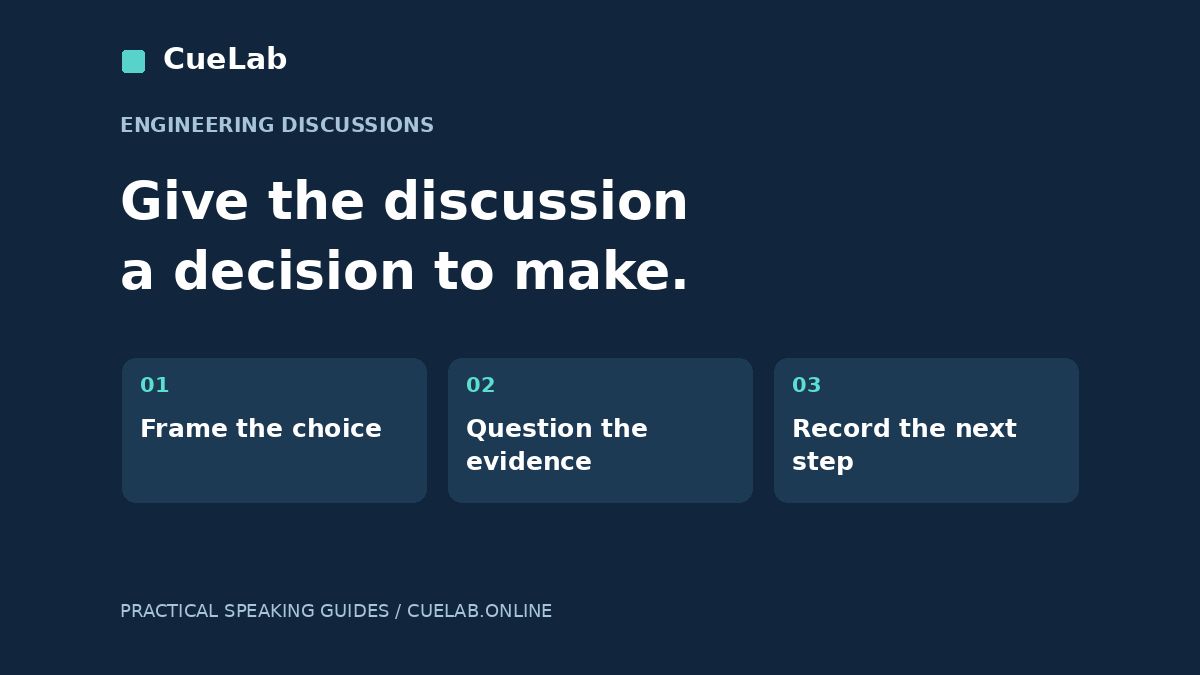
Useful group discussion topics for engineering students contain a decision, a constraint, and more than one reasonable answer. “Artificial intelligence” names an area; “What should a student design team disclose when it uses an AI tool?” gives the group something specific to examine. The second question makes room for evidence, uncertainty, responsibility, and disagreement.
The 20 briefs below are original, hypothetical practice situations. They are not reports about real campuses or engineering projects, and they do not supply technical approval for a design. Use the scenarios to practise explaining tradeoffs. Where a discussion concerns safety, access, cost, or performance, identify the information and qualified review that a real decision would require.
Choose a question with a decision inside it
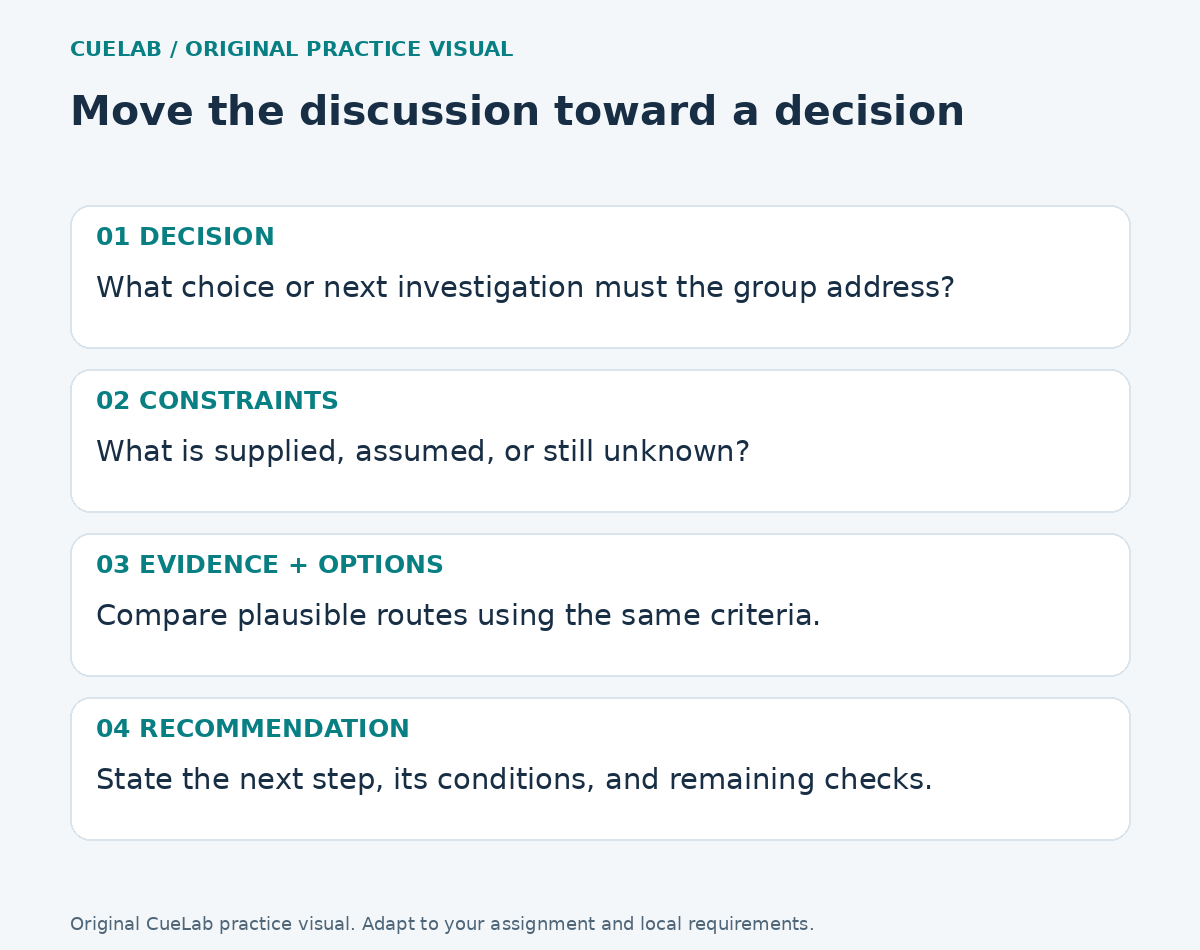
Before selecting a topic, agree on what the group must produce. It might recommend a next investigation, compare two options, or identify conditions for a small trial. A discussion that ends with “both sides have advantages” has not necessarily answered the question. Ask which conditions would make one option preferable and what remains unknown.
Waterloo’s teaching guidance emphasizes preparing a discussion around a clear purpose, helping participants prepare, and establishing participation expectations. For engineering practice, a useful adaptation is to separate the decision from the evidence needed to make it. That keeps confident opinions from quietly becoming assumed facts.
How to use these fictional briefs
Choose a brief relevant to the participants’ level. Read it together, define unfamiliar terms, and allow a short preparation period. Participants should label information as supplied in the scenario, proposed for investigation, or assumed for the exercise. Do not invent a regulation, test result, or price to win the argument.
The prompts deliberately leave some facts unresolved. Your task is not always to choose a final design. Sometimes the strongest recommendation is a specific check that would make the next decision defensible.
Equipment, software, and shared resources
1. Repair or replace shared laboratory equipment?
A department has a fictional piece of shared equipment that is unavailable more often than users expect. Discuss whether the next step should be repair, replacement, or a better investigation of the faults. Consider maintenance records, required performance, support availability, disruption, and the authority to approve work. Do not treat age alone as proof that replacement is necessary. Finish by naming the information that would change your recommendation.
2. Open-source or proprietary software for a student project?
A team must choose software for a project that will be handed to another group next term. Compare suitability for the task, licensing conditions, access, documentation, support, and the team’s ability to maintain the work. Open-source does not automatically mean effortless, and a paid product does not automatically guarantee continuity. Recommend a selection process and identify which licence or compatibility details need checking against the actual products.
3. Queue or reservation for a shared machine?
Students compete for access to a fictional project-room machine. Should access follow arrival order, advance booking, or a combination? Examine missed reservations, short tasks, training requirements, accessibility, and urgent work. Keep authorization to operate the equipment separate from permission to reserve time. Propose a small set of rules and explain how the department could review whether the arrangement is fair and workable.
4. Automate an inspection step or improve the checklist?
A team is dissatisfied with an inspection process in a classroom exercise. Compare an automated aid with clearer instructions and a revised manual check. Ask what each option would detect, miss, and require from the operator. Discuss validation and responsibility without assuming that automation removes error. The output should be an evaluation plan, not an unsupported claim that one method is safer.
Campus investigations and design choices
5. What should a campus water-use study measure first?
A student group has limited time to investigate water use in one building. Compare starting with records, observation, suitable measurements, or user accounts. Define the question before choosing an instrument. Discuss permission, measurement limits, disruption, and how the group would distinguish a suspected issue from a demonstrated one. Recommend a manageable first stage rather than promising a saving that has not been measured.
6. How should a limited maintenance budget be prioritized?
Imagine several maintenance requests competing for one review meeting. Develop criteria for triage, such as consequence of failure, urgency, effect on access, and the quality of available evidence. Avoid treating the loudest complaint as the highest priority. Explain what needs immediate escalation under local procedures and what can wait for further assessment. Keep classroom ranking separate from the decisions of qualified facilities personnel.
7. What should a design report disclose about AI assistance?
A project team used an AI tool during brainstorming and drafting. Discuss what a reader needs to know about its role, what the team checked, and who remains responsible for the submitted work. Start with the institution’s actual rules rather than inventing a universal policy. Consider a short contribution record that distinguishes generated suggestions from verified calculations, design decisions, and the students’ own explanations.
8. Recycled or purchased material for an early prototype?
A fictional team must build a demonstration model. Compare available reused material with new material selected for the task. Discuss condition, consistency, suitability, traceability, cost information to obtain, and disposal. Reuse is not a sufficient reason to ignore a material’s limitations. State which features the early model needs to demonstrate and which performance claims would require a different prototype and appropriate testing.
9. What information should a campus sensor system collect?
A proposal aims to understand how often a shared space is used. Compare collecting aggregate occupancy information with collecting information that could identify individuals. Ask whether the purpose needs personal data at all, who could access the records, and how long they would be retained. The exercise should produce questions for institutional review and a clear statement of purpose, rather than a casual promise that the system is anonymous.
10. Battery access or a smaller device enclosure?
An illustrative design brief asks for a compact portable device while leaving maintenance requirements unresolved. Discuss how access for replacement or service might affect size, assembly, durability, and responsibility. Do not invent battery performance or safety specifications. Identify the actual requirements and qualified assessments needed before choosing an enclosure. Explain whether a prototype could compare access arrangements without pretending to be a finished product.
Review, handover, and responsibility
11. Remote or in-person design review?
A mixed-location team needs to review a model and its supporting explanation. Compare the formats against the actual task: inspecting a physical object, sharing a drawing, asking questions, and recording decisions. Consider access and participation rather than assuming everyone can travel or turn on a camera. Recommend what should be circulated beforehand and how someone could contribute if their preferred communication channel differs.
12. What belongs in a technical handover?
One student team is handing an unfinished prototype to another. Decide what the receiving team needs to continue responsibly: current state, file locations, known problems, assumptions, permissions, and checks still outstanding. Separate a successful demonstration from evidence of dependable operation. Draft the first paragraph of the handover and identify anything that should be clearly marked as provisional instead of buried in a long history of the project.
13. How should a demonstration accommodate different access needs?
A project presentation relies on a small moving component and a fast explanation. Compare ways to make the task understandable through a visible model, a described sequence, readable material, or an alternative viewing arrangement. Ask participants what access arrangements they need rather than assuming a single solution fits everyone. Discuss how the demonstration could preserve the learning purpose while reducing avoidable barriers.
14. How should students report a near miss in a project room?
Discuss what an immediate factual report should include and how the group would locate the institution’s reporting route. Separate what someone observed from what they think caused it. Avoid naming a guilty person before an appropriate review. This is a communication exercise, not an investigation protocol: real incidents require the site’s procedures and responsible staff. End with a clear description of the information the next person needs.
15. What is a fair record of team contribution?
A group wants its final submission to explain how work was shared. Compare a task log, version history, peer discussion, and a brief individual account. Examine less visible contributions such as checking, organizing, and explaining decisions. No single record automatically proves the quality of a contribution. Recommend a transparent process agreed early, with a route to correct mistakes and alignment with the actual assessment rules.
Pilots, estimates, and evidence
16. Which campus transport change deserves a small pilot?
A fictional committee is considering changes to a route or timetable. Decide what the first pilot should test and how users would be consulted. Distinguish travel-time observations, access requirements, operating constraints, and personal preferences. Do not manufacture ridership statistics. Recommend a question, a bounded trial, and a review condition, explaining which decision the pilot could support and which wider questions it would leave open.
17. How should a team report an uncertain estimate?
A project report needs an estimate before all inputs are known. Discuss how to present assumptions, a justified range where appropriate, and the consequences of a wrong input. Compare a single unexplained number with a transparent account of the estimate’s limits. The group should identify what must be measured next and how a reader would recognize that the estimate is provisional rather than a verified specification.
18. What would make an electronic-waste collection pilot workable?
A student society proposes collecting unwanted electronics. Discuss what it needs to confirm before accepting items: institutional permission, storage, handling responsibilities, data-bearing devices, and an appropriate downstream route. Avoid assuming every item can be accepted or reused. Produce a preparation checklist and a public-facing acceptance statement whose claims can be verified. A promotional poster should follow the plan, not substitute for it.
19. Demonstration, report, or oral review for project assessment?
Compare these assessment components against the learning the instructor wants to evaluate. A demonstration may show one aspect of performance, while an explanation may reveal the reasoning behind a choice. Consider equitable access and the difficulty of distinguishing individual understanding within group work. Recommend a combination only after defining its purpose. The exercise does not replace the course’s actual assessment requirements.
20. How should a low-cost cooling investigation be scoped?
A team wants to compare conditions in two campus rooms. Discuss what “cooler” would mean for the study and which measurements, times, occupancy conditions, and permissions would matter. Do not jump from a single observation to a claim about energy savings or health. Recommend a limited comparison that the team can document, including factors it cannot control and the conclusions it would therefore avoid.
A twelve-minute discussion plan
This is an adaptable classroom practice plan, not a recruitment standard. Give everyone the same brief and keep any separate reading time outside the twelve minutes. A timekeeper can signal transitions, while a recorder captures the recommendation and the unresolved evidence.
| Time | Purpose | Visible output |
|---|---|---|
| 0:00–2:00 | Define the decision and constraints. | One shared question. |
| 2:00–5:00 | Compare plausible options. | Reasons for each option. |
| 5:00–8:00 | Question assumptions and missing evidence. | Checks that could change the choice. |
| 8:00–10:00 | Develop a bounded recommendation. | A proposed next step and its conditions. |
| 10:00–12:00 | Review the summary and remaining disagreement. | An agreed record, including differences. |
A worked opening and a fair disagreement
For the equipment-booking brief, an opening could be: “We need a booking approach that gives trained users predictable access without wasting long gaps. I suggest we compare a reservation system with a short-task queue, then decide what information we need about actual demand.” This establishes a question without claiming the answer is already obvious.
A useful disagreement might be: “The reservation idea addresses predictability, but we have not discussed unused bookings. Could we compare what happens when a person cannot attend before choosing the rule?” It responds to the proposal and adds a criterion. It does not turn a process disagreement into a judgment about the speaker.
Observe reasoning rather than volume
During practice, note whether a participant makes a relevant contribution, explains its support, responds fairly to another view, and helps the group reach a usable output. Speaking frequently is not the same as doing those things. A short clarification can improve the decision more than a long speech that ignores the question.
Afterward, ask each person to name one assumption the group revised and one question it could not settle. If the summary hides disagreement, revise the record. A qualified recommendation can be stronger than apparent consensus built on missing information.
Take one question into a rehearsal
Select a brief, identify what the group may assume for the exercise, and run the discussion once. Use the rehearsal timer to keep the stages visible. For a larger assignment, explore group presentation formats and roles; for a formal two-sided motion, practise opening a debate speech.
Reference: University of Waterloo: Facilitating Effective Discussions. The 20 engineering briefs, timed practice plan, and sample contributions are original CueLab illustrations.