6 Impromptu Speech Examples for Students, with Planning Notes
Impromptu speech examples for students are most useful when they reveal how a speaker chooses an angle, develops one idea, and reaches an ending. Memorizing a complete answer is a different exercise: it can leave you trying to force a prepared speech onto a prompt that asks for something else.
The six responses below are original practice models, written in advance to show different ways of developing a short answer. They are not recordings of spontaneous performances. Study the choices behind them, then use fresh prompts and your own truthful examples to practice thinking and speaking together.
What counts as an impromptu speech?
An impromptu speech is prepared with little notice, often in response to a topic or question supplied on the spot. The preparation time, speaking time, and rules vary by assignment or competition. Always follow the actual instructions rather than assume that a practice routine is an official format.
Short preparation does not mean the response has to be a list of everything that comes to mind. A clear answer can take one relevant interpretation, explain it through an example, and finish with a point the audience can recognize. That is the skill the models in this guide are designed to make visible.
A thirty-second planning drill
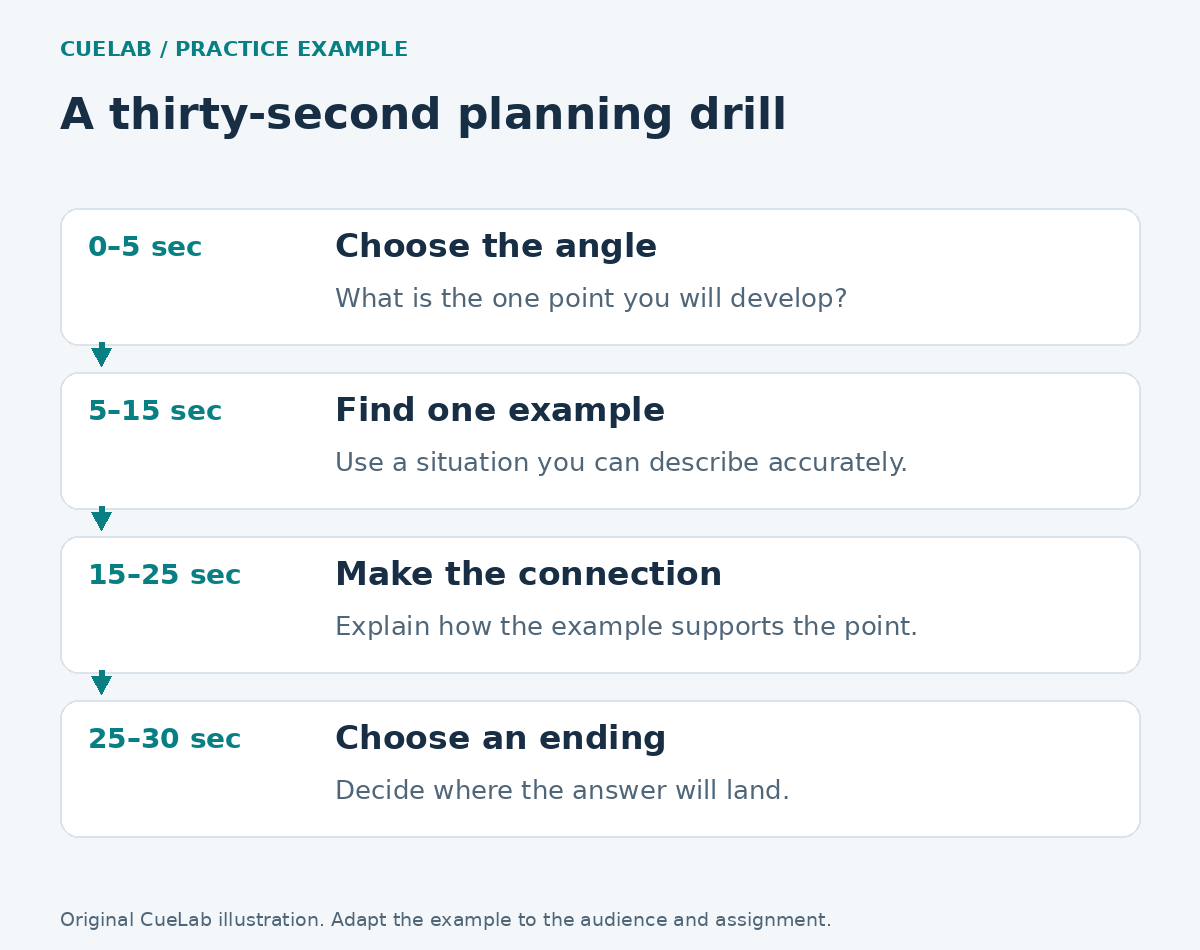
Use this allocation for practice when you want a quick start. It is deliberately short and can be expanded for a class that allows more preparation time. Write prompts rather than a full script, because the writing itself can otherwise consume the whole preparation period.
| Planning time | Decision | What to note |
|---|---|---|
| First 5 seconds | Choose an interpretation of the prompt. | One sentence expressing your point. |
| Next 10 seconds | Find a relevant example. | A familiar situation you can describe accurately. |
| Next 10 seconds | Explain the connection. | Why this example supports the point. |
| Final 5 seconds | Choose a landing sentence. | The thought you want the audience to leave with. |
Example 1: “One small change”
Chosen angle: Make an instruction easier to act on. The response uses a fictional contrast rather than an unsupported claim about what all students need.
One small change I would make is to put the required action at the start of a group message. We often write several lines of background before explaining what another person needs to do. By the time they reach the request, they may already be trying to guess the point.
Compare “We have been discussing the event and there are several possibilities” with “Please choose one of these two meeting times by tomorrow.” The second message can still include the background, but the reader knows what to do with it.
This is not a rule for every friendly conversation. A chat does not always need a task. But when a message really does need a response, a clear opening respects the other person’s attention. My small change would therefore be to ask what the recipient needs to do, then make that action easy to find.
Planning note: The qualification keeps the claim reasonable. The speaker is defending a useful habit for requests, not insisting that every conversation become a checklist.
Example 2: “Something worth keeping”
Chosen angle: Keep the habit of asking a useful question, even when an answer is available quickly.
Something worth keeping is the habit of asking how we know an answer is right. Finding an answer and understanding its basis are related, but they are not the same achievement.
Suppose two people recommend different routes to the same place. One route may be shorter on a map, while the other avoids a closed entrance. Before deciding which answer is better, we need to know what each person assumed. The extra question reveals the conditions behind the recommendation.
The same habit helps in a classroom discussion. Instead of treating disagreement as a contest between confident voices, we can ask what evidence or experience supports each view. Sometimes that question changes the answer; sometimes it simply makes the limits clearer. Either result is useful. I would keep that small pause for a question, because it gives an answer something stronger to stand on.
Planning note: A familiar route example carries the abstract idea. The speech avoids adding a second unrelated story when the first already does the explanatory work.
Example 3: “When plans change”
Chosen angle: Preserve the purpose while changing the method. This version uses a problem-and-response structure.
When plans change, the first useful question is what we were trying to achieve. If we protect every detail of the old plan, we may lose the purpose it was meant to serve.
Imagine preparing a short activity for a room with a projector, then discovering that the projector will not work. The purpose might be to help the group compare two ideas. Printed examples or a spoken description could still support that comparison, even though the delivery looks different.
Of course, not every problem has a simple substitute. Some activities need equipment or conditions that cannot be replaced. But identifying the essential outcome lets us distinguish a necessary requirement from a preferred arrangement. A changed plan is then a practical decision rather than proof that the whole effort has failed. I would start by keeping the purpose visible and asking which parts of the method can move.
Planning note: The ending answers the prompt directly. The example is labeled as imagined, and the limitation prevents the response from promising that every disruption is easily solved.
Example 4: “A useful mistake”
Chosen angle: A mistake becomes useful when it changes the next attempt. You can replace the imagined situation with a truthful experience of your own.
A useful mistake is one that tells us what to change next. Simply repeating “I will try harder” may express determination, but it does not always explain what the next attempt will look like.
Consider a speaker who loses their place because every line on a note card looks equally important. The useful lesson might not be to memorize the entire speech. It might be to separate the three main prompts and keep only the exact details that need checking.
That gives the next rehearsal a specific question: can the speaker find the next point without reading a paragraph? If the answer improves, the mistake has produced a practical adjustment. If it does not, another part of the preparation needs attention. I would therefore judge a mistake less by how embarrassing it felt and more by whether it helped identify a better next step.
Planning note: This is a definition developed through an example, not a catalogue of famous failures. It stays within a situation the speaker can explain without invented biographies or statistics.
Example 5: “A place to begin”
Chosen angle: Begin with a version small enough to inspect. This response moves from a concrete task to a wider observation.
A useful place to begin is with a version of the task that can be checked. When a project feels enormous, an impressive opening plan can be less helpful than one clear example.
If we are creating a guide for new club members, we could spend the first meeting discussing every possible section. Another approach is to draft the page that answers three immediate questions: where to go, what to bring, and whom to ask. Someone unfamiliar with the club can then tell us what is still missing.
The small draft does not replace the whole project. It gives the group something concrete to improve and exposes questions the planning discussion may have missed. That is why I would begin with an inspectable example rather than wait for a perfect overview. A beginning becomes useful when it helps us learn what the next part of the work should be.
Planning note: The speaker explains the limit of the small draft. This avoids turning a sensible starting tactic into a claim that planning is unnecessary.
Example 6: “The question behind the question”
Chosen angle: Clarify what a listener needs before answering at length. This version uses a contrast between two possible needs.
The question behind the question can change the answer we should give. When someone asks how long an activity takes, they may be deciding whether to join, checking when to arrange transport, or wondering how much work is involved.
An answer such as “about an hour” might help with one of those decisions and leave another unresolved. A brief follow-up can reveal whether they need the finish time, the preparation time, or the amount of active participation.
We do not need to interrogate people before every ordinary answer. Often the context is clear enough. But when a question seems vague or our first answer does not help, it is worth checking what the person is trying to decide. Listening for that purpose can make a short answer more useful than a long explanation of the wrong thing.
Planning note: The speech remains connected to the original phrase throughout. It does not use the prompt as a brief excuse to deliver a prepared talk on an unrelated subject.
Choose a structure that fits the prompt
Point, example, explanation
Use this when you have a clear view and one familiar example. State the point, develop the situation, then explain what the audience should understand from it. The explanation is essential; otherwise a listener may enjoy the example but miss its connection to the topic.
Situation, problem, response
Use this when the prompt suggests a practical difficulty. Keep the response within what the situation allows and acknowledge an important limitation. You do not need to invent a dramatic success story to give a thoughtful answer.
Two interpretations, one chosen view
Use this when a broad phrase has several possible meanings. Name the interpretation you are choosing, develop it, and return to the phrase at the end. Avoid spending the whole speech defining every interpretation without saying anything about one of them.
Practice with prompts you have not prepared
Try “a better question,” “the missing detail,” “a fair comparison,” “something we overlook,” or “a plan worth changing.” Give yourself a short planning period, speak from a few notes, then ask whether the answer would make sense to someone who heard the prompt only once.
Vary the task on later attempts. Explain one object, defend a modest preference, or respond to an unfamiliar phrase after checking its meaning. Do not secretly write complete speeches for every possible prompt; the useful practice is choosing and developing an angle under the conditions you have set.
What to do when you lose the next sentence
Pause and return to the point you are making. You can introduce the example more simply or move to the ending if the main idea has already been developed. Filling the gap with several new topics often makes it harder to find the original route again.
If you cannot support a factual claim, avoid inventing a figure to keep the speech moving. An ordinary example clearly identified as hypothetical can be enough for a practice response. A formal researched task may require a different level of evidence, which is another reason to check the rules.
When the prompt is unfamiliar
Use the preparation time to check what the prompt means, if the rules permit clarification. In practice, look up an unfamiliar expression before developing an answer. Once its meaning is clear, choose an interpretation you can explain honestly. You do not need to invent knowledge of a historical event or technical subject simply to make the response sound impressive.
Review one feature before the next attempt
Ask a listener to state the central point and identify the example that supported it. Then choose one thing to improve: a more relevant opening, a clearer connection, or an ending that arrives sooner. A short review gives the next attempt a purpose without turning every hesitation into a failure.
For related practice, use CueLab’s guide to speaking slowly and confidently and entertaining topic and story-angle guide.
Reference: NSW Department of Education, The Arts Unit: Preparing for Impromptus. The six model responses and the thirty-second practice allocation above are original CueLab teaching examples.