30 Entertaining Speech Topics, with Story Angles and Openings
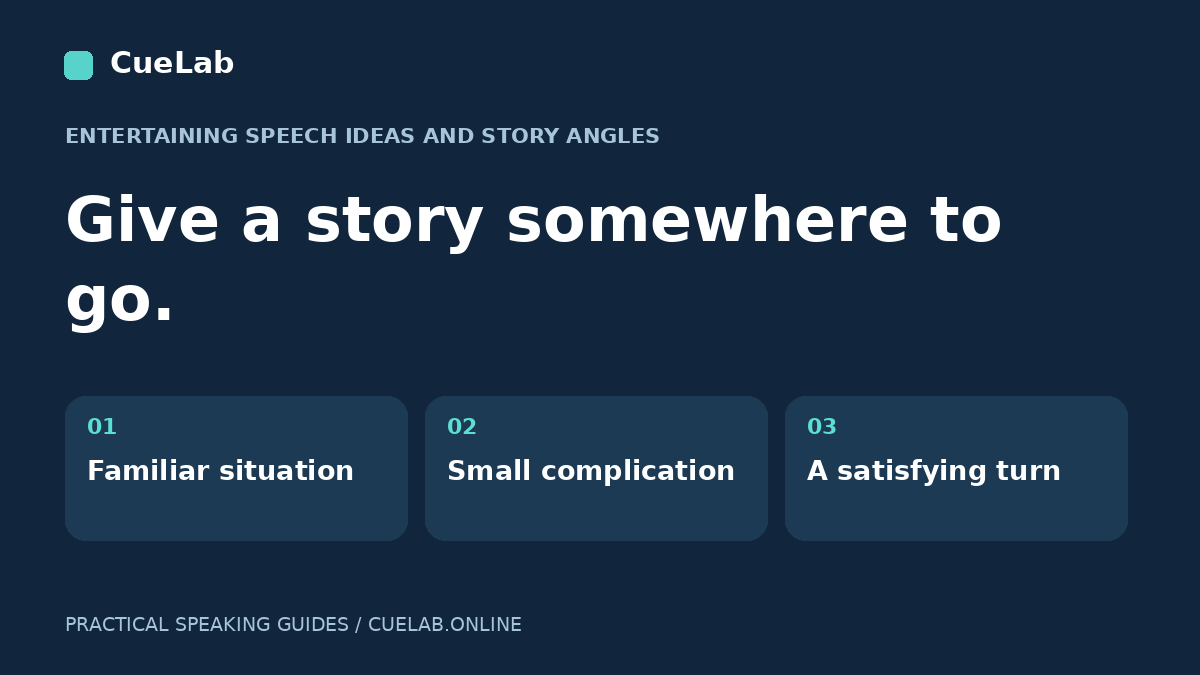
The most useful entertaining speech topics give an audience a familiar situation and a fresh way to see it. You might turn a group-chat misunderstanding into a small detective story, give a mock award to the classroom clock, or describe the elaborate planning behind a very ordinary snack. You do not need a string of jokes if the situation, details, and ending hold together.
This guide offers 30 topic angles for classroom speeches, club events, and light social occasions. Each comes with a direction you can develop, rather than a title you still have to decode. A worked example then shows how to shape an amusing premise into a short speech with a satisfying ending.
What makes an entertaining speech different?
An entertaining speech is designed to give listeners an enjoyable experience while carrying a recognizable idea. Depending on the occasion, that experience may be funny, affectionate, surprising, or moving. A welcome speech and a playful classroom story need different tones, even when both are enjoyable to hear.
Before choosing a topic, finish this sentence: “I want this audience to enjoy noticing…” The answer might be the strange rules of group projects or the small kindnesses behind a club event. This gives you a center of gravity. Without it, a speech can become several unrelated memories held together by the hope that one of them gets a laugh.
Amusing does not have to mean a comedy routine
Some speakers are comfortable performing characters; others are better at quiet observation. A gentle story about your own overcomplicated planning may suit you better than a loud mock debate. Choose a delivery style you can sustain in normal conversation, then sharpen its structure rather than imitate a performer whose timing you cannot yet control.
Match the promise to the occasion
A class assignment may ask for a humorous speech with a clear message, while a farewell event may call for warmth and recognition. Confirm what is expected before using satire or a fictional scenario. If the occasion centers on another person, the audience should leave remembering that person rather than your cleverest line.
Thirty entertaining speech topics with a direction to develop
Everyday situations that become surprisingly complicated
- The committee meeting inside my head when I order food. Give competing priorities their own voices: budget, appetite, curiosity, and the friend waiting behind you. Keep the humor focused on the decision process rather than a restaurant employee.
- A user manual for finding something in my bag. Describe the bag as if it were an unfamiliar machine with unreliable compartments. Build toward the discovery that the missing item was in the most sensible place.
- The invisible rules of borrowing a pen. Follow a pen from a small favor to its mysterious disappearance. You can make the object the main character without naming a real classmate as the villain.
- Why choosing a film takes longer than watching one. Show how each new requirement eliminates an option. End with the group selecting something for a reason nobody mentioned at the beginning.
- The ambitious life of a shopping list. Start with three essentials, add distractions, and compare the original plan with the final basket. Use an invented list if the details involve someone else’s habits.
School and club life without making someone a target
- The secret job descriptions in every group project. Invent roles such as File Name Inspector or Deadline Translator. Let the audience recognize behaviors while avoiding labels that humiliate a particular person.
- An acceptance speech for the classroom clock. Thank the clock for its dramatic range during tests, breaks, and the last lesson. Use changes of pace to make the contrast audible.
- What the lost-property box would say at assembly. Give forgotten objects brief personalities and one shared complaint. A warm ending can turn the joke into a reminder to look after what you own.
- The very serious art of selecting a team name. Compare an overconfident proposal, an incomprehensible abbreviation, and a name chosen just before the deadline. The escalation comes from increasingly elaborate discussion.
- A museum tour of unfinished classroom posters. Present fictional exhibits as important discoveries, explaining each abandoned design decision. Keep the final observation about how hard it is to stop improving something.
Technology as a familiar supporting character
- A peace negotiation between me and my notifications. Turn competing alerts into delegates with different demands. The ending should resolve one small conflict, rather than become a general lecture about technology.
- The biography of a file called final-final-really-final. Follow the fictional file through several revisions and owners. Each new name can reveal a new stage of confusion.
- What a muted microphone teaches about dramatic entrances. Build an invented meeting scene around a confident opening nobody hears. A visual gesture can communicate the mistake before you explain it.
- My phone’s imaginary performance review. Praise one useful function, question its interruptions, and set modest goals for the next week. Avoid technical claims about what a real device secretly knows.
- The group chat that needed a project manager. Give a fictional chat one simple task and show how replies create several different conversations. End with a practical message that finally settles it.
Playful arguments that do not require an actual dispute
- A case for giving ordinary objects better names. Rename three everyday items according to what they really do in your life. Explain the naming logic so the audience can invent its own example.
- Why a bookmark deserves more respect. Give the neglected object a grand introduction and describe its quiet contribution. The mismatch between a modest object and formal language creates the premise.
- The official rules of a completely unofficial family game. Explain a fictional game’s changing rules as if you were a sports commentator. Use your own invented situation instead of exposing a private family disagreement.
- Which household object should run for class representative? Compare three candidates using the same amusing criteria. Let one useful quality carry the ending rather than rely on random insults.
- A defense of taking the scenic route to the correct answer. Describe an overly complicated attempt to solve a simple fictional problem. Let the speaker’s own reasoning be the joke.
Stories built around a small change of perspective
- The day a tiny instruction became a major expedition. Invent a simple errand and three reasonable misunderstandings. Keep each obstacle connected to the original task so the story feels purposeful.
- What an impatient plant might think of its owner. Tell a clearly fictional story from the plant’s viewpoint. Focus on the owner’s schedule and promises rather than offer plant-care advice as fact.
- A weather report for my study desk. Describe a spreading paper system as changing weather conditions. Finish with a small reset that makes the opening image return in a new form.
- The heroic journey of returning a library book. Give a routine task a dramatic structure with a modest obstacle and an ordinary ending. Make clear when you are exaggerating a scene for effect.
- What I misunderstood about a hobby before trying it. Use a truthful personal experience if you have one, or label the scenario as imagined. The useful turn is discovering why someone else enjoys the activity.
Warm topics for welcomes, farewells, and celebrations
- The small jobs that made this event happen. Notice the signs, chairs, reminders, and quiet preparation people overlook. Include accurate acknowledgments rather than invent a funny backstage story.
- A survival guide for the newest club member. Explain genuine harmless rituals and useful habits with affection. Avoid making newcomers feel they must tolerate embarrassment to belong.
- Three objects that tell the story of our year. Choose objects the group will recognize and give each one a brief scene. Ask permission before using an identifiable person’s story.
- A thank-you speech to the people who solve little problems. Celebrate the person who finds a marker, clarifies a time, or notices an empty chair. Specific, accurate details make the appreciation believable.
- What we will probably miss about this ordinary place. Describe a few familiar features without pretending every memory was perfect. Finish with a shared detail that feels welcoming to the whole audience.
Choose an angle with a beginning and a change
Pick three topics and write the first situation and final observation for each. “The group chat is confusing” is a complaint, while “We need to choose one meeting time, and every reply answers a different question” contains an event. Events give you movement, which is easier to shape into a speech than a collection of opinions.
Then identify the turn: what changes in your understanding or in the situation? Perhaps the missing file was carefully stored in the wrong folder, or the person who looked least organized has the only working plan. A turn need not be a surprise twist, but it should reward the attention the opening asked for.

Worked outline: the group chat that needed a project manager
The following is an invented classroom example, not a report of a real conversation. Its message is that a clear question can be kinder than a very long exchange. You can adapt the structure to your own truthful experience, but do not present the sample as something that happened to you.
Opening: give the audience one simple job
Begin with a fictional message: “All we had to do was choose a time to meet. By the end, we had chosen a snack, debated the weather, and discovered that two people were discussing a different project.” Let the audience understand the original task before adding the complications. A short pause after the list gives them room to recognize the situation.
Middle: escalate the same problem three ways
First, someone answers an older question, so two conversations overlap. Next, someone posts a helpful screenshot that leaves out the date. Finally, a confident “yes” arrives with no obvious question attached. Each event should make the original scheduling task harder; unrelated jokes about phone brands would interrupt the story.
You can perform the messages with slightly different rhythms, but there is no need to imitate accents or exaggerate a real person’s mannerisms. Keep the voices easy to distinguish and the pace slow enough that listeners can follow which question is being answered.
Turn and ending: change the question
The speaker finally sends: “Tuesday, four o’clock, library table two. Reply yes if you can come, or suggest one alternative.” The invented group settles the matter. Return to the snack from the opening: “We still had three opinions about the biscuits, but at least we knew when to bring them.” This callback gives the ending a connection the audience can recognize.
Turn an amusing idea into a short speech
For a three-minute assignment, try a planning allocation of about thirty seconds for the opening, ninety seconds for the connected developments, forty seconds for the turn and ending, and twenty seconds of breathing room. This is an editing aid, not a standard formula. A different story may need less setup or more space for an audience reaction.
Write the ending before polishing every sentence in the middle. Once you know what the speech is moving toward, you can remove details that are amusing but do not contribute. One well-developed situation is usually easier to deliver than six topics compressed into the same time limit.
Keep humor directed at a situation
Make the source of amusement a recognizable contradiction: elaborate preparation for a small task, confident instructions that become confusing, or an object treated as important. Avoid using someone’s disability, body, identity, financial circumstances, or private experience as your material. If a joke needs the target to sit silently while everyone else laughs, choose a different premise.
Self-directed humor also needs judgment. A mild observation about losing your notes can make the speaker approachable; repeated claims that you are stupid or hopeless can make listeners uncomfortable. Give the audience an enjoyable situation without requiring them to reassure you.
Adapt the same topic for three audiences
For a classroom
Choose a situation classmates understand without extra background. Make the speech’s message clear enough to explain afterward, and check whether fictional stories or mock award speeches meet the rubric. A teacher may be assessing organization and delivery even when the assignment emphasizes entertainment.
For a club or workplace gathering
Use shared experiences that include newcomers. A running joke understood by six long-standing members can leave everyone else outside the speech. Explain the necessary context briefly and keep acknowledgments accurate, especially when the event recognizes someone’s work.
For a family celebration
Choose affectionate stories the people involved are comfortable sharing. A story that is funny in a private conversation may feel different in front of a larger gathering or a recording. When in doubt, ask permission and select a less personal detail.
Rehearse for clarity before you rehearse for laughs
First ask a listener to describe what happened in the story and why the ending connects to the opening. If they cannot follow the sequence, repair that before changing your comic timing. Clear setup gives a playful turn something to work with.
On the next run, leave space after the lines where the audience may react. If nobody laughs during the speech, continue at a steady pace instead of explaining why the line was funny. Your story should remain understandable and enjoyable without a response at every planned moment.
Start with the situation you can tell simply
Choose one premise from the list, write a plain two-sentence summary, and decide what changes before the ending. Expand that into a short outline you can tell comfortably in your own voice. Specific details, a clear sequence, and a considerate view of the audience will do more work than forcing a joke into every paragraph.
For delivery practice, read CueLab’s guides to using vocal variety naturally and opening without sounding rehearsed.
Reference: University of Minnesota: Speaking to Entertain. The topics, sample lines, and worked story in this guide are original CueLab examples.