Anchoring Script for Morning Assembly: An English Run Sheet
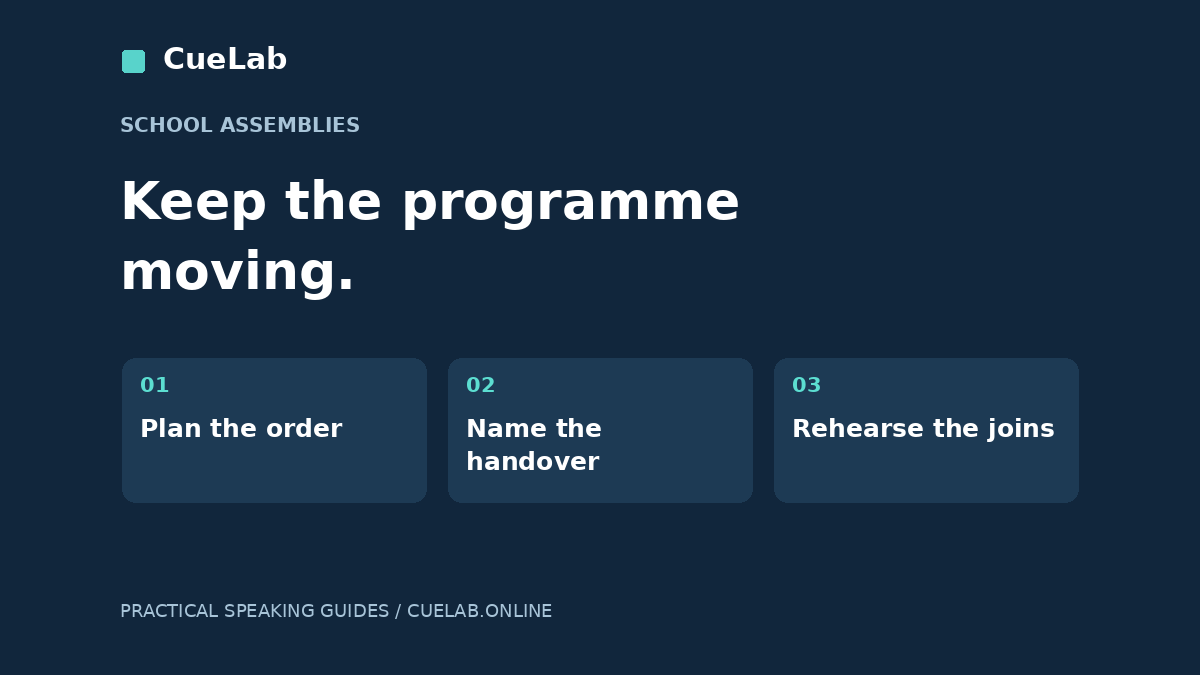
An anchoring script for morning assembly should tell the audience what is happening, help each participant enter at the right moment, and leave enough time for the actual programme. The anchors provide the connections. They do not need to turn every introduction into another speech or keep inventing elaborate ways to say “thank you.”
The English script below is an adaptable two-anchor example with an eight-minute planning sheet. It includes original welcome lines, transitions, a short student contribution, and recovery wording for common interruptions. Names in square brackets need replacing, while directions in italics are preparation cues rather than words to read aloud. The programme is illustrative; use your school’s approved order and required wording.
Confirm the programme before choosing the opening
Get the actual running order from the teacher coordinating the assembly. Confirm who is speaking, how their names are pronounced, where they will stand, and whether they need a microphone, music, or a visual. A script can sound polished on paper and still fail when it introduces someone waiting at the wrong side of the stage.
Check which items are compulsory in your setting. Prayer, reflection, a pledge, an anthem, or a formal greeting may have an approved place and wording. Add them through the school’s normal process and adjust the time allocation accordingly; this sample does not prescribe religious or national observances for every audience.
An eight-minute morning assembly run sheet
This allocation totals 480 seconds, including handovers. It is a rehearsal starting point, not a claim that the sample wording has been audio-tested to last exactly eight minutes. The news reader, student speaker, and teacher giving notices need to know their own limits.
| Item | Allocation | Person to confirm |
|---|---|---|
| Welcome and theme | 30 seconds | Both anchors. |
| Approved reflection or opening observance | 40 seconds | The designated participant or teacher. |
| Thought for the day | 40 seconds | The student presenting it. |
| Verified news | 90 seconds | The news reader and reviewing teacher. |
| Student contribution | 120 seconds | The student speaker. |
| Approved notices | 75 seconds | The teacher or authorized announcer. |
| Closing and dismissal instruction | 45 seconds | Anchor and supervising teacher. |
| Handovers and small pauses | 40 seconds | Everyone using the microphone. |
If a required item needs more time, revise the programme before the event. Do not quietly expect the student speaker to compensate for an overlong welcome. Mark which anchor lines can be shortened and who has authority to change the order.
Complete English anchoring script
The example uses the theme “making instructions clearer.” It is deliberately modest enough to suit an ordinary school day. Replace that theme if it does not fit your programme, and make sure the thought, student contribution, and closing still connect to one another.
1. Welcome the school
Anchor 1: “Good morning, teachers and students. Welcome to today’s assembly, presented by [class or group]. I’m [name], and I’ll be hosting with [co-anchor’s name].”
Anchor 2: “Our theme is making instructions clearer: noticing what another person needs to know before they can act. We’ll begin with [approved opening item], followed by the thought for the day, news, a student contribution, and the school’s notices.”
Preparation cue: Look up between the greeting and the programme preview. Check that the second anchor is ready before handing over. If you have a formal salutation approved by the school, use it once in the appropriate place rather than repeating it before every item.
2. Introduce the opening observance or reflection
Anchor 1: “We will now begin with [approved item]. Please follow the guidance of [teacher or participant’s name].”
Use the school’s exact directions for standing, sitting, participation, or respectful observation. For an approved quiet reflection, an alternative line is: “We will take a brief moment to think about one instruction we could make easier for someone else to follow.” Do not add an unfamiliar prayer, quotation, or participation requirement simply because it appeared in an online script.
3. Invite the thought for the day
Anchor 2: “Thank you. [Student’s name] will now share today’s thought and explain how it connects with our theme.”
Student: “Today’s thought is an original line for this assembly: ‘Before asking someone to follow an instruction, check whether you have given them enough to begin.’ A clear instruction names the task, the place to start, and anything the person needs to bring. We can try that when explaining classwork or helping someone find a room.”
The thought is original practice wording, not a quotation attributed to a famous person. If you choose a published quotation instead, verify its wording and author. An attractive sentence with an uncertain name attached is better left unattributed or replaced with something you can check.
4. Hand over to the news reader
Anchor 1: “Our next item is the news. [Reader’s name] will share the headlines selected for today’s assembly.”
Anchor 2, afterward: “Thank you, [name], for the update. We now return to our theme with a short student contribution.”
The headlines must be prepared for the actual date and checked with the supervising teacher. Record the source and date of each item, distinguish confirmed information from a developing report, and avoid turning rumours about students or staff into announcements. The reusable anchor script supplies the handover, not invented current news.
5. Introduce the student contribution
Anchor 1: “Please welcome [speaker’s name], who will show how a small change in wording can make an instruction more useful.”
The following short contribution is an original illustrative example. It can be adapted by a student who understands it, rather than memorized as though it describes something that happened at their school.
“Imagine a new student receives this message: ‘Bring the form to the usual room after the break.’ The writer may know exactly which form, room, and break they mean. The new student may not know any of those things.
“We can improve the message by checking what the reader needs to act. Name the form, give the room number, and state the time in a way the reader can identify. If they need a signature or another document, explain that before asking them to make the journey.
“Clear wording also helps the person giving the instruction. Instead of answering the same questions later, they can check the message once before sending it. That does not mean every instruction needs to be long. It means the necessary details should be easy to find.
“Today, try reading one instruction from the point of view of someone seeing it for the first time. Ask yourself where they would begin, what they need, and how they would know they have finished. If one of those answers is missing, that is a useful place to revise.”
Preparation cue: Time the contribution in the student’s own voice. If it finishes early, allow a deliberate pause or a brief example the student can explain; do not add a second unrelated speech merely to fill the slot.
6. Invite the approved notices
Anchor 2: “Thank you, [speaker’s name]. We will now hear the school’s notices from [authorized person’s name]. Please listen for any details that affect your class or activities today.”
Check notices for a clear action, audience, place, and time. For a classroom rehearsal, a clearly fictional model might be: “Students taking part in the display rehearsal should bring their approved caption sheet to Room 4 at the time listed on the class notice.” A real announcement must replace those details with the current, authorized instruction.
Do not improvise changes to dismissal arrangements, examinations, transport, fees, or school rules. If a notice appears inconsistent with another instruction, ask the teacher to resolve it before the microphone is live.
7. Close the assembly clearly
Anchor 1: “Thank you to today’s readers, speaker, and the teachers who prepared the programme.”
Anchor 2: “Our theme leaves us with a practical check: can someone act on the instruction we have given? As we begin the day, choose one message or explanation you can make clearer.”
Anchor 1: “This brings our assembly to a close. Please follow [supervising teacher’s name] for the next instruction. Thank you, and have a thoughtful day.”
Use the final line to mark that the programme has ended. Dismissal itself should follow the school’s normal arrangements, especially where classes leave in a particular order. The anchor should not create a new movement instruction without the supervising teacher’s agreement.

Adapt the script for one anchor
A single anchor can deliver both sets of lines after removing the co-host introduction. Keep one copy of the programme and mark the point where you step aside or turn toward the incoming speaker. The audience needs a clear handover more than it needs two voices alternating every sentence.
When two anchors are available, divide complete items rather than splitting every short announcement. One can handle the welcome and student contribution, while the other handles news and notices. Both should understand the whole programme so an absent participant or changed order does not leave one host unable to continue.
Prepare three recovery lines
A recovery line should explain the next step without blaming a participant or filling the gap with nervous jokes. Agree the wording and the backup order with the teacher before the assembly. The anchor can then respond within their role rather than inventing an announcement under pressure.
| Situation | Possible line | What must already be agreed |
|---|---|---|
| The next participant is not ready. | “We will move to the approved notices now and return to the student item afterward.” | The teacher has authorized that alternative order. |
| A microphone needs attention. | “We will pause briefly while the microphone is checked. Please remain where you are.” | The supervising adult is handling the equipment and audience. |
| The programme is running late. | “We will keep our closing brief and hand back to [teacher’s name].” | The optional anchor comments can be shortened. |
If an alarm, emergency, or safety concern occurs, follow the school’s established procedure and the supervising adult’s instructions. A hosting script is not an emergency plan. Keep the teacher’s agreed contact or signal where you can find it without searching through several pages.
Make the final copy easy to use
Put spoken lines and stage directions in visibly different formats, and leave enough space to find the next item quickly. Write difficult names phonetically for your own use after checking the pronunciation with the person. Toastmasters’ emcee guidance similarly emphasizes prepared introductions, accurate names, and realistic timing; those broad hosting principles are useful here without replacing school protocol.
Rehearse the actual handovers with the readers and speaker, including the time it takes to reach the microphone. Make one final check of names, news, notices, and the approved order before printing or sharing the script. A few dependable lines delivered at the right moment will serve the assembly better than extra paragraphs nobody has practised.
Agree on one route for last-minute changes
Before the assembly, decide who can approve a change and how that change reaches both anchors. If several people give separate instructions at the microphone, even a clear script becomes difficult to follow. Keep one master running order with a visible version date or handwritten correction, and confirm the revised sequence with the person responsible for the programme.
For example, if the student contribution is removed, cross out the whole item and its introduction. Join the preceding item to the next approved item with one short line. Do not announce why a participant is absent unless the school has authorized that information to be shared. If a substitute is introduced, check the name rather than reusing the original name from memory.
Give the person handling sound or slides the same updated order. A clean handover depends on everyone expecting the same next item.
Run the programme once before the day
Use CueLab’s presentation time planner to allocate the items and the rehearsal timer to record a complete run. The speech writing format guide can help you separate words to speak from cues to follow.
Reference: Toastmasters International: When You Are the Emcee. The assembly script, student contribution, run sheet, and recovery examples are original CueLab practice material.