Speech Writing Format: An Annotated Script and Flexible Template
A useful speech writing format makes two jobs easier: shaping a message for listeners and finding your place while you deliver it. A page that looks tidy as an essay can still be awkward to speak from if its sentences are dense, its transitions are hidden, or its delivery notes look like words you are supposed to say.
Start with the assignment or occasion, then choose a manuscript layout that supports your delivery. The format below separates the spoken script from preparation notes, shows an original annotated example, and gives you a flexible template to adapt. It is a practical writing aid rather than a universal school-exam rule.
Check which kind of format the task requires
“Speech format” can mean a preparation outline, a fully written manuscript, or a speaking card. These are related documents with different purposes. An outline helps you organize ideas; a manuscript records intended wording; a speaking card gives prompts for an explanation you already understand.
If a teacher supplies a required layout, use it. A formal examination may require a particular greeting, word limit, or written presentation, while a live club speech may need only short notes. Do not assume that a format suitable for one course is compulsory everywhere.
A preparation outline organizes the argument
Write the purpose, central message, main points, examples, and sources before polishing every sentence. At this stage, you are checking whether the speech has a clear destination. If two sections make unrelated promises, revising the outline is easier than rewriting a finished script.
A manuscript supports the wording
Use a manuscript when the precise language matters or when writing the whole speech helps you develop it. Give each spoken thought enough space to be found quickly. A manuscript can be a preparation tool even if you later deliver the talk from prompts.
A speaking card supports recall
Reduce the manuscript to useful cues only after you understand the explanation. Keep exact figures, names, quotations, or required wording where accuracy matters, and use short prompts for familiar material. A card full of tiny sentences often creates the same reading problem as the manuscript it replaced.
Put the purpose above the script
Before the first spoken line, write three preparation notes: who is listening, what the occasion requires, and what the audience should understand or consider afterward. Mark these as notes so they are not confused with the opening. They give you a reference point when deciding what to cut.
For example, a classroom explanation might aim to show how one clear message guides a short talk. That purpose excludes a long history of public speaking and a catalogue of slide-design rules. The notes protect the speech from becoming a collection of everything you know about the general subject.
A flexible speech writing template
Copy the structure below into your own document, then replace the prompts with material that fits the task. The labels are for preparation; you do not normally announce “attention getter” or “supporting example” to the audience. Delete any field that adds no value to your particular speech.
| Part | What to write | What it helps you check |
|---|---|---|
| Preparation heading | Audience, occasion, time limit, purpose, central message. | Whether you are answering the actual task. |
| Opening | A relevant starting point and a clear promise. | Why this audience should give the talk its attention. |
| First main section | One point, an example or support, and an explanation of its relevance. | Whether the audience has enough context to follow. |
| Transition | A spoken connection to the next idea. | Whether the sequence can be heard without visible headings. |
| Further main sections | Only the points needed to develop the central message. | Whether the speech is growing beyond its purpose. |
| Ending | A brief return to the message and an appropriate final thought or action. | Whether the speech reaches a clear destination. |
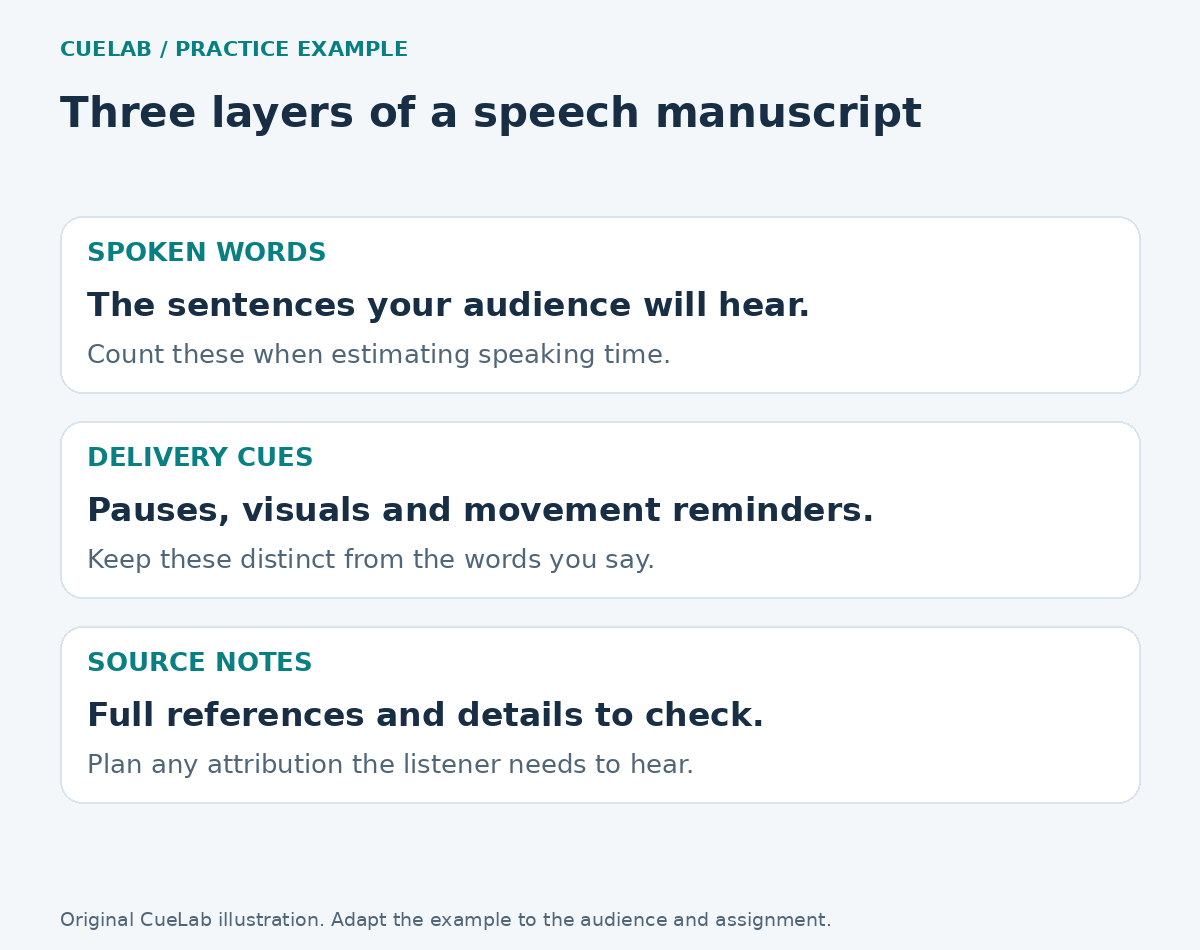
| Delivery cues | A few distinct notes for a pause, visual, or change of position. | Whether your words and actions can work together. |
| Source notes | Full references, exact figures, and any attribution that must be spoken. | Whether important details can be checked. |
Format the manuscript for the person speaking
Choose a readable type size and spacing by trying the page at the distance you will actually use it. A desk-reading size may be too small on a lectern or when your notes are held lower. There is no single font size that suits every person, room, and delivery method.
Use clear paragraph breaks where the thought changes. Keep a transition with the section it introduces rather than leave it alone at the foot of a page. Number the pages and arrange them so a page turn does not interrupt a name, a figure, or the important part of an example.
Make spoken words and directions look different
A delivery instruction such as “[show the card]” should be easy to distinguish from the sentence beside it. You might use brackets, a different color, or a separate margin. Choose a method that remains clear in the actual printout or device display, including a black-and-white copy if that is what you will use.
Keep headings useful without reading them aloud
Headings can help you navigate a long manuscript, but listeners cannot see the page’s hierarchy. Write a transition they can hear instead of relying on a bold heading to explain the connection. “That gives us the main message; now we can decide which example belongs” is a spoken bridge, while “Section Two” often tells the audience much less.
An original short speech manuscript
The following is an illustrative classroom speech about choosing a central message. It is written for this guide and is not attributed to a real student or presented as a transcript of a live performance. Its actual duration depends on the speaker, pauses, and any visual demonstration.
Imagine that you have one minute to explain a project. You know how it started, what went wrong, what changed, and what you would like to do next. The difficult part is deciding which of those details the listener needs first.
A useful starting point is a sentence that answers one question: what should the audience understand when I stop speaking? For a book-swap project, that sentence might be, “A small, clearly organized exchange is easier to maintain than an unlimited collection.”
Once that message is clear, the details have a job. The shelf location helps explain access. The collection rules explain what belongs. A named organizer explains who deals with questions. A long story about choosing the poster color probably does not help the listener understand the main point.
This does not mean removing every interesting detail. It means choosing details because they contribute. One well-chosen example can make an idea easier to picture, while several unrelated examples can leave the audience wondering what the talk is really about.
Before your next short presentation, write the sentence you want a listener to remember. Then read your outline and ask what each section does for that sentence. You may discover that the speech needs a better example, a clearer order, or simply one less thing to say.
What each part of the example is doing
The opening creates a relevant situation
The first paragraph gives the audience a recognizable writing problem. It does not begin with a quotation that would require checking or a statistic unrelated to the assignment. Its job is to make the next question feel useful: how do you decide what belongs?
The middle develops one message
The second paragraph names the central question, and the book-swap example gives it something concrete to work on. The following details are evaluated against that one message. A listener can therefore follow both the idea and the example without switching to a different subject in every paragraph.
The qualification prevents an overstatement
The fourth paragraph clarifies that a focused speech does not have to be stripped of interesting detail. That distinction matters because a listener might otherwise mistake the advice for “remove every story.” The qualification improves the explanation without opening a whole new argument.
The ending gives the audience a writing action
The final paragraph returns to the central-message sentence and explains how to use it while revising. It does not add a new set of presentation rules at the last moment. The action fits the speech’s modest purpose and can be tried on a draft the listener already has.
Add delivery cues after the wording makes sense
First read the script aloud without adding dozens of performance marks. Notice where you naturally need to breathe, where the meaning changes, and where a visual would require attention. Add a small number of cues that solve those actual delivery needs.
For the example above, one useful cue could be to pause before the central-message question. Another could indicate when to hold up a card containing the book-swap sentence. You do not need to mark every emphasis or prescribe a fixed pause length; too many directions can become another thing to read.
Write source references for speech as well as paper
If a claim relies on a source, decide how a listener will know where it came from. A short spoken attribution may be more useful than a footnote the audience cannot see. Keep the full reference in your preparation document and confirm any required citation style with the instructor.
Do not add research-looking numbers to make a simple sample sound authoritative. If the speech uses an invented situation, identify it as an example. If a finding comes from a particular study or setting, preserve that limit instead of turning it into a claim about every audience.
Estimate the time, then rehearse the actual delivery
A word count can provide a rough starting estimate, but it does not include showing an object, moving a slide, waiting for a reaction, or recovering your place. Count spoken text separately from headings, directions, and reference notes, then time a complete run.
When the speech runs long, first check whether a section repeats the same point or needs too much background. Cutting that section is often more useful than making every sentence shorter or trying to accelerate your delivery. Preserve the example that actually helps the audience understand.
Turn the manuscript into speaking notes
Write the central message at the top of a card, followed by a few prompts for the main sections. Retain exact wording only where you need it. Rehearse from that card to find out which ideas you can explain comfortably and which still require work.
If you repeatedly lose the connection between two sections, repair the transition rather than add the whole manuscript back to the card. The aim is a reliable route through the explanation, not a smaller photograph of the original page.
Test the page before making the final copy
Place the manuscript where it will be during delivery and speak a complete paragraph while looking up between thoughts. Notice whether you can find the next line without searching. A clear layout at a desk may need wider spacing, a more visible section label, or a different page break when used standing up.
Try a page turn during rehearsal too. If it divides an important comparison or leaves a delivery cue on the previous sheet, move the break. Keep a clean final copy after those changes and make sure its page numbers still match your rehearsal notes. These small checks concern the document you will actually use, rather than the appearance of a template on someone else’s screen.
Use the format to improve the draft
Before finishing, check that the opening promises what the body delivers, each example supports the message, and the ending fits the audience’s next step. Confirm names, sources, and required wording, then practice with the page or cards you will actually use. A useful format earns its place by helping you write and deliver a clearer speech.
Continue with CueLab’s presentation structure guide and script-marking exercise for pauses.
Reference: University of Florida IFAS: Speech Writing and Types of Speeches. The manuscript, template, and annotations above are original CueLab examples.