Body Language in Communication: Context, Clearer Signals and Everyday Examples
Body language in communication includes visible behaviour such as gesture, posture, facial movement, gaze, and how people use space. These can support a spoken explanation, help organize turns, or make an interaction feel easier or harder to follow. Their meaning depends on the person and situation; a single movement is a weak foundation for a confident story about someone’s thoughts.
This guide uses eight original fictional situations to separate what a communicator can observe from what they might infer. It also offers ways to make your own communication clearer. The examples are practice material, not a body-language test or a method for deciding whether someone is honest, interested, capable, or comfortable.
What body language includes
A pointing gesture may connect speech to a location. A raised hand may request a turn under an agreed meeting convention. A shift in position may affect who can see a shared object. These are practical communication functions that you can examine without pretending that every movement has one hidden psychological meaning.
Nonverbal communication is broader than body movement. Features of the voice and the arrangement of a setting can also matter to an interaction. For this guide, the emphasis is on visible behaviour and its relationship with words, the task, and the opportunity to check understanding.
Observation is different from interpretation
“A colleague folded their arms while I was speaking” describes something visible. “They rejected my idea” is an interpretation. The interpretation might fit other evidence, but the posture alone does not establish it. Keeping the two separate gives you room to ask a relevant question rather than reacting to an assumed motive.
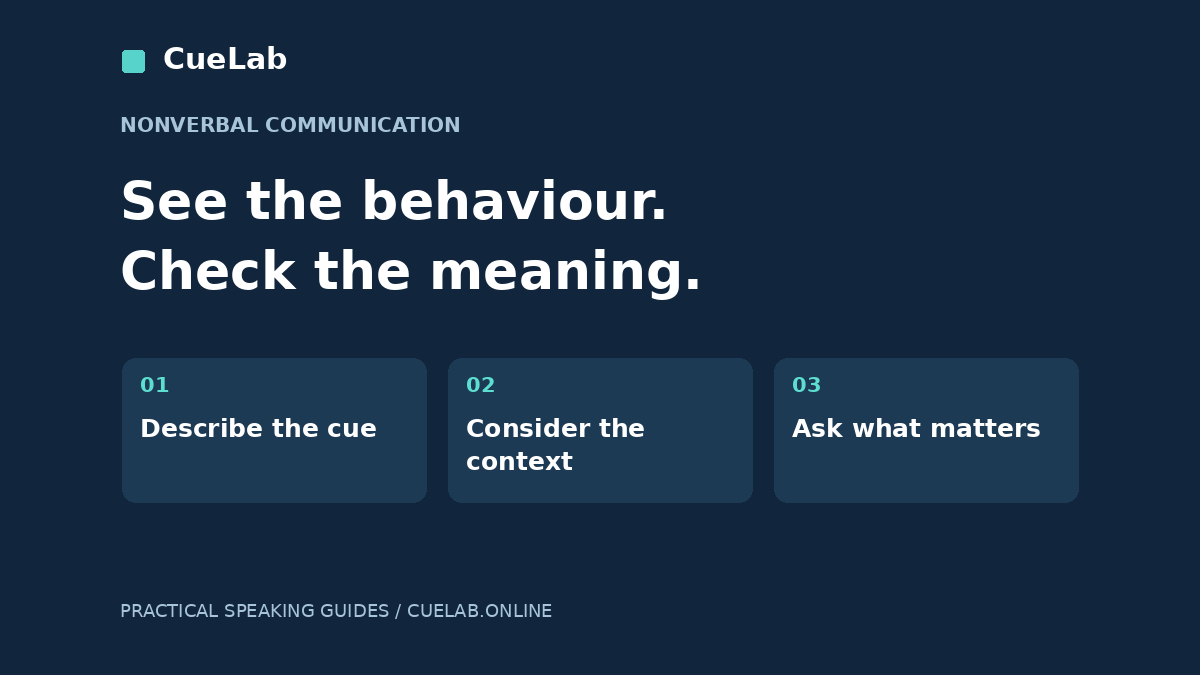
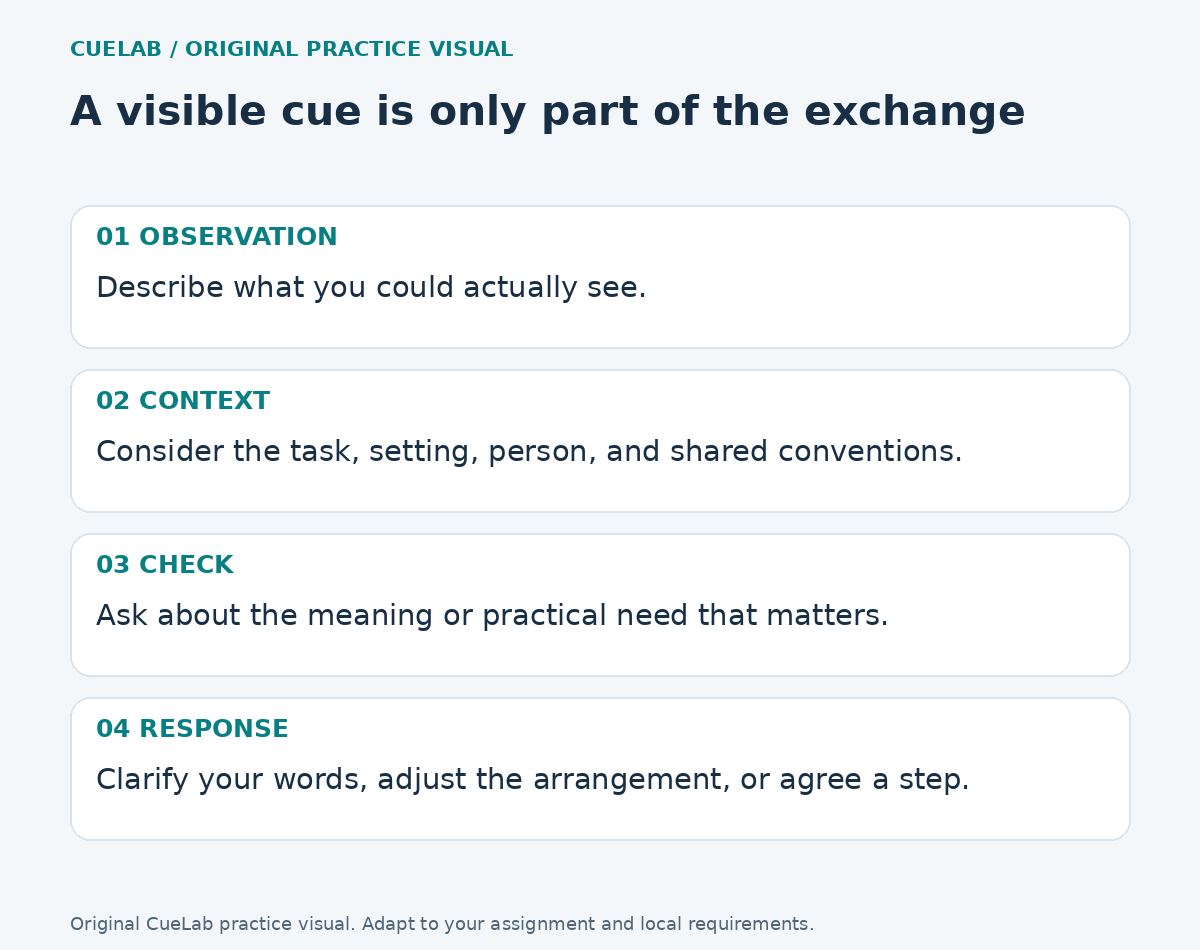
UC Santa Barbara’s account of work by Alan Fridlund and colleagues emphasizes the importance of context and the limits of interpreting nonverbal behaviour. A useful everyday application is to describe the cue, consider the situation, and check the issue that actually matters before deciding how to respond.
1. Folded arms during a meeting
Fictional situation: You are explaining a project option. A listener sits with folded arms, and you immediately wonder whether they oppose the proposal.
You have an observation about posture, but several parts of the situation remain unknown. The person may use that position habitually, the seating may be uncomfortable, or the posture may have no useful connection to their view of the proposal. Listing possibilities does not tell you which one applies.
Check comfort before assigning a motive
If the practical issue is participation, ask about the proposal: “Which part would you want us to examine more closely?” If there is an obvious room arrangement problem, offer an adjustment without requiring a personal explanation. You do not need to ask the person to defend their arms before discussing the work.
For your own delivery, choose a position that lets you use notes and indicate material comfortably. A rigid instruction to keep your arms in one approved pose can draw attention away from the explanation you are trying to give.
2. A listener looks away
Fictional situation: A learner looks at their notebook during your explanation. You are tempted to say that they are not paying attention.
The notebook may contain the information they are checking. Looking away could also mean something else that you cannot determine from the movement. Continuous eye contact is not a fair universal requirement for demonstrating attention, and personal or cultural preferences may differ.
Check the message rather than demanding a pose
Ask a task-related question: “Which step do you want me to go through again?” or “How would you start this example?” Choose a question that reveals understanding without using it as punishment for looking elsewhere. If notes help the person follow, make room for that arrangement.
When you are listening, you can explain a practical need directly: “I may look down while I write the file names, but please continue.” Words can make your behaviour easier to understand without requiring the other person to decode it correctly.
3. A presenter points to a figure
Fictional situation: A presenter gestures toward a crowded chart and says, “This is where it changes.” People watching from different positions are unsure which point the presenter means.
The gesture has a useful purpose, but the reference is incomplete. A finger position may be hard to see, outside a camera frame, or ambiguous when several lines are close together. A gesture works better when the spoken reference gives the audience another route to the same information.
Make the reference usable in words
Try: “Look at the blue line between March and April; that is the change I want to examine.” Use labels actually present in the figure, and avoid relying only on colour if another clear description is available. Pointing can then support the reference rather than carrying the whole explanation.
During rehearsal, ask someone to identify the item you meant without watching your hand. If they cannot, improve the wording or the visual. This checks a communication task; it does not measure whether your gestures look sufficiently confident.
4. A nod follows an instruction
Fictional situation: You explain a document revision, the recipient nods, and you assume the task is understood and accepted. Later, their revision differs from what you intended.
A nod can be part of an interaction without specifying every detail of agreement. It may indicate acknowledgement, an invitation to continue, or agreement with only part of what was said. The relevant question is what confirmation the task needs.
Confirm the action when it matters
For a consequential handover, ask for a short account of the next step: “Which section will you change, and is any input still missing?” That gives both people a chance to identify an ambiguity while it is easy to resolve.
Use this proportionately. A casual conversation does not need a formal check after every nod. Reserve explicit confirmation for the decisions, responsibilities, or instructions where an unnoticed difference would matter. The aim is shared meaning rather than constant monitoring of the other person’s behaviour.
5. Someone tries to enter a discussion
Fictional situation: One participant raises a hand slightly, another leans forward, and a third starts to speak. The chair keeps following only the person who speaks loudest.
Unspoken turn-taking can become difficult when people interpret entry signals differently. In a mixed group or an online meeting, some signals may be invisible to part of the audience. Guessing who “looks ready” can leave a person waiting without a usable route into the conversation.
Make the turn-taking rule explicit
Agree on a method that fits the setting, such as a visible hand signal, a speaker queue, or a message to the facilitator. Explain how it works and provide an alternative where needed. A clear convention gives the gesture a shared local meaning.
As a participant, you can also use a short verbal entry: “I have a question about the second option when there is a gap.” That states the purpose without requiring the chair to infer it from posture. Leave room for the current speaker to finish unless the situation requires immediate interruption.
6. A colleague checks the clock
Fictional situation: During your explanation, a colleague looks at the clock twice. You interpret the movement as boredom and rush through the final part.
The time check could concern another commitment, the meeting agenda, or something unrelated to the quality of your explanation. Your response to the assumed motive may create a new communication problem by cutting the information the colleague needs.
Ask about the available time
A practical check could be: “We have the comparison and the next step left. How much time can we use for them?” If the time is limited, agree on what to cover now and what to send afterward. That answers the scheduling issue without demanding that the colleague explain an expression.
If you are the person watching the clock, say what the constraint is when appropriate: “I need to leave in five minutes, and I want to hear the decision before I go.” Explicit information reduces the need for the presenter to interpret the movement.
7. A pause follows a difficult question
Fictional situation: After you ask a complex question, the respondent pauses and looks down. You assume they do not know the answer and immediately ask another question.
The pause may be time for organizing an answer, checking a detail, or deciding which part of the question to address. You do not need to determine the internal cause before allowing a reasonable opening for a response. Several questions asked in quick succession can make the original task harder to follow.
Allow thinking and clarify the request
If clarification would help, identify the scope: “I am asking about the choice of method rather than the entire project.” Then allow the person to answer. They may also ask for the question to be repeated or explain that they need to check information.
As a respondent, you can make your own pause easier to understand: “Let me separate those two parts,” or “I need to check the figure before giving that number.” This explains a useful process without performing a particular expression of certainty.
8. A gesture does not travel across settings
Fictional situation: A participant uses a familiar hand gesture in a new group. Another person is uncertain whether it requests a turn, signals agreement, or carries a different local meaning.
Do not assume that a gesture has the same interpretation in every place or relationship. Cultural context can matter, but so can an individual’s habits and the specific convention of a team. A country label is not a complete explanation of how every person in the room communicates.
Ask about preferences without stereotyping
For the immediate task, establish a shared convention: “For this session, shall we use a raised hand to request a turn?” If a person states a preference about space, contact, or communication style, respect it without demanding a representative explanation for their whole community.
Use a verbal description where a gesture may be unclear. “I agree with the proposed next step” is more specific than expecting everyone to interpret a sign the same way. Shared words and agreed conventions can reduce avoidable ambiguity.
A practical observation log
When reviewing an interaction, record the task and what you actually observed before writing a possible interpretation. Keep the record respectful and proportionate. This is a self-review exercise, not a system for profiling classmates, colleagues, or interview candidates.
| Part of the note | Illustrative entry |
|---|---|
| Task | Explain which document section needs revision. |
| Observation | The recipient nodded and asked no question. |
| Uncertain interpretation | I assumed the required revision was understood. |
| Relevant check | Ask which section they plan to change and what input they need. |
| Response | Clarify the section and record the agreed action. |
A good review can end with “I do not know what that movement meant.” You can still decide to describe a figure more clearly, make a turn-taking rule explicit, or ask whether the message was understood. Those are useful changes within your own communication.
Rehearse clarity instead of performing confidence
Choose a short explanation that uses one visual or object. With permission from anyone involved, record yourself or ask a practice partner to observe. Review whether the audience can identify what you point to, hear the relevant words, and recognize when you invite a response.
Look for actions connected to the task. Turning toward a screen may make a reference harder to follow; repeatedly indicating the wrong area may confuse the comparison. Revise those points without treating natural movement as a flaw that must be eliminated.
If you use a recording, remember what it leaves outside the frame. A camera view is a partial record of an interaction. Avoid building a detailed explanation of another person’s feelings from a brief clip, and keep any recording within the permission and sharing arrangements you agreed.
Describe what you need directly
Many awkward interpretations can be reduced by stating a practical need. “I need to look at my notes while I answer,” “Please leave this aisle clear,” or “I would prefer to discuss the draft by text first” gives another person usable information. They do not have to infer the need from gaze, position, or silence.
Likewise, invite a direct request from others. Ask whether the format is working and what would help them follow the task. A person should not have to display an approved posture before an access need or a useful question is taken seriously.
Review one interaction with better questions
For your next practice session, ask what your visible behaviour helped the audience do and which meaning you assumed without checking. Use the rehearsal timer to review a short explanation. For related work, explore webcam eye contact and using vocal variety alongside a clear spoken message.
Reference: UC Santa Barbara: The Importance of Context When Interpreting Nonverbal Behavior. The eight situations, observation log, and rehearsal exercise are original CueLab illustrations.