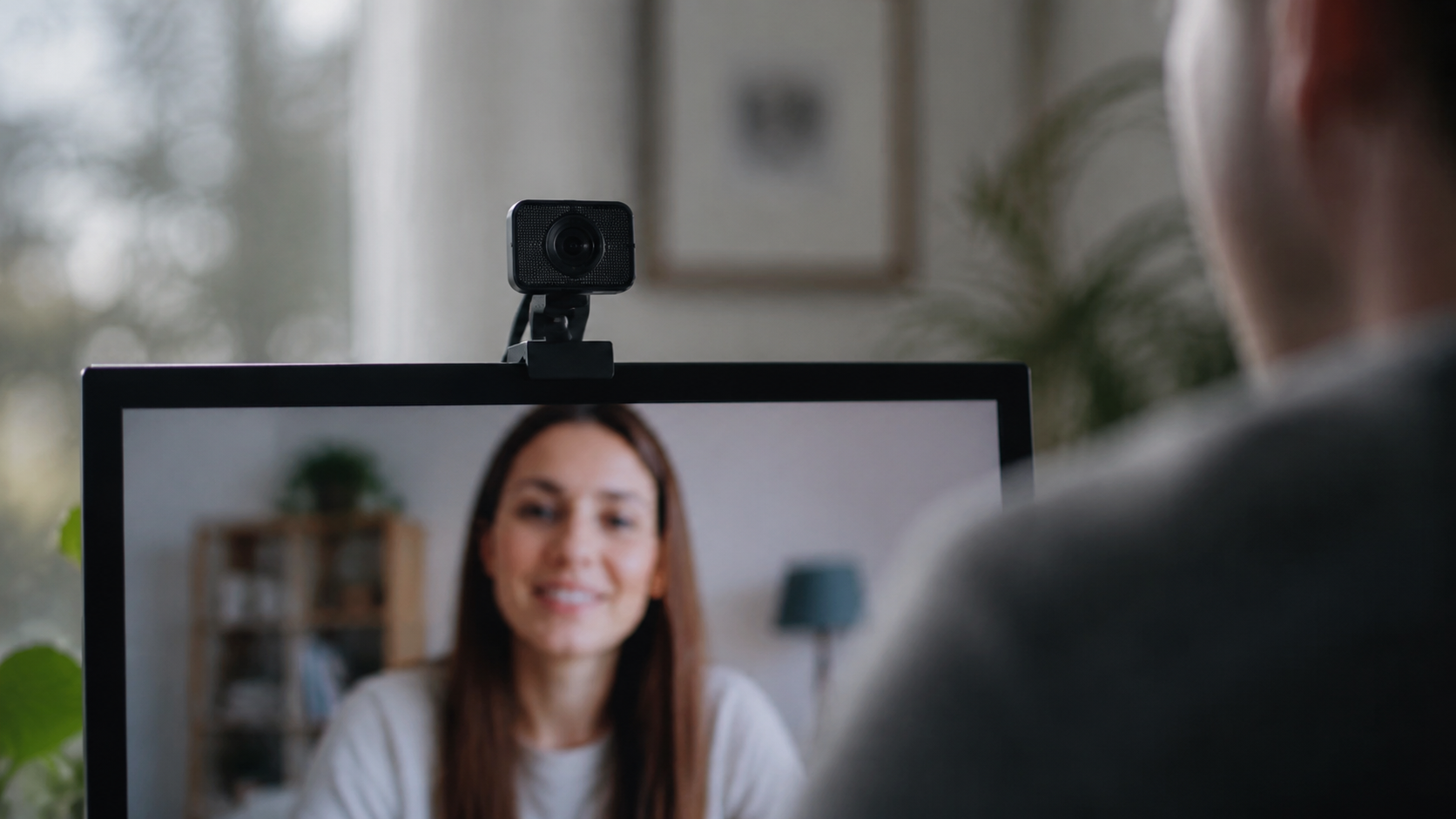
Eye contact works differently through a webcam because the place you look and the place that records you are usually separate. The other person’s eyes appear on your display, while your camera may sit several inches above or beside them. You can be watching someone closely and still appear to be looking away.
There is a second difference: the other person sees a flat camera image rather than your physical position in a shared room. Screen layout, camera placement, and the way the image is displayed all affect the signal they receive. These differences make webcam gaze an imperfect guide to attention, confidence, or interest.
The camera and the face ask for different kinds of attention
Looking toward the lens helps you direct your recorded gaze toward the viewer. Looking at the on-screen face helps you receive information from the person who is speaking. Those are both reasonable goals, but a conventional setup doesn’t place them at exactly the same point.
The mismatch is easy to notice with two screens. If the call is on a large monitor and the camera is attached to a laptop beside it, you may spend the conversation looking sideways in the transmitted image. From your side, you are facing the speaker. From theirs, you appear oriented elsewhere.
This is a property of the setup, not proof of an attitude. Before interpreting someone’s gaze, consider whether their camera is positioned near the screen they are actually using.
Perceived eye contact isn’t identical to looking at the lens
Alice Gao and colleagues found that gaze slightly below the camera could produce stronger perceived eye contact than gaze directly into the lens in their study of displayed camera images. This shows why lens direction and the viewer’s judgment shouldn’t be treated as identical measures.
The finding doesn’t give every meeting participant one universal point to stare at. A small shift in gaze can be perceived differently depending on how the face is captured and viewed. The practical lesson is to test what your setup communicates instead of assuming that the exact camera center is always ideal.
For a practical arrangement of the screen, notes, and camera, see where to look during a video call. That guide focuses on balancing direct address with listening.
The screen doesn’t preserve a shared room
In a meeting room, people share a physical arrangement. Looking toward a colleague, a whiteboard, or a door gives others contextual information because they can see many of the same objects. On a call, your camera shows only a small part of your environment.
If you look down, the other person may not know whether you are reading their document, checking captions, taking notes, or looking at an unrelated message. The movement alone doesn’t identify its purpose. A brief explanation can remove that uncertainty.
“I’m looking at the figures you sent” is often enough. You don’t need to narrate every glance, but it helps to explain a sustained shift when the reason matters to the conversation.
Group layouts make the recipient of a glance unclear
Participants in a group call don’t necessarily see the same arrangement of faces. A person in the upper-right corner of your display may appear in the lower-left corner of someone else’s. Your glance toward one tile therefore doesn’t reliably tell the group whom you are addressing.
Names and verbal handoffs become more useful. Ask a particular person a question, or invite a response from a clearly defined group. This gives the conversation a structure that the camera image cannot provide on its own.
When several people begin speaking at once, a short pause and an explicit handoff can help. The problem may come from limited turn-taking cues or connection delay rather than anyone’s failure to pay attention.
Direct-looking gaze can be one-sided
A speaker can look toward the camera and appear to address every viewer while seeing none of their faces clearly. A prerecorded video can create the same impression of direct address even though no live exchange is happening. That illustrates the difference between appearing to look at someone and participating in mutual attention.
During a live call, you need opportunities to observe and respond. Check whether the other person wants to speak, whether your explanation needs clarification, and whether the shared material is visible. A camera-facing pose that prevents those checks may make the conversation less responsive.
Use gaze as one part of communication alongside wording, timing, questions, and acknowledgment. A clear response to what someone has said often communicates attention more convincingly than an uninterrupted stare.
Looking away can support the task
Many calls involve documents, demonstrations, or note-taking. Looking at those materials is part of doing the work. It would be unreasonable to judge every glance away from the lens as a lapse in engagement.
People also differ in how comfortably they use direct gaze. Cultural expectations, visual needs, and individual communication preferences can affect what feels natural. Don’t use webcam eye contact as a test of honesty, competence, or respect.
If you need to know whether a point was understood, ask a useful question. “Which option would work for your team?” provides more evidence than trying to interpret a small eye movement in a compressed video image.
Presentation habits don’t transfer perfectly to a webcam
Advice about sweeping your gaze around a room assumes that an audience can see where you are looking. Repeating that movement in front of a fixed webcam may simply make your gaze appear to wander. A remote presentation needs a different balance.
Use the camera area for moments of direct address and return to the participant view or shared material when it serves the explanation. Keep the main point clear enough that listeners don’t depend on subtle visual signals to follow the argument.
If remote delivery makes you rush, work on the pace of the explanation as well as the camera setup. Our guide to slowing down when you speak too fast offers ways to give important ideas more room without making your delivery rigid.
Improve the signal without turning the call into a performance
Place the speaker’s image near the camera when practical, keep your face visible, and use notes that are easy to consult. Test the arrangement in a short recording that includes ordinary glances and movement. This gives you a realistic picture of what the other person receives.
Then focus on the conversation itself. Ask questions, listen to the answers, and make the next step explicit. Webcam eye contact is useful when it supports that exchange; it becomes a distraction when maintaining its appearance takes attention away from the person you are trying to understand.
Research source
Gao and colleagues, 2025: Don’t look at the camera—Achieving perceived eye contact in remote video communication, Journal of Vision. The study examines perceived gaze in displayed camera images, rather than establishing a universal standard for successful meetings.