How to Identify Barriers to Communication: Eight Checks and Worked Repairs
To identify barriers to communication, compare what someone needed to understand or do with what actually happened. Locate the gap before deciding why it occurred. A missed response might concern access to a message, an ambiguous instruction, conflicting versions, an unsuitable format, or an unanswered question. Those problems need different repairs.
The eight checks below are a practical troubleshooting arrangement, not a fixed scientific classification or a diagnosis of the people involved. Each includes an original illustrative example. The aim is to make a communication problem observable enough that you can change something and check whether the change helped.
Start with the intended action
Write down the purpose of the message in one sentence. Perhaps a teammate needs to review a drawing, a learner needs to submit a plan, or a meeting participant needs to identify a decision. “Keep everyone informed” may be too broad to tell you what successful communication would look like.
Then describe the result you observed. “Two people submitted different document versions” gives you something to investigate. “Nobody listens” mixes an observation with a sweeping explanation. The first description can lead to a version-control check; the second can make people defensive without locating the problem.
Separate an observation from an explanation
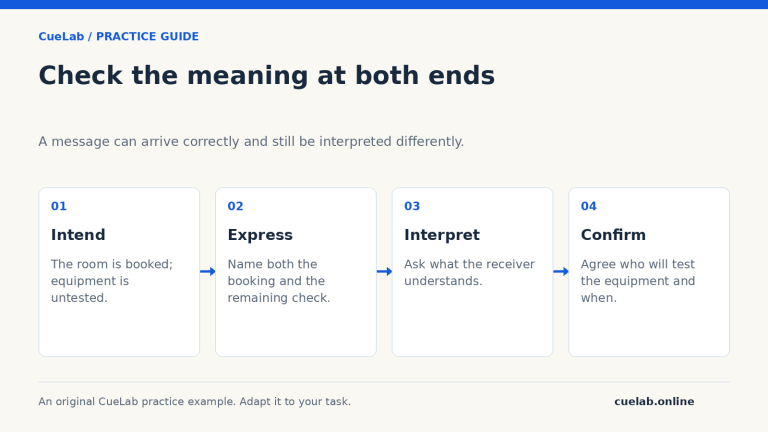
NC State’s communication guidance emphasizes checking understanding and recognizing the context and assumptions people bring to an exchange. A useful practical extension is to keep three notes separate: what happened, what might explain it, and what would help you distinguish among those explanations.
For example, a person did not reply to a group message. You may know that the message was sent, but you may not know whether it reached their account, appeared among several updates, made the required response clear, or arrived while they were unavailable. Ask a relevant question before treating one possibility as established.
1. The message does not reach the person
Illustrative failure: A course team posts a revised submission instruction in a channel that one member cannot open. The member follows the earlier instruction and is later described as ignoring the update.
Check the destination, access requirements, and the audience that actually received the message. Sending a file and making that file usable are separate steps. A link may point to the right material while still requiring permission the recipient does not have.
Repair access before adding detail
Confirm the intended recipient and an approved route they can use. If the message matters to several people, make the correction available consistently rather than creating a different unofficial copy for each person. Ask the recipient to confirm that they can open the relevant item, without asking them to disclose passwords or share access they should not grant.
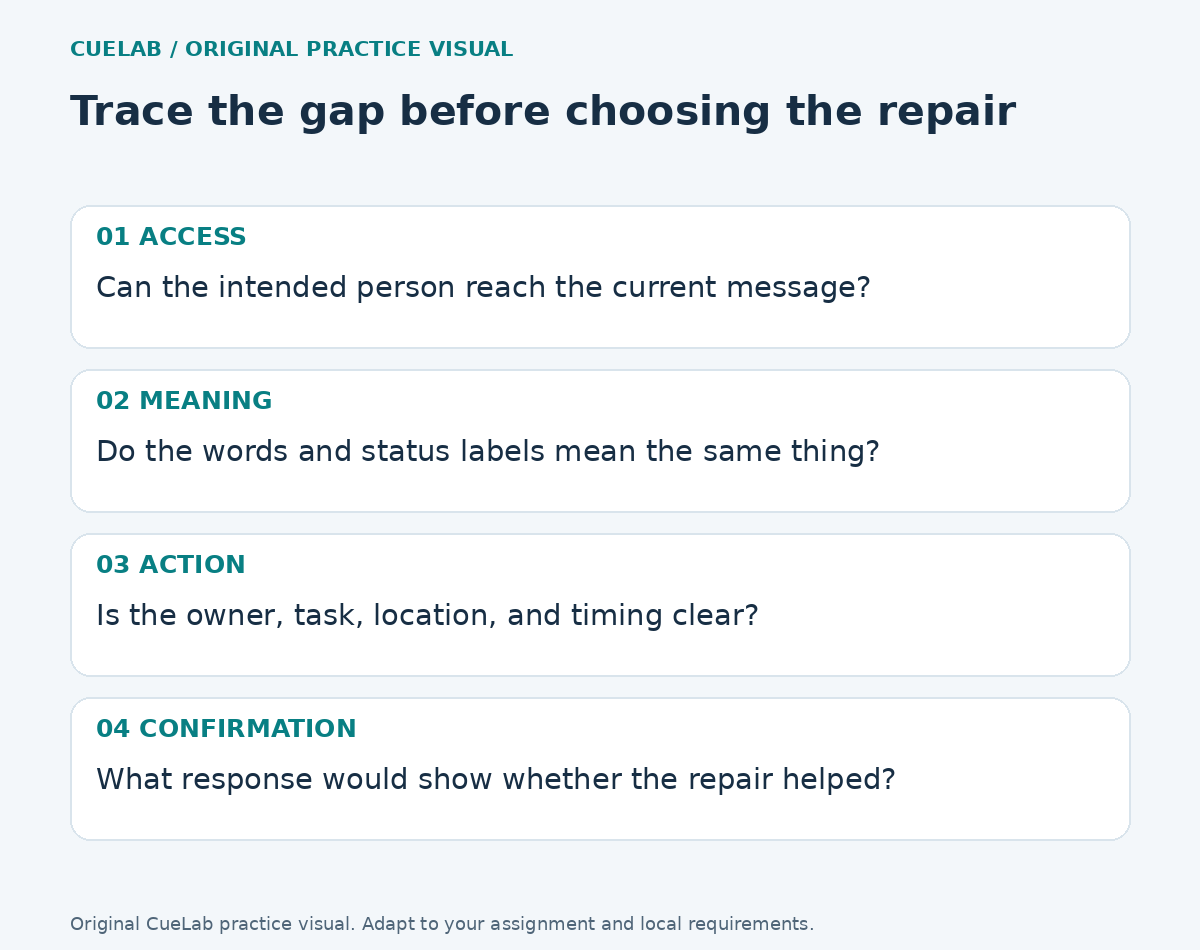
The observable check is simple: can the intended person reach the current material through the agreed route? Rewriting the explanation will not resolve a blocked or misdirected message on its own.
2. A key word has two meanings
Illustrative failure: A project leader asks for a “finished draft.” One person interprets that as ready for review; another treats it as approved for release. Both can follow the words while expecting different states of the work.
Look for terms whose meaning changes with role or context. “Urgent,” “complete,” “check,” and “publish” may carry important unstated conditions. A familiar acronym can also be understood differently by people from different teams.
Define the decision-relevant term
Replace an ambiguous label with the state or action you mean. For the fictional draft, a clearer instruction would specify whether the document is ready for comments, awaiting approval, or authorized for distribution. Keep any official status labels consistent with the process your organization uses.
Ask the recipient what they understand the term to require. The purpose is to reveal a mismatch while it is easy to correct. Explaining every possible word is unnecessary; focus on the terms that change what someone should do.
3. Instructions omit an owner or deadline
Illustrative failure: A meeting ends with “Someone should update the slides before the review.” Several people assume another member will do it, and “before the review” means different things to those preparing the final file.
The problem may be an incomplete action rather than a lack of motivation. Check who owns the task, what must change, where the result belongs, and when another person depends on it. If no owner was agreed, avoid pretending that one person failed to meet an instruction they were never given.
Put the next action in one sentence
A fictional repair could be: “Mina will add the labelled diagram to the review deck in the course folder by Thursday at 16:00 campus time, then tell the group it is ready for checking.” The name and deadline are illustrative; a real team should agree its own feasible commitment.
Check whether the named person accepts the action and has the required input. Assigning an impossible deadline more clearly does not make the task workable. Clarity should expose dependencies so the group can address them.
4. Competing versions create uncertainty
Illustrative failure: A handover contains an attachment called “final,” while a later chat links to a different file. Nobody can establish which includes the latest correction.
Compare the routes through which updates travel. The issue may concern a missing status record, an outdated attachment, or a correction visible only to part of the audience. The word “latest” is weak guidance if several copies look equally current.
Name the authoritative version
Identify the agreed working location and the person or process that confirms status. Mark superseded material clearly under the team’s normal document rules. If a change affects earlier instructions, explain what changed and which action now applies.
The check is whether two recipients independently locate the same current version and interpret its status the same way. An impressive folder structure has limited value if users still need to guess which file controls the task.
5. The format makes information difficult to use
Illustrative failure: A learner receives a screenshot of a dense table on a small screen. The relevant instruction is present, but it is difficult to locate, enlarge, or use with the tools available to the learner.
Consider the task and the recipient’s access needs. A picture of text, a long unstructured message, a quiet spoken instruction in a noisy room, or an unexplained visual can each create a practical obstacle. Ask what arrangement would help instead of assuming that everyone uses the same device or communication mode.
Make the task accessible in the chosen channel
For the fictional table, provide the relevant instruction in readable text and an appropriate accessible version of the material. For a spoken explanation, consider the setting, audibility, a written record, and the arrangements participants need. Use the institution’s accessibility support where appropriate.
Ask the recipient to perform the specific information task, such as locating the deadline or identifying the next step. That check concerns the usability of the message; it should not become a test that blames someone for an inaccessible format.
6. Assumptions replace a check
Illustrative failure: An experienced group member explains a process using terms introduced in a session a new member did not attend. The speaker assumes shared knowledge, while the new member assumes asking a basic question would interrupt the meeting.
Look for the point where the explanation requires information that was never supplied. The gap may concern a definition, a previous decision, a permission, or the reason a task is being done. More detail about later stages may leave the missing foundation untouched.
Ask for a reconstruction of the meaning
Invite a useful response: “Before we move on, what do you understand the first step to be?” If the answer reveals a missing prerequisite, supply that prerequisite and revisit the explanation. The aim is to find the mismatch, not to catch the person out.
Where several people are involved, make room for questions without requiring someone to publicly identify themselves as the only confused participant. A written question route or a short individual preparation step may fit the setting better.
7. The conversation leaves no room to question
Illustrative failure: A chair says “Any questions?” while closing the laptop and moving to the next item. A junior participant has a concern but sees no usable opening in which to raise it.
Examine the interaction as well as the wording. People may have different authority, language confidence, processing time, or experience in the group. A question invitation can be formally present while the meeting arrangement makes a response difficult.
Create a usable route for disagreement
State what input is needed and leave a real opportunity to provide it. “What could prevent this handover from working?” is more specific than an invitation to comment on everything. Explain how someone can raise a concern later if that is a genuine available option.
If you lead the conversation, respond to corrections in a way that keeps the route credible. Inviting concerns and then dismissing each one without examination teaches the group little about how to contribute usefully. Record an unresolved issue rather than forcing an immediate appearance of agreement.
8. A response is mistaken for understanding
Illustrative failure: Several recipients react to a message with a thumbs-up symbol. The sender takes that as proof that everyone knows what to do, although some people only meant that they had seen the message.
A receipt, acknowledgement, agreement, and correct understanding are different things. Decide which one matters for the task. You do not need a formal confirmation for every casual message, but a consequential handover may need more than a reaction icon.
Check the actual next step
Ask for a short description of the action, a relevant question, or a review of the completed item, depending on the task. For example: “Please confirm which section you will revise and flag any missing input.” That response can reveal an assumption before work proceeds.
Keep the confirmation proportionate. Demanding repetitive proof for routine exchanges can create unnecessary work. Choose the smallest check that addresses the specific uncertainty and fits the relationship and process.
A worked audit of one project message
Consider this fictional classroom message: “Please update the lab plan soon. Use the latest sheet in the folder and send it to everyone before the review.” It sounds action-oriented but leaves several decisions to the reader.
The audience may not know who owns the task, what “update” includes, which sheet is current, how soon the work is needed, or who “everyone” means. Sending it again in capital letters would increase emphasis while preserving those gaps.
A revised version could read: “For Friday’s classroom review, Noor will add the labelled diagram to Section 2 of Lab Plan Review Draft 03 in the shared course folder by Thursday at 16:00 campus time. Mark dimensions that still need checking. When the draft is saved, tell the review group where it is; the document remains provisional.”
This version makes the task and status clearer, but it still needs checks. Can Noor access the folder? Is Draft 03 the agreed version? Is the deadline feasible? Does the review group know where to find it? A clear sentence is one part of a working exchange.
Choose a repair you can observe
Match the repair to the evidence. If recipients cannot open the file, resolve access. If they open different files, resolve the version route. If they use the correct file but misunderstand the task, examine the instruction and its prerequisites. Several barriers may coexist, so record which change addresses which problem.
After making a change, check the intended action again. One successful attempt does not prove that the whole communication process is fixed, but it gives you better evidence than assuming that a rewritten message must have worked.
Keep a short communication repair record
| Record | Question to answer |
|---|---|
| Purpose | What should the recipient understand or do? |
| Observation | What happened, without an assumed motive? |
| Possible barrier | Which part of the exchange may explain the gap? |
| Repair | What will change, and who owns that change? |
| Check | What observable response would show whether it helped? |
Keep private material out of a shared review record unless there is an appropriate reason and permission to include it. In many routine reviews, a de-identified description of the process is enough to explain the issue.
Review the process without blaming the receiver
Start with one recent low-stakes exchange and apply the checks that fit it. For the next explanation, practise making a difficult idea clear, examine how instructions can be missed, and use the presentation planner to leave room for questions.
Reference: NC State University: Communication. The eight-check arrangement, fictional project messages, and repair record are original CueLab practice material.