Focus Group Discussion in Qualitative Research: A Moderator’s Planning Guide
A focus group discussion in qualitative research is a guided conversation used to explore how participants describe, compare, and respond to a topic. The interaction matters: one person’s account may prompt another to add a different experience, question an assumption, or explain why the same arrangement works differently for them. It is more than asking several people the same survey question in one room.
This planning guide concentrates on the moderator’s communication task. It includes an original fictional campus example, question revisions, recovery wording, and an analysis-note illustration. It does not report research findings or provide a ready-approved study protocol. A real project needs a design, permissions, and participant arrangements appropriate to its institution and purpose.
What a focus group can help you understand
The CDC’s qualitative-methods guidance describes focus groups as semi-structured group interviews guided by a trained moderator. It explains both their usefulness for exploring shared perceptions and the limits introduced by group dynamics. A group setting can reveal differences and socially shared language while also making some personal accounts difficult to express.
Translate that into a specific research purpose. “Find out what students think” is too loose to guide a session. “Explore how commuting students describe choosing a place to work between classes” identifies an activity and a perspective. It still leaves open what the participants will consider important.
Choose the method before writing questions
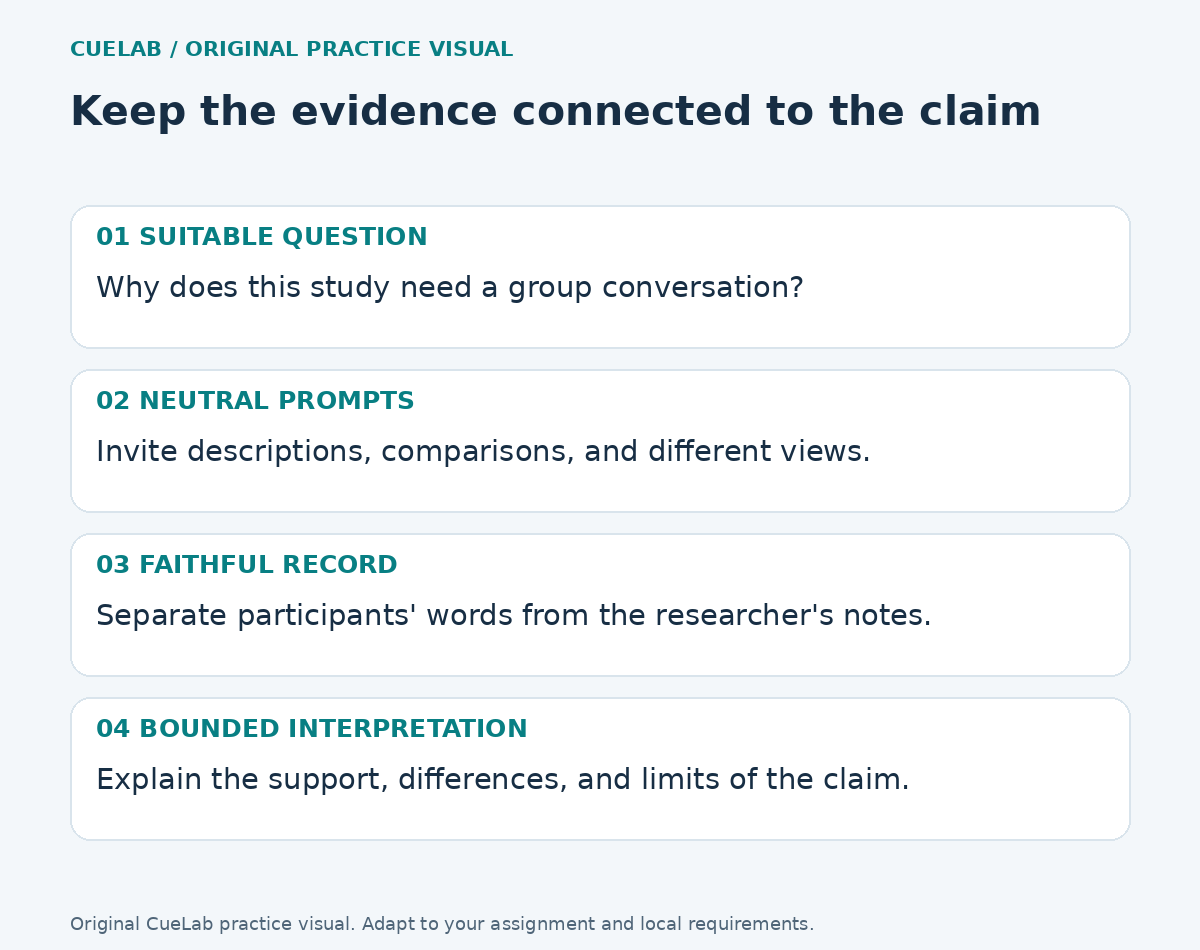
Ask why a group conversation is useful for the question. If participants’ comparisons and reactions are important, a focus group may be worth considering. If the project needs private individual accounts, observation of actual behaviour, or a numerical estimate for a population, another method or a combination may fit better.
For example, asking students to discuss study-space choices can reveal how they explain those choices. It does not directly measure the availability of every room or establish the proportion of all students who prefer one setting. Keep the kind of evidence you will collect aligned with the claim you intend to make.
Define the question and the limits of the study
Write a short scope statement before drafting the moderator guide. Identify the issue, whose perspective matters, and what the discussion will not decide. In the fictional example, the session explores students’ descriptions of finding study space; it does not promise that the university will build, reserve, or change any space.
Give the research question and each proposed discussion question different jobs. The research question directs the study. A participant-facing question should sound like something a person can answer from experience. “Describe the determinants of spatial selection” is less usable here than asking someone to describe how they chose a place on a particular day.
Plan who belongs in the conversation
Recruitment should follow the study purpose, with eligibility criteria and a reasoned account of the perspectives sought. Consider whether differences in role, status, language, or familiarity could make the conversation difficult. A group containing students and the person who evaluates them may produce a different discussion from a student-only group.
There is no single participant count or number of sessions that makes every qualitative project adequate. Plan with the relevant methodological guidance and supervision. Explain the choice in relation to the question and the depth and range of material needed, rather than treating a convenient group as representative of everyone.
Separate research from a classroom exercise
A role-play can help a student practise moderation without collecting real research data. Participants can use invented accounts, and the review can focus on wording, turn-taking, and note-taking. Label the activity clearly so nobody mistakes the resulting conversation for evidence about an actual population.
A real study introduces different responsibilities concerning recruitment, consent, records, and use of material. Do not quietly convert a rehearsal into research because a participant says something interesting. Decide what the activity is, explain that purpose, and follow the appropriate arrangements before collecting material for a study.
Prepare consent and a realistic privacy explanation
Before a real session, participants need a clear account of the purpose, what participation involves, any recording, who will use the material, and the choices available to them. Use the wording and process approved for the project rather than copying a generic script and assuming it covers the study.
Privacy in a group has an important limit: other participants hear the discussion. A moderator can request respectful handling of what is shared but cannot guarantee what others will repeat afterward. The CDC specifically notes the confidentiality limitations of group interviews. Consider a more private method where sensitive personal accounts are central to the question.
Give the moderator and note-taker different jobs
The moderator follows the guide, listens for the meaning of an answer, invites relevant comparisons, and keeps the discussion within its purpose. A note-taker can record the sequence, speaker identifiers where permitted, questions asked, and contextual details needed to understand an exchange.
Agree on how the two people will signal a missed point without interrupting unnecessarily. Decide how recordings and notes will be stored under the project’s arrangements. Writing down “everyone nodded” is not a substitute for recording what participants actually said; a gesture does not automatically establish agreement with a research claim.
Worked example: finding campus study spaces
Imagine a practice session about how commuting students choose a place to work between classes. All participant lines below are fictional teaching material. The moderator wants to understand the decisions students describe, including occasions when a place that suits one person does not suit another.
A preparation sheet could name four areas to explore: the initial search, information used, constraints on the choice, and what happens when the first option is unavailable. These areas organize the guide without assuming that noise, seating, travel time, or any other factor must be the most important.
Open the session without promising a solution
After the project’s actual consent and procedural introduction, an illustrative topic opening might be: “We are interested in how you choose somewhere to work between classes. People may use different places for different reasons. Please describe your own experience, and feel free to offer a different view from something you hear.”
Compare that with “We want you to confirm that students need more quiet rooms.” The second version supplies a preferred conclusion. Participants should understand the topic without being told what the researcher hopes they will establish.
Move from description to comparison
Begin with an answerable prompt: “Think of a recent occasion when you needed somewhere to work between classes. How did you decide where to go?” Follow the account before moving to a general preference. A specific account can reveal steps that an abstract question overlooks.
Later, invite comparison: “Does anyone choose differently when the gap between classes is short?” This connects the discussion to something already raised. It leaves participants free to say that the length of the gap does not matter to them, or to introduce a consideration the guide did not anticipate.
Ask neutral follow-up questions
A follow-up should clarify or deepen an answer without placing a reason in the participant’s mouth. The examples below are alternative wording choices for the fictional study, not claims about actual students.
| Leading or unclear wording | A more open alternative |
|---|---|
| Why are the study rooms so inconvenient? | How does that room fit into the rest of your day? |
| Wouldn’t a booking app solve it? | What information do you use before going there? |
| Everyone wants quiet, right? | What kind of setting suits the work you are doing? |
| Is it because you dislike the library? | You said you went somewhere else. What shaped that choice? |
| How satisfied are you with all campus facilities? | Thinking about that occasion, what helped or made the search harder? |
A closed question can confirm a specific detail, but a series of yes-or-no questions may produce little explanation. Use a probe such as “Can you describe what happened next?” when the sequence matters. Avoid stacking several questions together and then guessing which one the participant answered.
Invite difference without forcing a turn
Suppose one speaker says the library is always their first choice. The moderator might ask, “Does that fit other people’s experience, or is there a different approach?” This invites comparison without presenting disagreement as a duty or asking the group to vote on the speaker’s account.
A quieter participant can be offered an opening without being required to disclose a personal experience. Respect the project’s participation arrangements. Silence may reflect several things, including having nothing to add; do not label it agreement, lack of interest, or a hidden opinion.
Respond to a dominant or sensitive contribution
If one person occupies most of the time, a moderator can acknowledge the point and reopen the space: “Thank you; that explains how the travel time affects your choice. I’d like to hear whether anyone approaches that decision differently.” The intervention concerns participation rather than criticizing the person.
If someone begins sharing identifying or sensitive information beyond the session’s purpose, avoid probing for more detail. Use the study’s agreed procedures and redirect appropriately. For the fictional example, a neutral return might be, “You do not need to identify anyone. What part of the arrangement affected where you could work?”
Plan an online session around access and privacy
Check the practical route into the session, how a participant can ask to speak, and what happens if the connection fails. Explain the recording arrangement and who can access the platform material. Do not add an unannounced recording, automated transcript, or additional observer simply because the software makes it easy.
Think about what the moderator can and cannot observe online. A camera frame gives a partial view, and a delayed response may concern the connection. Offer a clear way to signal a wish to contribute rather than interpreting posture or camera status as a research finding.
Close by checking the summary
Give a short account of the main differences you heard and invite correction. A fictional closing might be: “I heard that some choices depend on the time available, while others depend on the kind of task. Have I missed a consideration you wanted included?” Avoid converting a varied discussion into “We all agree the library needs changing.”
Explain the next steps using the actual study arrangements. A participant’s agreement with a closing summary does not, by itself, validate the entire later analysis. It is one opportunity to notice a misunderstanding before the session ends.
Keep the record faithful to the discussion
Follow the project’s rules for transcription, identifiers, storage, and quotation. Separate a participant’s words from the note-taker’s interpretation. If a section was inaudible or a speaker was uncertain, preserve that uncertainty rather than silently repairing the record with a plausible sentence.
Write a session memo while the sequence is fresh. Record departures from the guide and issues that may affect interpretation. For instance, if the moderator introduced a proposed booking system, note that intervention; do not later present every response to it as a topic the participants raised spontaneously.
From transcript to a provisional interpretation
Fictional participant A: “I use the room near my next class even if it is not my favourite place.”
Fictional participant B: “For a short gap, I do that too. For a longer task, I check somewhere else.”
An initial note could be: “These two illustrative accounts connect location choice with the next activity and time available.” A provisional label such as “fit with the day’s schedule” might help retrieve related passages. It is a working analytic choice, not a proven theme just because it sounds persuasive.
A later analysis should examine the rest of the material, contradictory accounts, and the approach chosen for the study. Preserve the distinction between an extract, a coding decision, an interpretation, and a conclusion. That distinction makes an explanation easier to examine and revise.
Report insight without inventing prevalence
A group discussion does not automatically establish how common a view is across a whole institution. “A participant described choosing a nearby room before class” is a different claim from “Most students prioritize location.” The second needs an evidential basis that the first does not supply.
Describe the setting, recruitment, method, and relevant limits so readers can assess the account. Include differences that matter to the question rather than selecting only the most vivid quotation. Quotations should support a reasoned analysis, not stand in for one.
Rehearse the guide before recruitment
Run a clearly labelled fictional practice session and note where a question produces confusion, supplies an answer, or introduces too many topics. Revise the guide and review it through the appropriate project process. When preparing to explain the study, practise presenting uncertainty, use the thesis defense question prompts, and plan for questions you cannot yet answer.
Reference: CDC Field Epidemiology Manual: Collecting and Analyzing Qualitative Data. The campus scenario, moderator wording, question revisions, and analysis-note illustration are original CueLab teaching material.