An Example of Active Listening: Six Conversations with Revision Notes
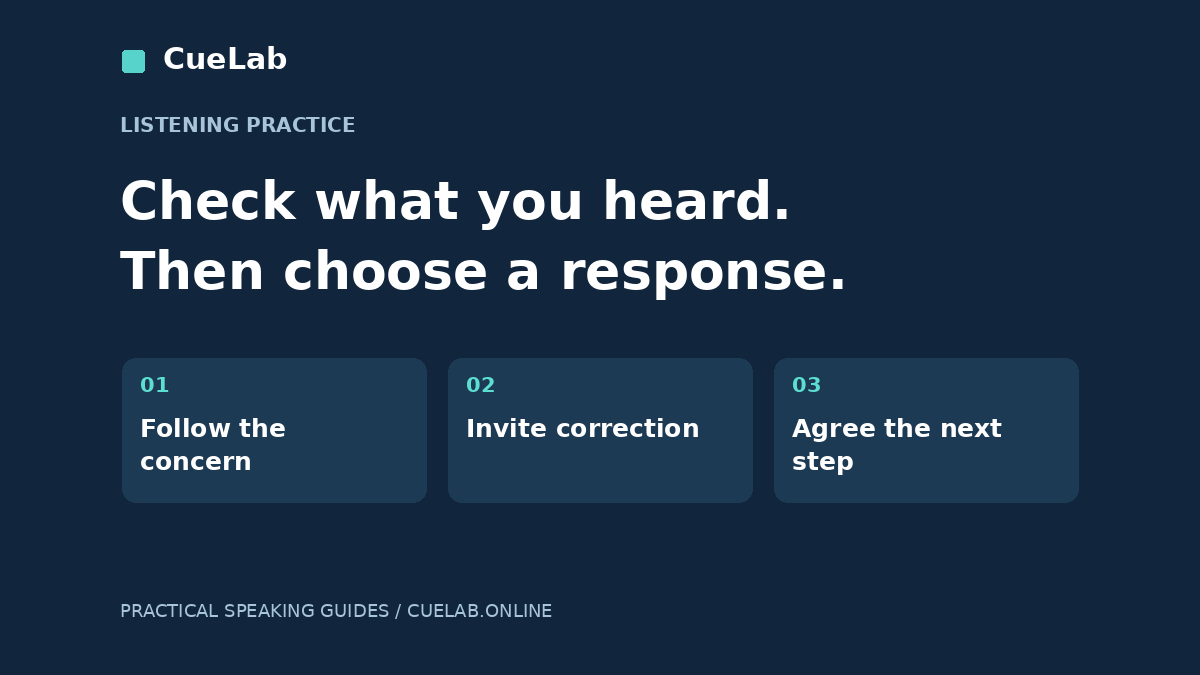
An example of active listening becomes useful when you can see what the listener did with the speaker’s meaning. A nod or a sympathetic phrase may show attention, but the clearer test is whether the response follows the concern accurately and leaves room for correction. The listener should not have to guess a hidden feeling or agree with a proposal to understand it.
The six conversations below are original fictional practice examples. Each includes a tempting response that misses something, a revised exchange, and notes on the choice. Use them to practise listening in classes, projects, meetings, and everyday conversations. They are adaptable examples rather than lines to recite word for word.
What makes a response active listening?
The Greater Good Science Center’s active-listening guidance describes practices such as paraphrasing, asking clarifying questions, allowing the other person to finish, and delaying advice while you understand the perspective. The important distinction is between making space for a meaning and replacing that meaning with your own interpretation.
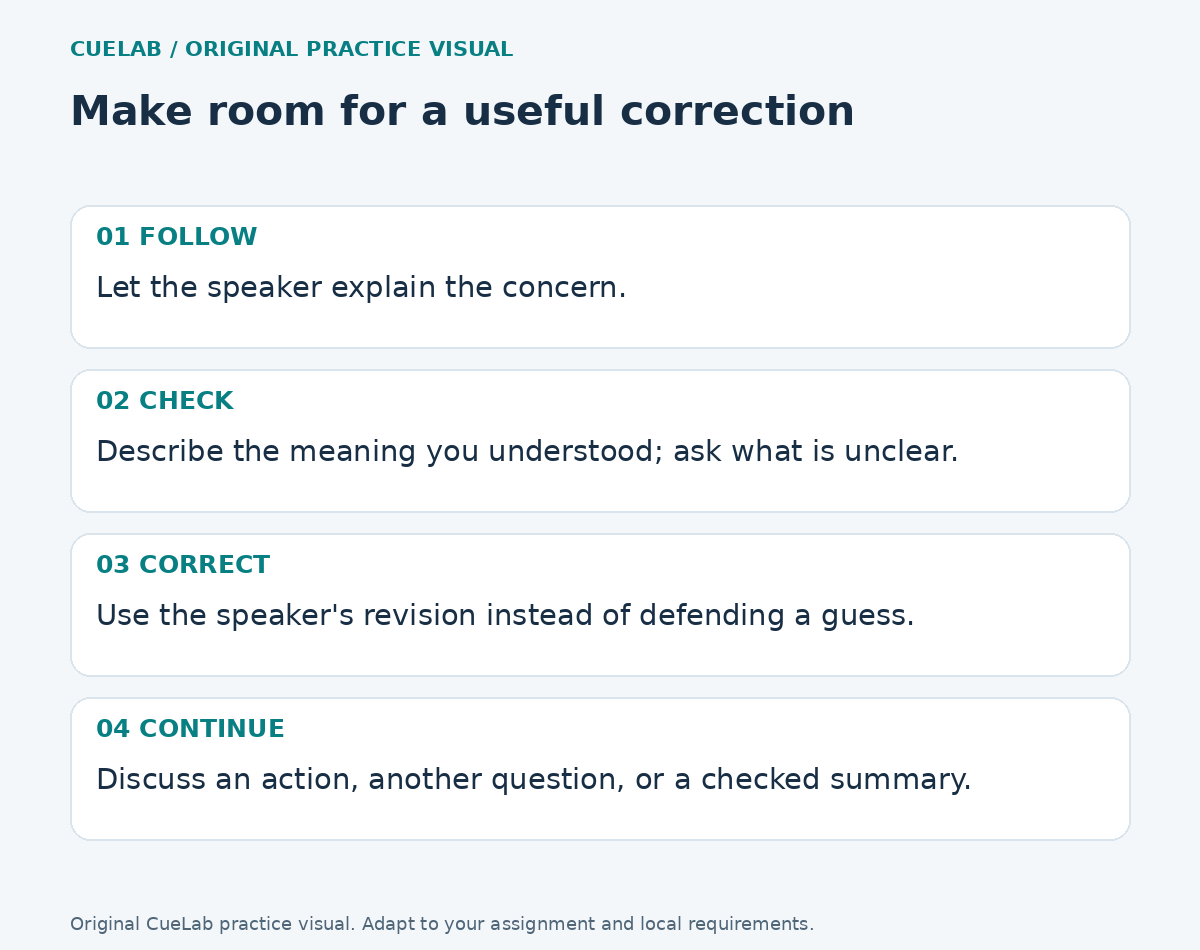
For these examples, use a simple working question: “What would the speaker need to correct if my understanding were wrong?” A response that permits a useful correction can reveal a missed deadline, a different priority, or an assumption that was never shared. A polished response that allows only agreement may hide the same problem.
A small example with a useful correction
Speaker: “I don’t think I can finish this before the review.”
Listener: “Which part is uncertain: finishing the analysis, or getting it into the review document?”
Speaker: “The analysis is finished. I don’t know which version of the document we are using.”
The listener did not assume that the speaker needed motivation or an extension. The question opened two plausible interpretations and allowed a third if necessary. The answer changed what help would be relevant: locating the agreed document is different from reassigning unfinished analysis.
1. A teammate questions the deadline
Situation: A fictional project team has agreed to circulate a draft on Thursday. One teammate raises a concern after the meeting.
Tempting response: “We’ve all got work to do. Just start earlier.” This assumes the problem is effort and makes it harder to explain an actual dependency.
Teammate: “Thursday might be difficult because I still need the revised drawing.”
Listener: “You can prepare your section, but the final version depends on that drawing. Is that the part putting Thursday at risk?”
Teammate: “Yes. I could circulate a provisional version if the missing dimensions are clearly marked.”
Listener: “Let’s check whether a provisional version meets the purpose of this review before we promise it.”
Locate the actual uncertainty
The revised response follows the relationship between a task and its missing input. It also avoids promising a change the listener may not have authority to approve. Understanding the concern makes a practical next question possible, but it does not establish that a provisional document is acceptable.
During practice, ask the speaker to change the underlying issue. Perhaps the drawing is available but its status is unclear. A listener who continues repeating the original summary is following a script rather than the new information.
2. A student asks about feedback
Situation: A student says a comment on an assignment seems unfair. The listener has not read the assignment or the marking criteria.
Tempting response: “Your teacher is wrong.” It offers agreement before establishing what happened, while “You must have misunderstood” dismisses the concern just as quickly.
Student: “The feedback says my explanation was incomplete, but I included all the steps.”
Listener: “You can see the steps in your answer, and you want to understand what the marker thought was missing. Which comment should we look at?”
Student: “This one asks me to explain why the final step follows.”
Listener: “So the question may concern the reasoning between steps. Shall we compare that comment with the task instructions?”
Separate hearing from agreeing
The listener recognizes the student’s account without deciding the marking dispute. The conversation moves toward the actual comment and instructions. If the evidence later supports an appeal or a correction, that decision can be made on its own basis.
It is possible to acknowledge frustration in ordinary language without declaring how someone must feel. “That comment has left you unsure what to revise” may fit better than a dramatic emotional label. If the speaker corrects your description, use the correction rather than defending the phrase.
3. A colleague reports a confusing handover
Situation: A colleague is trying to continue a task after another person has left for the day.
Tempting response: “We need a new project-management app.” A new tool might eventually be worth discussing, but the listener has not yet found the gap.
Colleague: “I have the files, but I can’t tell what I’m supposed to do next.”
Listener: “You can open the material. What is unclear about the next action?”
Colleague: “One note says check the figures. Another says the figures are approved.”
Listener: “The instructions conflict about their status. Before you repeat the check, we need to confirm which instruction is current.”
Check the sequence before proposing a fix
The exchange distinguishes access from status. That distinction matters because resending the same files will not resolve contradictory instructions. A useful follow-up would identify who can confirm the current status and how the correction will reach anyone else using the handover.
Notice that the listener does not use the colleague’s frustration as evidence that the previous worker was careless. The conversation can address the incomplete record while keeping an unverified explanation about another person out of it.
4. Two people disagree on a meeting format
Situation: One group member wants an in-person review, while another prefers a remote meeting.
Tempting response: “You just don’t want to come.” This turns a disagreement about arrangements into an accusation about commitment.
Member: “I don’t think everyone needs to be in the room for this review.”
Listener: “What part of the review do you think can be handled remotely?”
Member: “The document comments. I agree that someone needs to inspect the model in person.”
Listener: “I was treating those as one task. We could separate the document discussion from the model inspection, then check what each requires.”
Reflect the concern without erasing your own view
The listener changes an assumption, not necessarily the final preference. They can still explain why they think a particular task needs an in-person element. A clear response might begin with the newly understood point before presenting the remaining concern.
Listening is not a method for manufacturing agreement. If the tasks cannot be separated, the group still has a decision to make. What improves is the description of the disagreement: it concerns how work will be done, rather than whether one member cares.
5. A learner needs an instruction clarified
Situation: A learner has heard an explanation but is unsure what should be submitted.
Tempting response: “I already explained it.” Repetition may help, but repeating the same wording without locating the difficulty can leave the learner in the same place.
Learner: “Do we upload the plan or the completed report?”
Listener: “For this checkpoint, the plan is the submission. Which part of the instructions made the report seem due?”
Learner: “The example file is called final report.”
Listener: “That label is confusing here. I’ll distinguish the example from the required submission. Can you tell me what you’ll upload for the checkpoint?”
Let the listener show the next step
In this case, the person giving instructions is also listening. The learner’s question identifies a misleading label. The last question checks the task rather than testing whether the learner can repeat a reassuring “yes.”
A correction should reach the other learners who may have seen the same label. Helping one person privately is useful, but a shared instruction problem can remain in place for everyone else. Listening can reveal a communication repair beyond the immediate exchange.
6. A friend wants to finish a thought
Situation: A friend is describing a difficult afternoon. The listener recognizes a problem they think they could solve.
Tempting response: “Here’s what you need to do.” The advice might be sensible, but it interrupts the account and assumes that advice is what the friend wants.
Friend: “I kept trying to explain what happened, and the conversation moved on.”
Listener: “You didn’t get to finish your account. Would it help to tell me the rest before we think about what to do?”
Friend: “Yes. I mostly want to work out how to explain it clearly.”
Listener: “Go ahead. Afterward, I can tell you what I understood, and you can correct anything I missed.”
Ask what kind of response would help
The listener offers a specific kind of attention without claiming to know everything the friend needs. If the friend later asks for suggestions, there is room to discuss them. If the listener lacks time or capacity for a longer conversation, they can say that honestly and agree on another arrangement.
Ordinary listening does not require taking responsibility for another person’s decisions or offering expertise you do not have. Clear limits can belong in a respectful conversation alongside careful attention.
When your paraphrase is wrong
A wrong summary is not repaired by explaining why you thought it was reasonable. Suppose you say, “You’re worried about presenting,” and the speaker answers, “No, I enjoy presenting; I don’t understand the assignment.” A useful next response would acknowledge the distinction and ask about the task.
Try: “I misunderstood the problem. Which part of the assignment is unclear?” The correction removes an assumption and gives the conversation a better direction. Repeating an emotional interpretation after the speaker rejects it makes the conversation about your theory rather than their explanation.
Use questions that leave room for another answer
“You’re annoyed because they ignored you, aren’t you?” contains both a feeling and a cause. A more open question might be, “What part of that exchange do you want them to understand?” The second version lets the speaker identify the concern in their own terms.
Closed questions still have a place when confirming a specific detail, such as which file is current. The aim is not to ban a grammatical form. Choose the question according to what is uncertain, and avoid presenting your preferred explanation as the only available answer.
Attention does not require a fixed posture
Choose an arrangement that helps both people follow the conversation. That may involve facing each other, reducing distractions, using notes, or communicating through text. Do not turn continuous eye contact, stillness, or a particular facial expression into a universal test of listening.
When attention is uncertain, check meaning directly. A person can look attentive while missing a crucial distinction, and someone looking at notes may be following carefully. The content of the response gives you a better basis for the next clarification than a guessed interpretation of a pose.
Move from understanding to an agreed action
Before closing a practical conversation, distinguish what was understood from what was decided. “I understand why you want more review time” does not mean “The deadline has changed.” State the action, its owner, and any permission or information still needed.
If no action is being requested, the ending can be a checked summary. Ask whether you missed a point the speaker wants included. A conversation does not have to produce a solution to show that a perspective was heard accurately.
A ten-minute partner exercise
Choose a low-stakes fictional situation from this guide. Spend two minutes letting one person explain the concern. Use the next two minutes for clarification and a short summary, then one minute for the speaker to correct the summary. Swap roles and repeat. The timing is an original CueLab practice arrangement, not a tested intervention or a requirement.
During the review, identify one assumption the listener avoided, one question that located useful information, and one correction they accepted. Keep the feedback tied to what happened in the exchange. “You asked which instruction conflicted” is more useful than awarding a general label such as “excellent listener.”
Choose one response to revise
Take a conversation you are preparing for and write the first response you would normally give. Check whether it answers the concern, assumes a motive, or rushes to advice. For related practice, explore why instructions can be missed, making feedback specific, and leaving room for a thinking pause.
Reference: Greater Good Science Center, University of California, Berkeley: Active Listening. The conversations, correction examples, and partner exercise are original CueLab practice material.