Self Introduction Speech Examples for Classes, Clubs and Teams
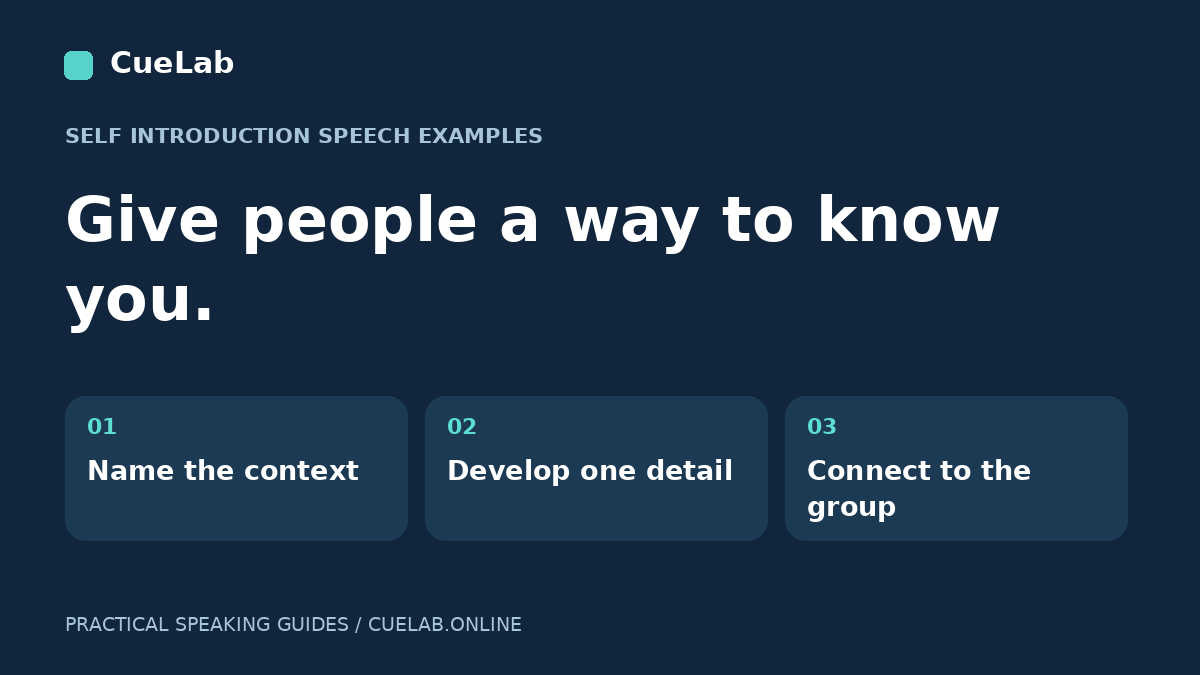
Useful self introduction speech examples show how to choose the details an audience needs, rather than fit an entire life story into a few sentences. A new class may need your name, an interest, and something you hope to learn. A project team may need your role and how you will contribute. The right introduction depends on the conversation it is meant to begin.
The examples in this guide use fictional speakers and situations. Treat their lengths as planning models, not guaranteed timings, and replace the details with your own truthful information. You can sound prepared without copying someone else’s background or turning a short introduction into a formal biography.
Decide what the audience needs to know about you
Begin with the setting: who is listening, why have you been asked to introduce yourself, and how much time do you have? These questions give the speech a useful boundary. You will make different choices for a first classroom meeting, a club welcome, and a task-focused project launch.
A self-introduction should give listeners a few reliable ways to place you in that setting. Your name is important, but a list of unrelated facts can be difficult to remember. Choose one or two details that connect naturally and give the audience a reason to continue the conversation.
Use a detail you can develop
An interest becomes more useful when you can explain what draws you to it. “I enjoy photography” gives a topic, while “I like photographing familiar streets because small changes make me look again” gives the audience something more specific. You do not need an unusual achievement to make the detail meaningful.
Choose what you are comfortable sharing publicly
Use details appropriate to the audience and the possibility that the speech may be recorded or discussed afterward. A current interest, a learning goal, or a relevant responsibility can be enough. You decide how much personal background belongs in the introduction; a short speaking exercise does not require you to disclose private experiences.
A self introduction speech outline with four useful parts
The outline below is a flexible planning aid. You can change the order or leave out a part when the occasion calls for it. A workshop round where everyone has twenty seconds will need a different version from an assessed classroom speech lasting several minutes.

| Part | Question to answer | Example of useful content |
|---|---|---|
| Name and context | Who are you in this setting? | Your name and course, group, role, or reason for attending. |
| Relevant detail | What would help these listeners understand you? | An interest, responsibility, or experience connected to the occasion. |
| Brief development | What makes that detail more than a label? | A concrete example or a sentence explaining why it matters. |
| Bridge | What conversation or activity comes next? | A learning goal, contribution, or natural connection to the group. |
Example 1: a brief introduction to a new class
Use: A short opening round. The following fictional script is compact enough to adapt for a roughly thirty-second turn, but you should time your own version.
Hello, I’m Nadia. I’m taking this class because I want to explain my ideas more clearly when I work with other people. Outside class, I enjoy drawing simple maps of places I know; I like deciding which details someone would actually need. This term, I would like to become more comfortable turning a rough idea into a short spoken explanation. I’m looking forward to hearing how everyone else approaches that task.
Why the details belong together
The script connects one interest with a relevant learning goal. It does not try to list every hobby or apologize for being a beginner. The closing also looks toward the class, which makes the introduction part of a shared activity rather than a private description delivered in public.
Example 2: an introduction for a public speaking class
Use: A longer opening exercise where the instructor wants some development. This fictional example gives one interest enough space to become a small explanation.
Good morning, I’m Sam. One thing I enjoy is helping a group turn a complicated idea into something we can actually try. I am often the person who asks, “What would the first small version look like?” That question can make a project feel less abstract.
For example, if a group is planning an event, I like starting with a rough sketch of the room and a short list of what visitors need to do. The sketch does not solve every problem, but it gives us something concrete to discuss.
In this class, I want to become better at explaining those early ideas aloud without reading every sentence from a page. I would like to keep the explanation clear while leaving room to respond to the people listening. I am looking forward to practicing that with you.
How the example develops one idea
The introduction names a preference, demonstrates it through an imagined kind of task, and connects it to a learning goal. It avoids claiming professional expertise or presenting a fictional event as a documented success. A student adapting the script should substitute a real interest and an example they can honestly describe.
Example 3: introducing yourself at a club
Use: A welcome round where the group wants to know why you have joined. The tone can be more conversational than an assessed classroom speech.
Hi, I’m Amina, and this is my first meeting with the group. I joined because I enjoy making short videos and would like to learn how other people plan a story before recording it. So far, the part I enjoy most is deciding which shot actually helps the viewer understand what is happening. I can help with simple storyboards, and I would like to improve the way I explain ideas to a team. I am glad to be here and interested to hear what everyone is working on.
Give the group an easy way to respond
The speaker offers a current interest, a possible contribution, and something to learn. Any of those details gives another member a natural opening for conversation. You do not have to announce that you can solve a major problem to make your presence relevant.
Example 4: a project-team introduction
Use: A meeting where people need to understand roles and working connections. Keep the focus on the project rather than a complete personal history.
I’m Imran, and I will be coordinating the visitor information for this project. My first task is to identify the questions someone new to the event is likely to ask, then turn the answers into a clear draft notice. I will need to check practical details with the scheduling and venue teams before the wording is final. If you are responsible for a time, location, or access detail, I would like to speak with you after this meeting. I am looking forward to making the information useful for the people who will actually read it.
Make your role understandable
The fictional speaker explains the work in ordinary language and identifies the next connection. A job title alone might not tell the team what information to share. When adapting this version, confirm that the responsibilities and requests match your actual role.
Example 5: an introduction at a workshop
Use: A short participant round where a facilitator asks what you hope to take away. You can be specific about your goal without turning the introduction into a request for a personal consultation.
Hello, I’m Leila. I help organize a small reading group, and I joined this workshop to learn how to lead a discussion without answering every question myself. I would like to practice asking a clear opening question and giving people enough space to respond. If I leave with one method I can try at our next meeting, that will be a useful outcome for me. I am interested to hear the different settings everyone else brings to the session.
Connect a goal to the session
The script explains why the participant is present and gives the facilitator useful context. It does not promise that the workshop will solve every difficulty. A realistic goal also makes it easier for the speaker to notice what they have learned afterward.
Choose the version that fits your time allowance
For a very short introduction, keep your name, the relevant context, and one connecting detail. With more time, develop that detail through a brief example before the closing. If the assignment requires several minutes, you may need more than one main point, but each should still contribute to a coherent picture.
Do not extend a short script by adding unrelated facts solely to reach the time limit. Ask what another detail would help this audience understand. Equally, do not compress a long biography into an overfast delivery when the setting asks for a brief introduction.
Turn a list of adjectives into something memorable
A draft such as “I am friendly, hardworking, creative, and passionate” gives the audience several claims without much to picture. Choose the quality that is actually relevant, then describe a truthful action that illustrates it. The listener can understand the quality through the example instead of being asked to accept a label.
For instance, a fictional rewrite might say, “I like finding a simple first version of a group idea, so I often sketch the plan before we decide on the details.” That is more concrete, but it should be used only by someone for whom the description is true. Specific wording helps only when it reflects the person speaking.
Use an opening you can say naturally
Your name and a relevant first sentence can be a strong opening. You do not need to begin with a dramatic quotation, a riddle, or an exaggerated statement about your future. Those devices can work in some tasks, but they also create extra material to explain before listeners know who you are.
Read the first sentence aloud a few times and notice which words feel like ordinary speech. Replace wording you would never use in conversation, while keeping the level of formality the occasion requires. A prepared introduction can still sound like you.
Finish with a bridge to the group
A useful ending may name what you hope to learn, explain how you will contribute, or return to the purpose of the meeting. It gives the introduction a destination. Repeating every biographical detail at the end is usually less helpful than making the next connection clear.
For a classroom speech, your instructor may expect a more formal closing or recap. For a workshop round, a concise goal may be enough. Follow the actual task and avoid a closing that promises work or availability you cannot realistically offer.
Practice without memorizing every breath
Write three or four prompts that show the route through the introduction, then speak from those prompts. Keep your name, essential role, and any required wording accurate. Let the connecting sentences remain flexible enough that a small change does not cause you to lose the whole script.
Ask a practice listener what they remember about you and whether they know how the introduction connects to the setting. Their answer is more useful than a general “Was it good?” If they remember five unrelated facts, choose a clearer thread rather than add more detail.
Leave room for an actual conversation
If the setting allows questions and someone responds to a detail, listen before continuing your prepared wording. Their question may be the connection the introduction was meant to create. In an assessed uninterrupted speech, follow the teacher’s format instead. Knowing which kind of exchange is expected helps you prepare an ending without treating every interaction as an interruption.
Revise one introduction for your next setting
Write the audience and time allowance above your draft, then keep only the details that serve that occasion. Add one truthful example, rehearse aloud, and check the duration. A successful self-introduction gives people a clear starting point for knowing you, with enough room for the conversation to continue.
For related practice, see CueLab’s guide to natural openings and guide to speaking clearly.
Reference: Baruch College, CUNY: Self-Introduction Speech assignment guidelines. The five scripts and planning examples above are original CueLab teaching material.