20 Easy Persuasive Speech Topics You Can Research and Defend
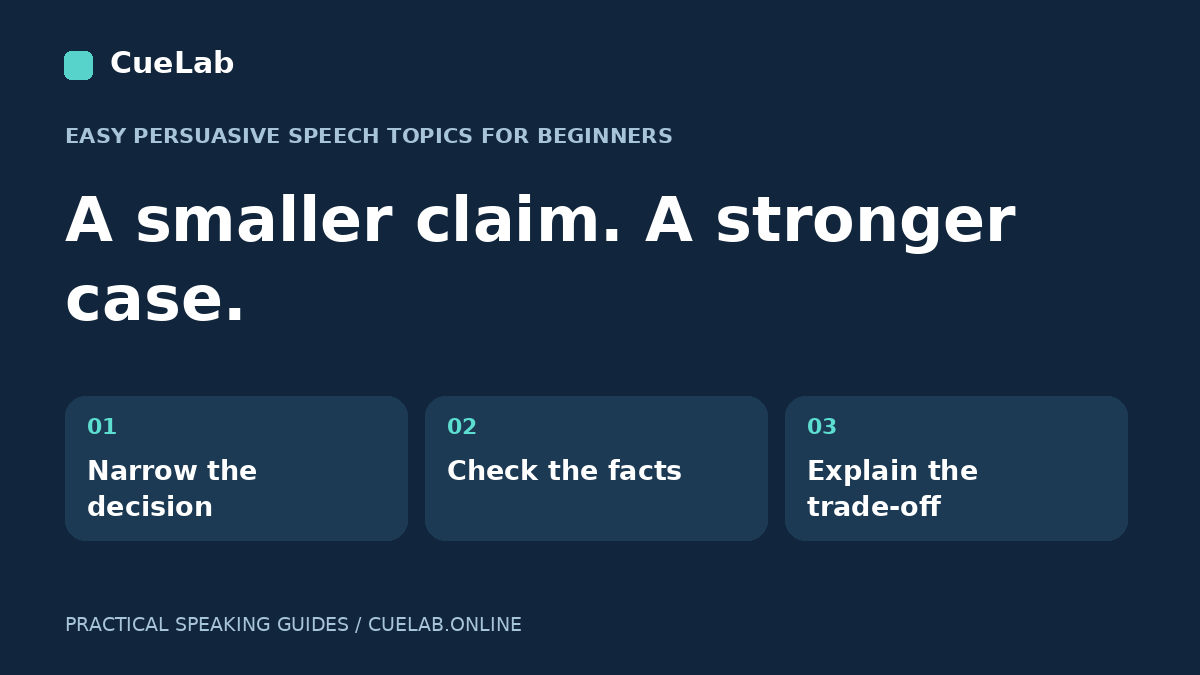
Easy persuasive speech topics are small enough to research and clear enough to explain to someone who has not studied the subject. A manageable topic gives you one decision to argue for, a few relevant facts to check, and an objection you can answer fairly. It does not remove the need for evidence or turn a personal preference into a proven fact.
If this is your first persuasive speech, start with an everyday change you understand: a clearer meeting invitation, a better notice, or a more useful way to share a project decision. The 20 ideas below are designed for that kind of focused argument. Use the selection method and worked outline to choose a topic you can support within your actual preparation time.
What makes a topic easy to argue well?
A topic is easier when its boundaries are clear and the audience does not need a long technical introduction. You can spend your speaking time explaining why the change is worthwhile instead of defining a whole field. “Every meeting invitation should state its purpose” is more manageable than “Organizations need better communication.”
Ease also depends on your access to material. If you already have permission to inspect a club’s event notice, you may be able to analyze it carefully. A topic involving national law, medical outcomes, or complex economic predictions demands a different level of research. Do not choose it simply because the title sounds familiar.
A narrow claim still needs a fair objection
If nobody could reasonably disagree with your claim, you may have chosen a general value rather than a persuasive position. “People should be considerate” has little to debate. “Organizers should publish a finish time for informal events” introduces questions about flexibility, changing plans, and how much detail an invitation needs.
Your interest is a starting point, not the evidence
Personal experience can help you notice a problem and explain why it matters. It cannot tell you how common the problem is or whether your solution will work for everyone. Separate what you experienced, what a source establishes, and what you are proposing as a reasonable next step.
Five topics about clearer everyday communication
| Position to consider | A manageable evidence route | Keep this limitation in view |
|---|---|---|
| 1. Meeting invitations should state the purpose and expected preparation. | Compare fictional before-and-after invitations and check an organization’s meeting guidance. | Urgent informal conversations may not need a formal invitation. |
| 2. Shared project decisions should be recorded in one agreed place. | Map a sample decision across a chat, email, and document; identify where the final version lives. | The agreed record still needs someone to maintain it. |
| 3. Event notices should include an expected finish time. | Review several public notices and explain which planning questions a finish time answers. | Some events need an estimate rather than an exact promise. |
| 4. Instructions should name the action before adding background detail. | Use an original example and compare the order in two versions. | Some unfamiliar tasks need context before the instruction makes sense. |
| 5. Non-urgent group messages should make the required response clear. | Rewrite a fictional message so the recipient can see whether to reply, attend, or simply read. | Not every social conversation needs a task-oriented format. |
Five topics about useful information design
These topics let you bring an example the audience can inspect. The example demonstrates a design choice; it does not automatically prove a universal improvement. Explain what someone needs to do with the information, then show how the proposed format supports that particular task.
| Position to consider | A manageable evidence route | Keep this limitation in view |
|---|---|---|
| 6. Short how-to guides should show the finished result near the start. | Build two original guide pages and compare what a beginner can identify before starting. | A suspense-based story has a different purpose from an instruction sheet. |
| 7. A presentation handout should include a useful next step. | Compare a copied slide deck with an original action summary. | Some handouts exist as reference material rather than an action plan. |
| 8. Charts used in short talks should identify the key comparison clearly. | Draw a simple chart and show the effect of an accurate descriptive annotation. | An annotation must not hide data that weakens the speaker’s case. |
| 9. Public event maps should highlight the places visitors actually need. | Inspect a published map and make a clearly labeled sample alternative. | A simplified map can omit details some visitors need. |
| 10. Shared documents should display a meaningful version date. | Use fictional documents to show how readers distinguish a current copy from an older one. | A date alone does not prove the content was reviewed or is accurate. |
Five topics about fairer shared activities
| Position to consider | A manageable evidence route | Keep this limitation in view |
|---|---|---|
| 11. Volunteer requests should state the task and likely time commitment. | Compare a vague appeal with a specific sample role description. | Some roles change when the event begins. |
| 12. Clubs should publish equipment costs before people sign up. | Check available club information and ask an authorized organizer what can be estimated. | Costs can change, so uncertainty must be visible. |
| 13. Group games should explain the rules before competitive play starts. | Use a simple original game and identify the decisions a new player needs to understand. | A trial round may teach some games better than a long explanation. |
| 14. Community events should give newcomers a clear contact point. | Review the visitor information and identify who can answer practical questions. | A contact person needs availability and a defined role. |
| 15. Shared resources should have an agreed borrowing and return method. | Develop a sample sign-out process and compare its work with the problem it addresses. | The process should not be more burdensome than borrowing the item. |
Five topics about small, testable improvements
A short trial can be a sensible proposal when the effect of a change is uncertain. You still need a reason to expect the trial to be useful, a person responsible, and a way to decide what happens afterward. “Try it and see” is incomplete if nobody knows what they are looking for.
| Position to consider | A manageable evidence route | Keep this limitation in view |
|---|---|---|
| 16. Try reusable sign holders at recurring small events. | Compare actual purchase cost, storage needs, and likely reuse before making an environmental claim. | Items that are rarely reused may not justify their cost. |
| 17. Put a brief return checklist inside a shared equipment case. | List the actual contents and demonstrate a check with a fictional or approved kit. | The list must change when the equipment changes. |
| 18. Add a final decision summary to a recurring team meeting. | Design an original summary showing the decision, owner, and next check. | A summary is useful only if it accurately reflects what was agreed. |
| 19. Label a shared shelf by use before buying more storage. | Inspect the permitted space and compare two simple layouts. | A layout change cannot solve a genuine shortage of space. |
| 20. Offer a short feedback question after a small workshop. | Write one question linked to the workshop’s purpose and explain how an organizer could use it. | A few responses cannot establish what every attendee learned. |
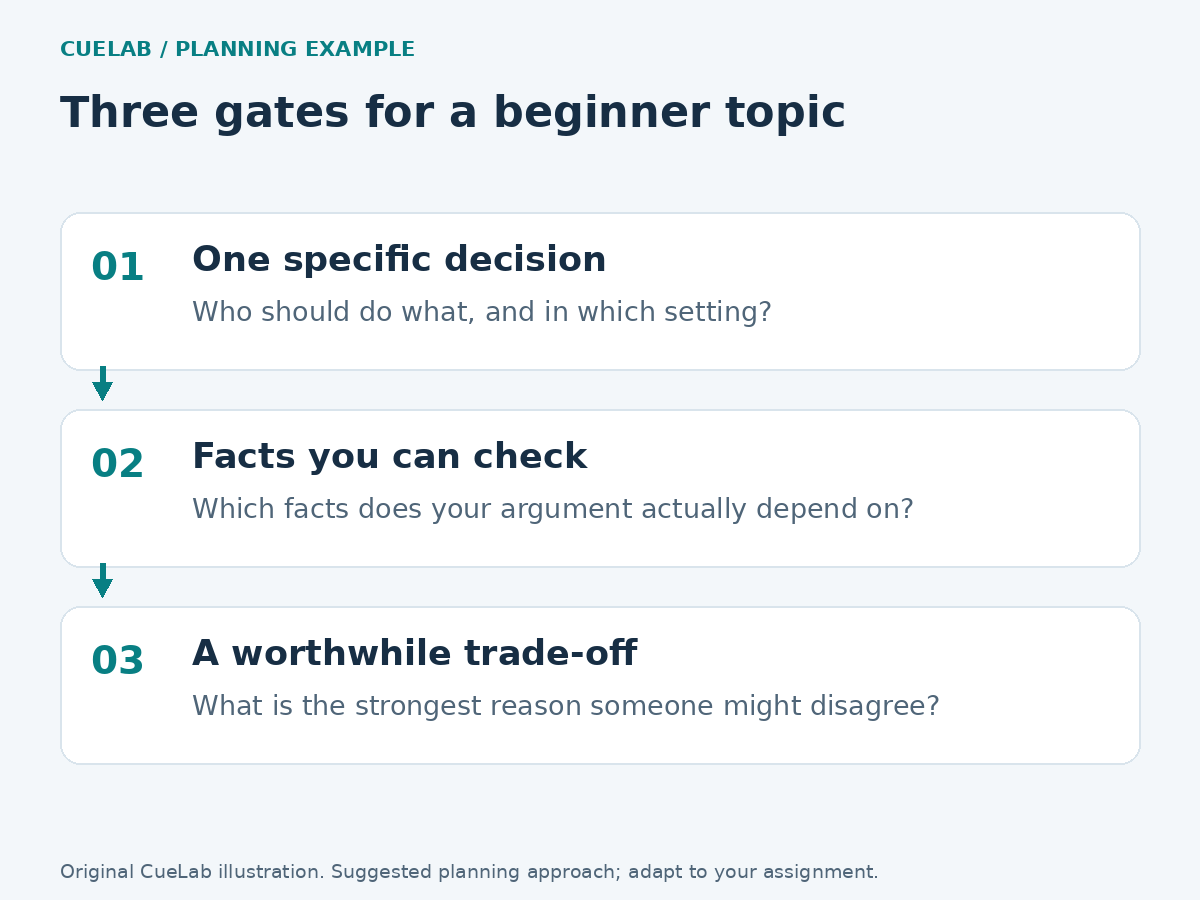
Use three gates to choose your topic
Gate one: can you state a single decision?
Write the actor, action, and context in one sentence: “The workshop organizer should include an expected finish time in the invitation.” If you need “and” several times, split the idea. The audience should be able to explain what you want without summarizing an entire reform program.
Gate two: can you check the necessary facts?
List the facts your case depends on before searching. For a reusable sign-holder proposal, those might be cost, storage, and frequency of use. If you cannot obtain them, choose another claim or present a narrower question. Do not fill the gap with an unrelated statistic because it makes the slide look researched.
Gate three: is there a worthwhile choice to make?
Identify the strongest reason to keep the current arrangement. Perhaps a new format needs maintenance, a trial needs staff time, or a rule reduces flexibility. If you can explain both the benefit and that cost within the assignment time, the topic has enough substance for a short persuasive speech.
Worked outline: every meeting invitation needs a purpose
This is an original practice outline for a short speech to a student club or small volunteer group. It uses fictional messages to illustrate the problem. Replace those examples with permitted real material only when you can describe it accurately and without exposing private information.
Start with a comparison listeners can see
Show two invitations. The first says, “Meeting on Thursday at four.” The second adds, “Choose the two activities for next month’s event; bring one suggestion and its approximate cost.” Explain that the second invitation gives people a clearer basis for deciding how to prepare. It does not guarantee that the meeting itself will be productive.
State the proposal before developing the reasons
Your claim could be: “Our club should include the purpose and expected preparation in every planned decision-making meeting invitation.” This keeps the case away from casual conversations and emergency discussions. You can then argue for the two details rather than defend a complicated new meeting policy.
Develop two reasons with suitable support
The first reason is that attendees need to know what the meeting is intended to achieve. Use the paired examples to show how an invitation can distinguish a decision from a general update. The second reason is that any requested preparation should be visible in advance. A published local meeting guide or an organizer’s permitted explanation can support that practical expectation.
After each piece of support, explain the connection to your claim. Do not jump from “this invitation is vague” to “vague invitations waste a fixed number of hours.” The first statement can be shown in your example; the second would need appropriate research and a clear explanation of its limits.
Answer the strongest objection
A reasonable objection is that writing longer invitations creates more work. Propose two short fields rather than a lengthy form: “Purpose” and “Preparation.” Acknowledge that the organizer still needs to think through those fields. Your case is that this small preparation step is worth considering for meetings where people are expected to contribute to a decision.
Close with a realistic next step
Ask the group to try the format for its next two planned meetings, then ask the organizer and attendees whether the information was useful. Do not promise that a tiny informal trial will prove a universal productivity benefit. It can help this group decide whether to keep, revise, or stop its own format.
Find evidence without making the task bigger
Use the source that directly answers the question your argument raises. A public event notice can establish what information is present; an official manual can explain a procedure; a price quote can establish a current cost. A broad article about communication may give context, but it cannot substitute for checking the particular detail your proposal depends on.
Keep a short evidence log with the claim, the source, its date, and the limitation. For a live speech, also note how you will identify the source aloud. “The organizer’s published guidance says…” gives listeners more useful context than announcing an unnamed “study” that you have not actually read.
A simple preparation session for a beginner
Start by narrowing the claim and identifying the audience’s decision. Gather the material that supports your main reason, then actively look for the objection that could weaken it. Write a rough outline before drafting a polished introduction, so you can see whether the argument works without an impressive opening.
Once the case is clear, rehearse aloud from short notes and record the full time. If you run long, remove a secondary point or narrow the example. Speaking faster makes a weakly bounded topic harder for the audience to follow and gives you less room to explain the objection fairly.
Check whether your argument is doing too much
Highlight every promise in the draft. Words such as “will,” “always,” “eliminate,” and “everyone” deserve a second look because they may claim more than your evidence establishes. Change the promise only if the original statement is unsupported, not merely to make the language sound cautious.
Then ask a listener to repeat the proposed action and name one condition under which it might not work. If they cannot identify either, simplify the claim and make its boundaries more visible. A clear limited argument is easier to assess than an enthusiastic speech with an uncertain destination.
Pick the topic you can support, then make it yours
Select the idea for which you have the best access to relevant material and a real interest in the decision. Write one original example, one fair objection, and one action the audience could realistically take. That gives you a useful foundation for your first persuasive speech without requiring a huge issue or a dramatic claim.
Continue with CueLab’s guide to presenting a recommendation without overselling it and opening-to-closing structure guide.
Reference: University of Minnesota, Communication in Practice: Choosing a Topic. The topic bank, selection gates, and worked outline above are original CueLab teaching material.