How to Use Vocal Variety Without Sounding Theatrical

You listen to a recording of your presentation and hear a voice that seems flatter than the one you use in conversation. Trying to fix it, you raise your volume, stretch important words, and add dramatic pauses. The second recording has more movement, but it sounds like someone performing a speech rather than explaining an idea.
Useful vocal variety follows meaning. A contrast should be audible as a contrast; an important condition should not disappear inside a rushed sentence; a completed thought should give listeners a moment to settle. You can create those differences within your ordinary speaking voice. This guide offers a practical way to mark, rehearse, and evaluate them without turning every sentence into a performance.
Start with what you want the listener to notice
The first question is not whether your voice moves enough. It is whether listeners can hear the structure of your explanation. Which idea is new? Which two options are being compared? Which word changes the instruction? Where does one thought finish and the next begin?
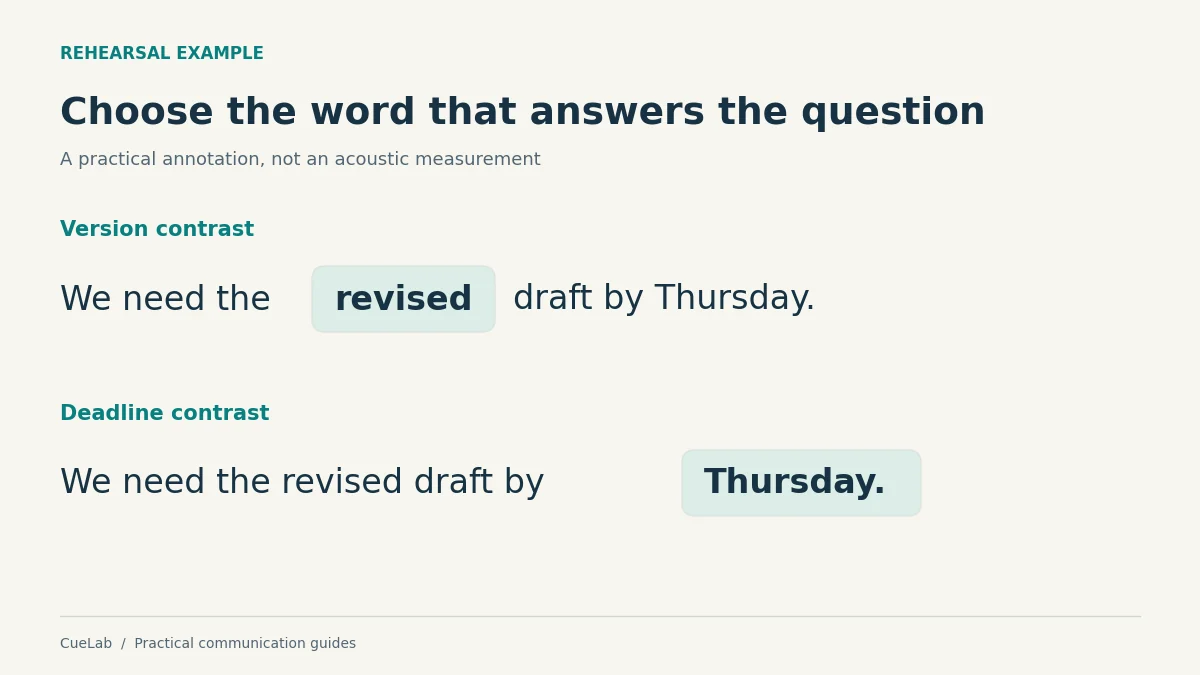
Take the sentence, “We need the revised draft by Thursday.” If the disputed issue is the document version, “revised” deserves attention. If the deadline has moved, “Thursday” carries the news. Emphasizing both equally, along with “need” and “draft,” makes the sentence busy without clarifying its purpose.
Before rehearsing, write a short note beside each paragraph: explain, compare, caution, invite, or decide. These are intentions, not mandatory tones. They help you choose a delivery that belongs to the content instead of attaching random excitement to it.
Toastmasters’ Your Speaking Voice manual describes vocal variety through changes in pitch, volume, and timing. Those are useful controls to recognize, but they are not a checklist that every sentence must complete. For everyday presentations, a small change at the right place can be enough.
Hear the difference between emphasis and loudness
A word can stand out because it is slightly longer, more clearly articulated, placed after a short pause, or spoken with a change in pitch. Increasing volume is one option among several. If loudness becomes the only tool, a talk can sound confrontational even when the subject is routine.
Try saying, “The delay is in approval, not delivery.” First, speak it in your usual conversational voice. Then make the contrast easier to hear by giving “approval” and “delivery” a little more space. Do not increase the overall volume. The point is to make the distinction accessible, not to make the entire sentence forceful.
Next, try “The delay is in approval, but only for new suppliers.” The phrase “only for new suppliers” limits the claim. It deserves clear delivery even though it is not the main headline. A common presentation error is to emphasize the attractive conclusion and swallow the qualification that makes it accurate.
Four controls, with a practical job for each
| Control | Useful job | What to watch for |
|---|---|---|
| Pitch movement | Make a contrast or a new thought easier to hear. | Repeating the same rise and fall on every sentence. |
| Pace | Give a difficult condition or unfamiliar term enough room. | Rushing the evidence to reach a polished conclusion. |
| Volume | Maintain audibility and support modest emphasis. | Shouting for authority or fading at sentence endings. |
| Pause placement | Separate units of meaning or allow inspection of a visual. | Pausing so often that the sentence becomes hard to connect. |
These controls work together. A slightly slower phrase with clear articulation may provide all the emphasis you need. Adding a large pitch jump, a volume increase, and a long silence at the same time can draw attention to your delivery rather than to the message.
Choose the smallest change that helps a listener. There is no requirement to sound like a broadcaster, adopt a different accent, or force your voice into a lower register. Audibility and understandable meaning are more useful goals than copying someone else’s vocal identity.
Mark a paragraph without scripting every sound
Use three simple marks in your practice notes: underline one key phrase, put a slash between thought groups, and write a brief intention in the margin. Avoid a page covered in arrows and performance directions. Too much notation can pull your attention away from the person you are addressing.
Here is an original practice paragraph: “We can finish the pilot this month, provided the test accounts arrive by Tuesday. The design work is complete. The remaining uncertainty is access, so I need one person to own that request.”
Mark “provided” and the Tuesday condition as one meaningful unit. Separate the completed design work from the remaining uncertainty. Give the ownership request a clear ending. You do not need to change character between sentences; you need the listener to hear a condition, a fact, and an action.
Now put the notes down and explain the same message to an imagined colleague who has just joined the project. Your wording may change slightly. That is acceptable if the condition remains precise. This exercise connects vocal movement to explanation rather than to reciting a fixed sequence of sounds.
Use contrast where the argument contains contrast
Presentations often compare a current process with a proposed one, a forecast with a result, or an assumption with new evidence. These are natural places for vocal variety because the content already contains a change. You are helping the audience hear that change.
Suppose you say, “Last week, we were estimating the cost. This week, we have supplier quotations.” The difference between estimating and having quotations is more important than the fact that one sentence starts with “last week.” Put attention on the change in the quality of information.
If every sentence receives the same emphatic ending, the contrast disappears into a repeated tune. Listen for that pattern in your recording. It may sound polished for thirty seconds and tiring over a longer explanation because listeners cannot tell which changes actually matter.
One useful rehearsal is to speak the paragraph with no deliberate emphasis, then add attention to just one contrast. Compare the recordings for clarity. The better version is the one that makes the distinction easier to report afterward, not necessarily the one that sounds more energetic.
Vary pace at the level of meaning
A familiar setup can move at a comfortable conversational pace. A technical distinction, an unfamiliar name, or a consequential exception may need more room. That does not mean dragging out individual syllables. Often the better change is a clean boundary before the difficult phrase and a complete ending afterward.
For example, “The total increased by twelve percent” is incomplete unless the audience knows what total and what comparison. Deliver the comparison as part of the claim: “The total number of resolved tickets increased by twelve percent compared with the previous week.” If you need to shorten it, revise the wording instead of racing through the missing context.
A single words-per-minute target cannot tell you whether this passage is clear. A number-heavy explanation and a familiar story place different demands on a listener. Time your talk to fit the slot, but assess the difficult passages through listener understanding.
If speed is the main problem across your whole talk, start with CueLab’s guide to slowing down when you speak too fast. Vocal variety is easier to work on when you are not trying to fit too much content into too little time.
Let pauses finish a thought
A pause is useful when it gives the audience something to do: consider a contrast, inspect a figure, or recognize that you have finished an explanation. A pause inserted only to sound confident can feel disconnected from the sentence around it.
Read this aloud: “Before you approve the change, check the renewal date.” The natural boundary after “change” separates the condition from the action. A pause after every two or three words breaks that relationship and makes the instruction harder to hold together.
When showing a visual, complete the orientation before becoming silent. “Look at the final column, which shows the renewal date” gives the pause a purpose. A sudden silence while you stare at the screen leaves listeners guessing whether they should read, answer, or wait.
For more detailed practice, see using pauses without making a speech feel awkward. The goal is a complete explanation with useful space, not a collection of dramatic stops.
Keep sentence endings audible
Some speakers start each sentence strongly and let the final few words disappear. That is especially costly when the ending contains a date, exception, or request. Record a passage from the distance and with the microphone setup you plan to use, then listen specifically to those endings.
Do not compensate by forcing a louder voice. First shorten sentences that contain too many clauses and check the microphone position. A sentence you can say comfortably is easier to finish clearly than one that requires an extra explanation after you have already run out of space.
W3C’s accessible-presentation guidance recommends clear speech, suitable microphone use, and time to process information. In practice, this means an expressive delivery still has to remain audible and understandable. A whispered aside may feel effective to you while being inaccessible to someone listening through a poor connection.
Adjust the rehearsal for a video call
Listen to a short recording made through the meeting setup, rather than judging only the sound you hear in the room. A headset microphone, a laptop microphone, and a noisy room can produce different results. Check a normal sentence, a quieter sentence, and a sentence with the emphasis you intend to use.
Make sure your head movements do not repeatedly take your mouth away from the microphone. If you turn to a second monitor to read notes, the sound may change for reasons unrelated to expression. Fix the setup before treating the recording as evidence that your voice is inadequate.
On a call, a brief verbal signpost can also do work that facial expression might have done in person. “Here is the condition that changes the recommendation” prepares listeners for the point. You can then deliver it calmly instead of trying to communicate its importance through volume alone.
A twelve-minute practice session
Choose a paragraph you actually need to present. Spend two minutes identifying its main point, contrast, and condition. Record an ordinary explanation for one minute, then listen once without judging whether you like the sound of your own voice. Write down where the meaning becomes difficult to follow.
Use the next three minutes to change just one issue. That might be a swallowed deadline, a rushed contrast, or an identical rhythm across three sentences. Record again. During the final five minutes, compare the versions and ask a listener to state the message and the required action.
Useful feedback is specific: “I heard the request but missed the Tuesday condition.” “Be more confident” is too vague to guide the next rehearsal. CueLab’s guide to giving actionable feedback explains how observations become a concrete next step.
If you are practicing alone, hide the script and summarize what the recording makes important. Check whether that matches your intention. You are not measuring charisma; you are checking whether vocal choices and content are pointing in the same direction.
Know when the delivery is doing too much
Reduce the performance if you hear exaggerated emphasis on ordinary words, a repeated dramatic drop at every sentence ending, or long pauses that interrupt straightforward instructions. Also watch for an energetic tone that makes an uncertain claim sound settled. The words and the delivery should agree about the strength of the evidence.
Return to a conversational baseline and restore only the changes that improve understanding. Sometimes the best revision is textual: a shorter sentence, a clearer contrast, or a more direct request. The guide to speaking clearly during a presentation covers that broader foundation.
Keep the final rehearsal simple. Say the passage to one person, with one clear purpose, and let the meaning determine the movement in your voice. When listeners can identify the point, hear the qualification, and know what to do next, the variety is serving its purpose.
Further reading
Toastmasters International: Your Speaking Voice
The sample sentences, annotation method, and twelve-minute exercise are original teaching examples. They are practical rehearsal suggestions, not a clinical voice assessment or a validated scoring system.