24 Persuasive Speech Topics for College Students, with Evidence Prompts
Useful persuasive speech topics for college students make a claim that classmates can reasonably question. “Campus sustainability” is a subject; “Our department should trial a shared equipment shelf for one semester” is a proposal with an owner, a cost and a way to judge what happens. A focused claim gives you room to present evidence and answer a real objection within a short speech.
The 24 topics below are proposals to investigate, not positions that CueLab has already proved. Each includes a research direction and an objection worth taking seriously. You may conclude that a proposal needs to be narrowed, changed or rejected after looking at the evidence. That is better preparation than choosing a position first and collecting only material that agrees with it.
Write a claim with someone who can act on it
Start with a sentence naming an actor, an action and a boundary. For example: “The library should trial a reminder message before reserved rooms are released, for four weeks.” That is more workable than “Libraries should be better,” because listeners can ask whether the reminder is feasible, who receives it and what problem it is supposed to solve.
Check that your assignment permits a policy proposal. Some instructors want a claim about a fact or a judgment rather than a call for an institutional change. Also consider your audience’s authority. Your classmates may be able to change how their project group works, but they cannot personally approve a university budget. In that situation, ask them to support a specific request to the appropriate decision-maker.
Campus access and student services
| Proposed speech claim | Evidence to look for | Objection to answer |
|---|---|---|
| 1. The library should test reminders before releasing unused room bookings. | Current booking rules, no-show records that may lawfully be shared, and notification options. | Could reminders create more work without making rooms more available? |
| 2. A department should publish one clear route for reporting inaccessible teaching materials. | The existing process, responsibilities and authorized student feedback. | Who can resolve reports, and what response can realistically be promised? |
| 3. Campus events should publish access information before registration opens. | Venue information, event workflows and the details attendees need to plan. | What happens when arrangements change after publication? |
| 4. A student society should offer a low-cost participation option for one event series. | An actual or fictional event budget with the funding source stated. | How would the option be funded without reducing the event’s viability? |
Learning, assessment and academic work
| Proposed speech claim | Evidence to look for | Objection to answer |
|---|---|---|
| 5. A project group should agree on roles and handover dates before dividing the work. | The assignment milestones and a sample responsibility plan. | Could fixed roles prevent members from helping where they are needed? |
| 6. A course should show an annotated example before the first unfamiliar assignment. | The learning objective, assessment rules and an example the instructor may share. | Could students copy the example instead of making independent choices? |
| 7. Peer feedback should require one specific observation and one actionable suggestion. | Two original feedback examples and the task’s assessment criteria. | Would a required format make feedback mechanical or burdensome? |
| 8. Students should record uncertainties alongside answers in a collaborative revision sheet. | A sample sheet showing sources and unresolved questions. | Could an uncertainty note spread confusion when nobody checks the answer? |
Digital habits and information choices
| Proposed speech claim | Evidence to look for | Objection to answer |
|---|---|---|
| 9. A class group should keep final instructions in one maintained document. | A fictional chat sequence and a versioned instruction page. | Who keeps the document current, and how will changes reach everyone? |
| 10. Students should check the original source before sharing a surprising statistic. | A traceable example showing the source, population and measurement. | How can someone check a claim quickly without becoming an expert? |
| 11. A project team should agree which information may enter an AI service. | Current course rules, provider terms and fictional data examples. | Could a vague rule discourage useful permitted work while missing actual risks? |
| 12. Student organizations should use descriptive link text in their event announcements. | Two original announcements and relevant accessibility guidance. | What minimum change is practical for volunteer-run organizations? |
Resources and everyday campus systems
| Proposed speech claim | Evidence to look for | Objection to answer |
|---|---|---|
| 13. A department should trial a lending shelf for a small set of course materials. | Demand, ownership, storage, replacement costs and checkout responsibilities. | Who pays for damaged or missing items? |
| 14. A campus café should measure avoidable waste before changing portion options. | A safe, authorized measurement plan and a clear definition of waste. | Would measurement add cost or confuse unavoidable waste with poor planning? |
| 15. A society should choose reusable event materials only after comparing their whole planned use. | Purchase, washing, storage and expected reuse assumptions. | What if the items are used fewer times than the plan assumes? |
| 16. A student project should include a repair or reuse option in its purchasing brief. | Availability, suitability, warranty terms and the project’s constraints. | Could the option create delays or higher maintenance costs? |
Work, careers and group responsibility
| Proposed speech claim | Evidence to look for | Objection to answer |
|---|---|---|
| 17. A student organization should document the handover before its committee changes. | A sample role record, recurring deadlines and permission requirements. | How can documentation remain useful rather than becoming an abandoned folder? |
| 18. A career event should publish the format and preparation expectations in advance. | Organizer guidance and questions first-time attendees need answered. | How much detail can organizers know before participants are confirmed? |
| 19. A group should use a short decision log for choices affecting everyone’s work. | An original example with owner, reason and review date. | Would logging every minor choice slow the group down? |
| 20. Students should describe the limits of a class project when presenting it in a portfolio. | The actual contribution, evidence available and permissions to share it. | How can a student stay precise without making their work sound insignificant? |
Public discussion and community participation
| Proposed speech claim | Evidence to look for | Objection to answer |
|---|---|---|
| 21. A student debate should separate factual disagreements from value disagreements. | A worked example showing what evidence could settle and what remains a judgment. | Could sorting the claims consume the time needed to discuss them? |
| 22. A community survey should publish its sampling limits alongside its headline result. | The recruitment method, question wording and response counts. | Will the explanation be understandable to readers without statistical training? |
| 23. A public event should accept questions through more than one route. | The room setup, moderation resources and a plan for duplicate questions. | How can the moderator include remote or written questions fairly? |
| 24. A student campaign should state the smallest specific change it is asking for. | The relevant decision-maker, current rule and practical implementation path. | Could narrowing the request leave the main problem untouched? |
Test the objection before you build the argument
Choose the objection an informed listener would actually raise. For a lending shelf, that might be replacement costs, access rules or the volunteer time needed to manage it. It is unlikely to be “some people dislike sharing.” An objection that is too weak makes the proposal look easier than it is and leaves you unprepared for questions.
Write the opposing view in terms its supporter could recognize, then identify the part you can answer. You may be able to show a limited trial addresses uncertainty, while acknowledging that the full cost remains unknown. If the objection defeats the proposal under realistic conditions, change the proposal. The purpose of preparation is to improve your judgment, not to defend the first sentence you wrote.
A worked argument: a small lending shelf
Imagine a fictional department considering a lending shelf for basic presentation accessories. The proposal covers only a few low-cost items and one semester. It excludes expensive equipment and materials that need specialist maintenance. Naming those boundaries keeps the argument from silently expanding into a much larger service.
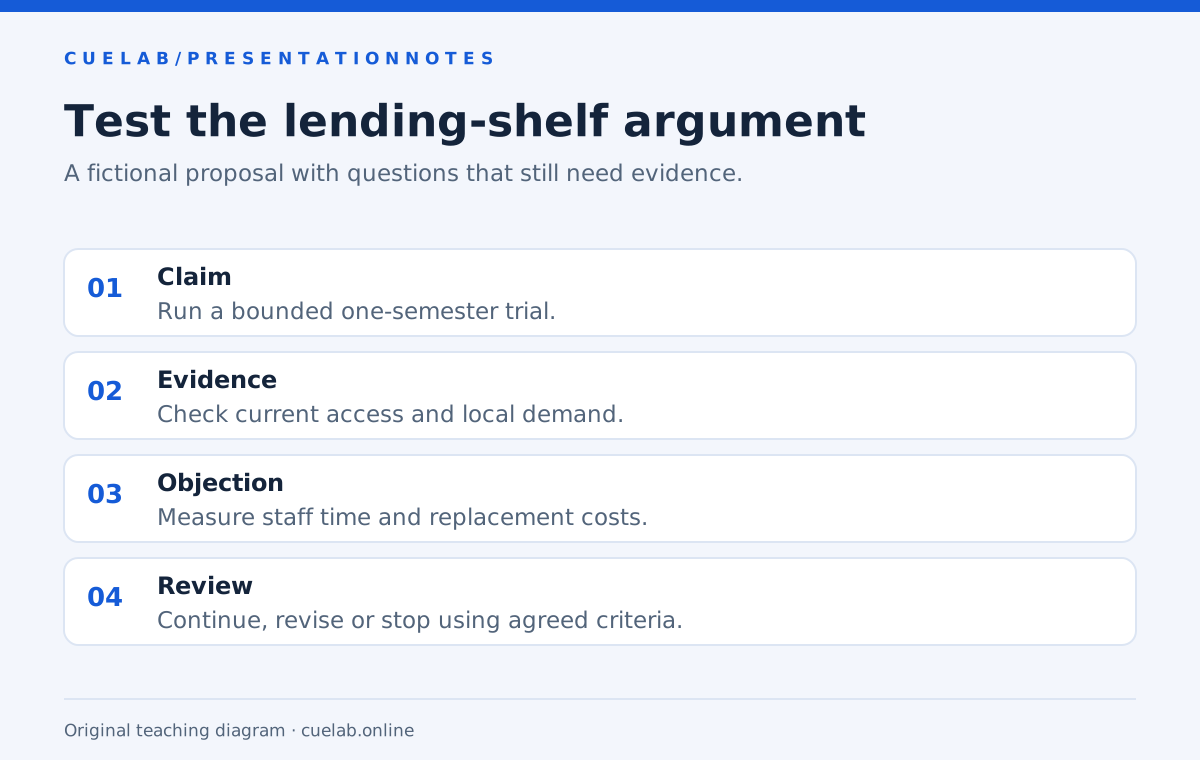
The claim might be: “The department should test a small lending shelf for one semester, with an identified owner and a fixed replacement budget.” The reason is that some students may need an item briefly and have no practical way to borrow it. That possibility needs evidence: check what is already available, what students actually request and whether the proposed items meet the need.
A persuasive speech should not invent survey percentages to make the problem sound urgent. If you do not have local demand data, say that demand is uncertain and make a small, authorized needs check part of the proposal. A few anecdotes may explain the situation, but they cannot establish the proportion of all students affected.
The strongest objection is that managing the shelf could cost more than it helps. Answer with an operational plan: an existing location, limited opening times, a checkout record that collects only necessary information, and a named person who may authorize replacements. Those details are proposed safeguards, not evidence that the service will succeed.
Define a review before the trial starts. The department could examine whether the items were used, whether they were returned, the staff time involved and which requests could not be met. Decide who reviews those records and which outcome would justify continuing, revising or stopping. Do not select a success threshold after seeing the results simply to make the trial look favorable.
A five-minute speech outline you can adapt
| Time | Purpose | Lending-shelf example |
|---|---|---|
| 0:00–0:35 | Introduce the problem and bounded claim. | Explain the short-term borrowing need and the proposed one-semester trial. |
| 0:35–1:35 | Present the best available evidence. | Show what is known about current access and state the missing demand information. |
| 1:35–2:35 | Explain how the proposal would work. | Items, owner, checkout process and replacement budget. |
| 2:35–3:40 | Address the strongest objection. | Show the management cost and the trial’s limits. |
| 3:40–4:30 | Make the action and review explicit. | Ask the appropriate decision-maker to approve or assess the limited trial. |
| 4:30–5:00 | Reserve space. | Allow a slower explanation or a brief question if the assignment permits it. |
These timings are a planning example. If questions count toward the five-minute limit, reserve their time explicitly. Use the Presentation Time Planner for the full session and the Words to Minutes calculator for the scripted portion. Then rehearse aloud; a listener needs time to understand a cost or an exception.
Use evidence without overstating what it says
Keep a claim-and-source sheet while preparing. For each important assertion, note the original source, date, population or setting, and the inference you are making. A study from another country or institution may help explain a mechanism, but it does not automatically tell you the size of the problem at your college. Separate that outside evidence from any local observations.
Represent numbers with their denominators and context. “Eight of twelve volunteers preferred the new form” says something different from “students prefer the new form.” If the volunteers were recruited through one society, that also matters. A carefully limited statement gives the audience a fair opportunity to evaluate the argument.
Avoid making medical, legal or financial claims from a topic list. If you choose a higher-stakes subject, use current authoritative sources and respect the limits of your assignment and knowledge. You can often make a more useful short speech by addressing a defined campus process than by trying to settle a broad national controversy.
Make the spoken argument sound like an explanation
Mark where listeners need a pause, particularly after the claim, a numerical comparison or an important limitation. If you practice with the online teleprompter, adjust the scroll to your delivery instead of racing to follow the text. Keep the final request short enough to say while looking at the audience.
Prepare for one question you cannot answer. A useful response identifies the missing information and explains whether it changes the recommendation. CueLab’s guide to handling questions you cannot answer offers a practical way to do that without inventing a fact.
Leave with a claim you would be willing to revise
Before rehearsing the final version, ask someone to challenge the proposal rather than simply praise the delivery. Give them the claim, the strongest evidence and the main cost. If they cannot tell what you want to change, tighten the request. If they can identify a serious unanswered objection, improve the research or reduce the proposal’s scope.
A credible persuasive speech makes its reasoning inspectable. The audience should understand the action, why you support it, what remains uncertain and what evidence could change your mind. That gives them something substantial to consider, even when they disagree with your recommendation.
Further reading: Persuasive Speaking, Stand up, Speak out — University of Minnesota Libraries. The topic prompts, lending-shelf case and timing plan on this page are original CueLab teaching examples.