20 Business Topics for a Presentation, with Decision Briefs
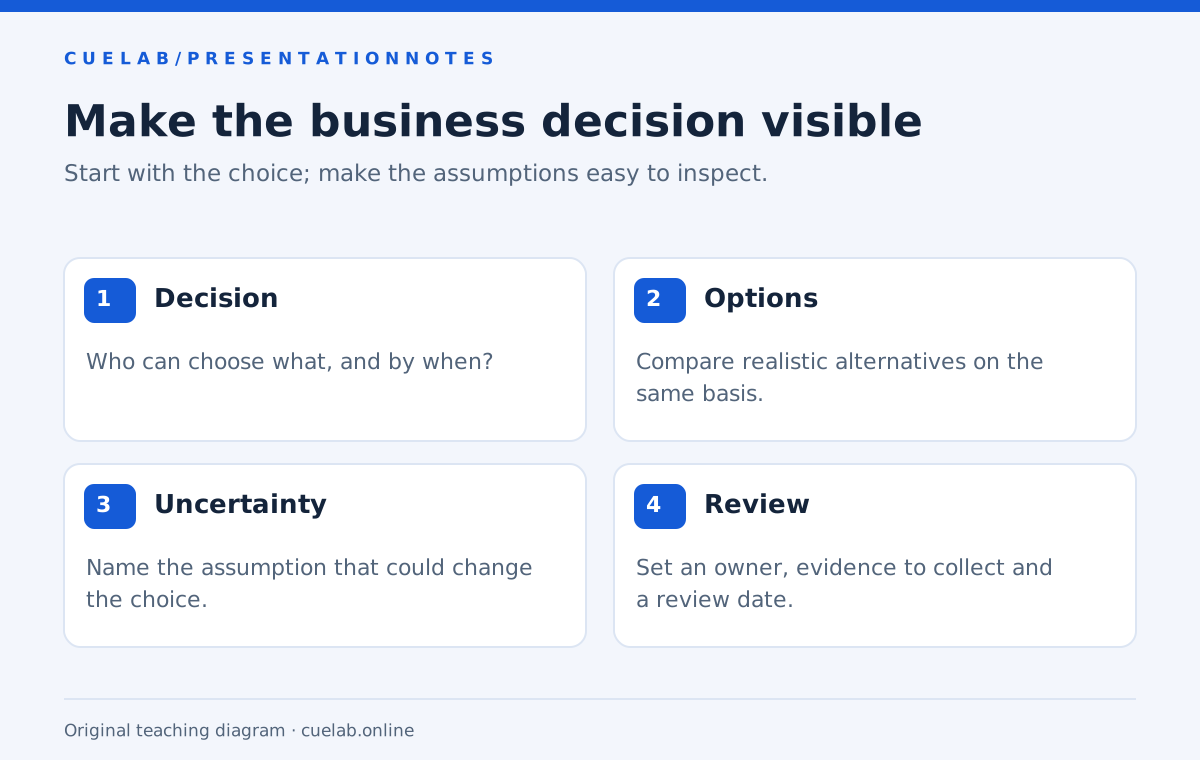
The most useful business topics for a presentation lead to a question the audience can answer. “Customer service” names a department. “Should we add a callback option during the lunch-hour queue?” identifies a decision, a group of people affected and the evidence needed to make a choice. For a classroom assignment, the same question can become a clearly labelled fictional case rather than a claim about a real company.
These 20 ideas cover customers, operations, money, people and technology. Some suit an explanatory presentation; others work as a proposal. Choose the purpose first, then use the suggested evidence to find out whether you can support the talk. A fashionable subject is not automatically a useful business question.
Decide what the audience can do with the presentation
A manager deciding whether to fund a trial needs different detail from classmates learning how a process works. Before choosing a topic, name the audience, the decision they control and the date by which they need an answer. If the presentation is informative, name the practical distinction they should understand instead. This prevents a ten-minute talk from becoming a general tour of an industry.
Also decide what information you may use. Internal customer records, employee information and commercial terms may be confidential. Use authorized, anonymized material where appropriate, or build a fictional case with assumptions visible on every relevant slide. Do not make a fictional company look like a real client, and do not describe a proposed improvement as a result already achieved.
Customer questions that can produce a useful discussion
1. Should a support team offer callbacks during its busiest period?
Compare the current queue with a limited callback trial. Useful evidence includes arrival patterns, handling time, missed callbacks and the number of people actually waiting. Explain who would own the callback and what happens when a customer cannot be reached.
2. Which information belongs on the first screen of a product page?
Present two original layouts for the same product and explain the task each serves. Use actual customer questions or a stated research plan. A cleaner design is a proposal; it is not proof of higher sales without appropriate measurement.
3. Where does a customer handover lose context?
Map the journey from an initial inquiry to the next team. Show which information must travel with the request, which team confirms ownership and where the customer receives an update. Keep individual customer details out of the slides.
4. What should a small customer feedback form measure?
Choose one decision the feedback will inform, then compare questions that measure different things. A question about satisfaction does not directly measure whether a task was completed. Show how you would interpret an answer before asking people to supply it.
Operations topics with visible trade-offs
5. Would a shared handover checklist reduce avoidable rework?
Define rework before proposing the checklist. Show a fictional request moving through two teams, then identify the information that would have prevented a return. Include the time needed to maintain the checklist, not just the hoped-for benefit.
6. Should stock be reordered on a fixed day or at a threshold?
Use one product, a transparent demand example and a stated delivery lead time. Compare what triggers an order under each method. Discuss storage limits and uncertain demand without suggesting that a simple classroom model is a full inventory policy.
7. Which part of a delivery promise needs a buffer?
Separate processing, dispatch and transport stages. A timeline can reveal where a delay accumulates and who can respond to it. Distinguish an average completion time from a promise to an individual customer.
8. Should recurring meetings become a written update plus an exception meeting?
Compare the decisions made in the meeting with the information merely reported there. Include preparation and reading time in your comparison. A shorter calendar entry is not automatically less total work.
Money topics that make assumptions inspectable
9. What does a proposed discount do to contribution per sale?
Use a fictional selling price, variable cost and discount. Show the arithmetic and the extra sales required under your assumptions. Do not equate revenue growth with profit growth or assume customer demand will respond as predicted.
10. Should equipment be rented for a short project or purchased?
Compare the same period and required capability in both options. Include delivery, maintenance, staff training and any resale assumption. Mark uncertain figures so the audience can see which estimate could change the recommendation.
11. Why can a profitable order create a cash timing problem?
Follow a fictional order through customer payment, supplier payment and completion dates. A dated cash timeline explains a different question from a profit statement. Keep the talk focused on the example rather than offering personal investment advice.
12. Which cost should determine whether a small pilot continues?
Separate the cost already incurred from the additional cost of continuing. Include the operational capacity the pilot consumes and the evidence the next stage would produce. State what would cause you to stop.
People and coordination
13. What should a new colleague be able to do after the first week?
Start with a small set of observable tasks and work backward to onboarding material. Explain who checks understanding and where the new colleague can ask for help. Completion of a document is different from successful completion of a task.
14. How should a team document a decision made in a chat?
Show an original example containing a decision, its reason, an owner and a review date. Compare it with a long conversation that leaves those details implicit. Address how colleagues who missed the discussion will find the result.
15. When does a task need an owner, a reviewer and a backup?
Choose one routine process and show what each role does. Discuss the delay added by review as well as the problem it is meant to catch. Avoid turning a simple workflow into an elaborate hierarchy.
16. How can a team hand over work across different working hours?
Build a timeline around one fictional request. Identify the information the next person needs to continue without waiting for a reply. Include a route for urgent exceptions and a clear definition of what counts as urgent.
Technology choices with a defined task
17. Which part of a repetitive report should be automated first?
Separate data collection, checking, calculation and commentary. Choose one step for a trial and explain how errors would be detected. Include maintenance and manual fallback rather than treating automation as a one-time installation.
18. What information should an AI assistant be allowed to handle?
Use fictional examples to distinguish public material from confidential records. Check the current provider terms and your organization’s rules before describing a real tool. The presentation can compare a decision process without claiming that a service is secure or compliant.
19. Should two teams share a dashboard or receive different views?
Start with the decisions each team makes. Show a common metric with the definitions, time window and owner visible. Explain where a combined view helps coordination and where it hides the detail one team needs.
20. When is a spreadsheet sufficient for a small workflow?
Compare the current task with requirements such as simultaneous editing, permissions, history and error checking. Define the point at which the workflow should be reviewed. Avoid recommending a new system simply because it has more features.
Turn the topic into a one-page decision brief
Before opening presentation software, write the decision at the top of a page. Under it, record the current situation, the realistic options, the evidence you have and the evidence missing. Add the person who can act on the recommendation. If you cannot identify that person or group, the proposed decision may sit outside the audience’s authority.
Then state the strongest reason the preferred option could fail. This is not a ritual “cons” slide; it tells the audience which assumption deserves attention. A callback trial, for example, could fail because the team cannot reliably make calls at the promised time. A presentation that counts only the shorter queue would miss a potentially important customer problem.
Worked example: should a team change its handover process?
The following case is entirely fictional. A small support team handles 100 requests in a week, and 12 are returned because the handover lacks information. In this example, each return requires 15 minutes of extra work. That produces 180 minutes, or three hours, of rework. These figures illustrate a calculation; they are not a benchmark for support teams.
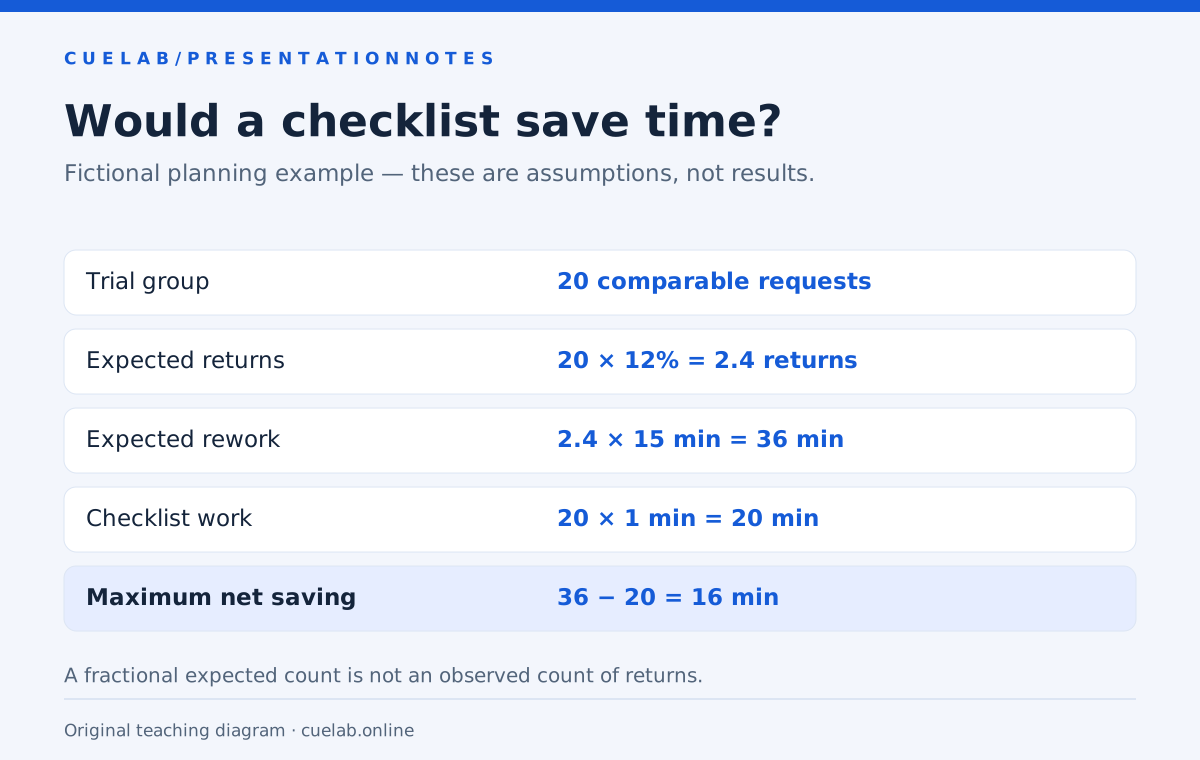
The proposal is to test a short checklist on 20 comparable requests. Completing it is assumed to take one minute per request, so the trial adds 20 minutes of documentation. Suppose the baseline rate would predict 2.4 returns among 20 requests. That fractional value is an expectation used for planning, not an observed number of actual returns.
At 15 minutes per return, the expected baseline rework for that group is 36 minutes. If the checklist prevented all of it, the net saving under these assumptions would be only 16 minutes: 36 minus 20. In reality, the checklist may prevent some returns, miss others, or reveal that the original definition of rework was too broad. Showing that arithmetic makes the proposal more useful than promising a large efficiency gain.
| What the decision needs | What the fictional presenter would show |
|---|---|
| A consistent baseline | What counts as a missing-information return, over a stated period. |
| A comparison | Comparable requests handled with the current process and the trial process. |
| Time costs | Both time spent completing the checklist and time spent correcting returns. |
| A customer check | Whether the handover becomes slower or produces repeated questions. |
| A next decision | Continue, revise or stop the trial after reviewing the evidence. |
For a real trial, agree on the observation period and comparison method with the process owner. A small sample can be useful for finding confusing checklist fields, but it may not support a precise estimate of long-term savings. Record unusual cases and changes in workload, because those can affect the comparison.
Shape a seven-minute talk around the choice
One workable allocation is 45 seconds for the decision and current problem, 75 seconds for the baseline, 90 seconds for the options, 90 seconds for costs and uncertainty, 60 seconds for the proposed trial and 60 seconds for questions or recovery. That totals seven minutes. Change the allocation to suit the meeting; a team that already knows the problem may need more time on the options.
Use the Presentation Time Planner to reserve questions before expanding the script. If you have written the explanation out, the Words to Minutes calculator can estimate the spoken portion. Rehearse any chart or calculation separately, because explaining the assumptions often takes longer than reading the numbers.
Show the comparison the audience actually needs
Keep units and periods consistent across options. A monthly software subscription and a one-off setup fee can be compared over a defined period, but placing them beside each other without that period creates a misleading impression. Show a range when an assumption is uncertain and identify the value at which the preferred choice changes.
If the comparison is numerical, choose between a table and a chart according to what listeners need to inspect. A table may suit a small set of exact costs; a chart may help reveal a pattern over time. Neither format repairs a weak definition or an unsupported estimate.
Leave the room with a decision someone owns
The final slide should state the proposed action, who would carry it out, what evidence would be collected and when the choice would be reviewed. If the evidence is insufficient, the action may be to gather one missing fact rather than approve the proposal. That is still a useful result from a business presentation.
For a college business class, make the same closing explicit: “Given these fictional assumptions, I recommend this limited trial.” For a workplace meeting, connect the recommendation to the audience’s real authority and constraints. CueLab’s guide to presenting a recommendation without overselling explains how to make that boundary clear.
Further reading: Preparing Your Presentation — University of Waterloo, on defining objectives and considering the audience. The business questions, decision brief and numerical case above are original CueLab examples.