Assertive Communication Techniques: Six Ways to Make a Clear Request
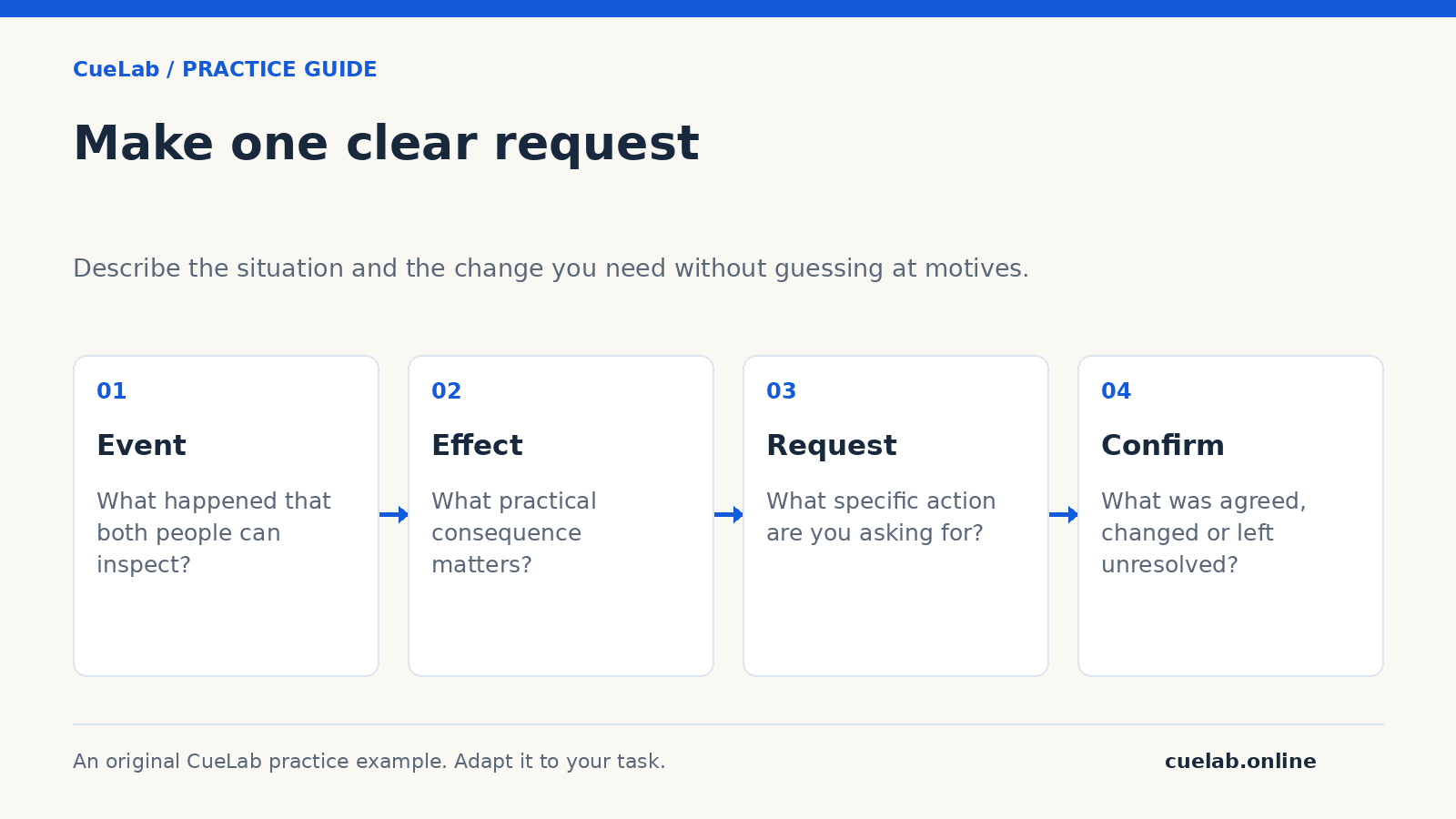
Assertive communication techniques help you state a view, request or boundary clearly while recognising that the other person also has choices and needs. Assertiveness does not mean winning every exchange, speaking without hesitation or making someone agree. A clear request can receive a reasonable “no.”
The examples below concern everyday planning and study situations. They are original rehearsal cases, not scripts that guarantee a particular response. Where an exchange involves intimidation or a serious power imbalance, choose an appropriate support or reporting route rather than treat better wording as the whole solution.
1. Describe the event before judging the person
Begin with an observable situation. “The review copy arrived after the meeting started” identifies an event. “You never respect my time” assigns a broad motive and invites a different argument. The event provides something both people can examine, including the possibility that your account is incomplete.
Add the effect relevant to the conversation: “I could not include your changes in the version we discussed.” Avoid turning an effect into a hidden accusation, such as “I feel that you are lazy.” That sentence begins with “I” but still judges the other person’s character.
2. Make one specific request
A request should make the possible action visible. “Communicate better” leaves the receiver guessing. “Please mark the file as a draft until the dates are checked” names a change that can be discussed. If the timing matters, include it and explain the reason.
Keep the first request small enough to answer. A message that combines a deadline dispute, an old disagreement and a request to change someone’s entire working style may make the immediate issue harder to resolve. You can discuss the broader pattern after establishing the next action.
3. State a boundary without inventing a punishment
A boundary describes what you can or cannot do. “I cannot review a complete report tonight. I can check the summary tomorrow morning” is clearer than agreeing and hoping the problem disappears. Offer an alternative only when you can actually provide it.
Do not describe an attempt to control another person as your boundary. “You must reply to every message immediately” is a demand about their behaviour. A practical agreement might instead specify an urgent channel and realistic response expectations. If the other person cannot meet a requirement, decide what arrangement is workable.
4. Acknowledge a concern without withdrawing your point
Acknowledgement can show that you heard a constraint: “I understand that the venue confirmation arrived late.” It does not require pretending that the missed handoff had no effect. You can continue, “I still need the final location before I can approve the invitation.”
This is useful when two accounts can both be true. The other person faced a delay, and your task depends on the missing information. State both without competing to decide whose difficulty matters more. Then discuss the next action or the authority needed to change the plan.
5. Repeat the core request when the conversation drifts
If the exchange moves into unrelated accusations, briefly return to the practical issue. “The point I need to settle is which version can be sent today.” Repetition should clarify the request, not become a way to ignore a relevant objection. If the objection changes what is possible, respond to it.
When the conversation is no longer productive, suggest a pause, a written summary or an appropriate third person. Endless repetition does not guarantee resolution. Choose a next step that fits the relationship and the consequences of the disagreement.
6. Confirm what was agreed
At the end, state the action, person and timing in neutral words. “I will revise the summary, and you will check the dates before noon. We will keep the full report as a draft until then.” Ask the other person to correct that account if it differs from their understanding.
If agreement was not reached, record the unresolved issue accurately. Do not turn an acknowledgement into consent. A respectful exchange can clarify disagreement and the next decision route without producing an immediate compromise.
Four original examples to rehearse
| Situation | A clear response | What to check next |
|---|---|---|
| A classmate asks you to complete their assigned section | “I can help you understand the brief, but I cannot write your section. Which part is unclear?” | Whether help is being requested within the group agreement. |
| A deadline changes after your work is scheduled | “I can deliver the summary today. The full version needs another day. Which output is required for the meeting?” | The actual priority and who may change the scope. |
| You are interrupted repeatedly in a planning discussion | “I have one condition to add before we decide. May I finish it, then hear your response?” | Whether the group’s turn-taking arrangement needs repair. |
| A colleague asks for an immediate answer to an unclear request | “I need to check the file before confirming. I can reply at 2.” | Whether that timing meets the real need. |
Read each example aloud and change it to fit your own vocabulary. A phrase that looks polished on a page may sound unnatural in your setting. Keep the event, request and next step clear while adapting the tone and level of formality.
Use a short rehearsal to test clarity
Write the situation without a personality label. Add the effect, your request, one relevant constraint and the response you need to clarify. Ask a practice partner to state what they think you are asking for. If they identify a different action, revise the wording.
Assess the practice by whether the request is understandable and realistic, not by whether your partner performs instant agreement. Leave room for questions, alternative arrangements and refusal. Assertiveness is a communication choice; it does not remove differences in responsibility, authority or available resources.
Common questions
What is the difference between assertive and aggressive communication?
Assertive communication states a position or request while recognising another person’s agency. Aggressive behaviour may threaten, demean or pressure them. Volume or confidence alone does not settle the distinction.
Do I always need an “I feel” sentence?
No. Personal statements can help explain your experience, but practical messages can also state a task, constraint or request directly. Avoid using an “I” phrase to disguise a character judgement.
Can assertive communication be written?
Yes. A written message can name the event, effect, request and next step. Review whether it contains enough context and whether a conversation is needed to resolve ambiguity.
Related guides: interpersonal response examples; a constructive feedback rubric.