How to Start a Debate Speech: Openings for Both Sides
Learning how to start a debate speech begins with knowing your job in the debate. Your opening should establish your side, make the disputed question clear, and show how your argument will develop. A greeting can be brief; the useful work starts when listeners understand what you are defending or challenging.
The examples below use a classroom motion about individual reflections in group projects. They are original practice openings for both sides, not transcripts from a real competition or evidence that a school adopted the policy. Check your teacher’s or organizer’s format before using them, because speaker roles, definitions, interruptions, and time limits differ between debate formats.
Identify your role before drafting the first sentence
A first proposition speaker may need to establish the meaning and scope of the motion as well as begin the case. A first opposition speaker also needs to engage with what the proposition actually presented. Later speakers usually enter a debate that already has a history, so repeating a generic introduction can waste time they need for response and development.
The English-Speaking Union’s student guidance treats a clear definition as important to a productive debate. Use that principle to ask what the audience needs to know before assessing your argument. Follow the particular format’s instructions rather than treating a sample opening as a universal set of competition rules.
Give the opening five practical jobs
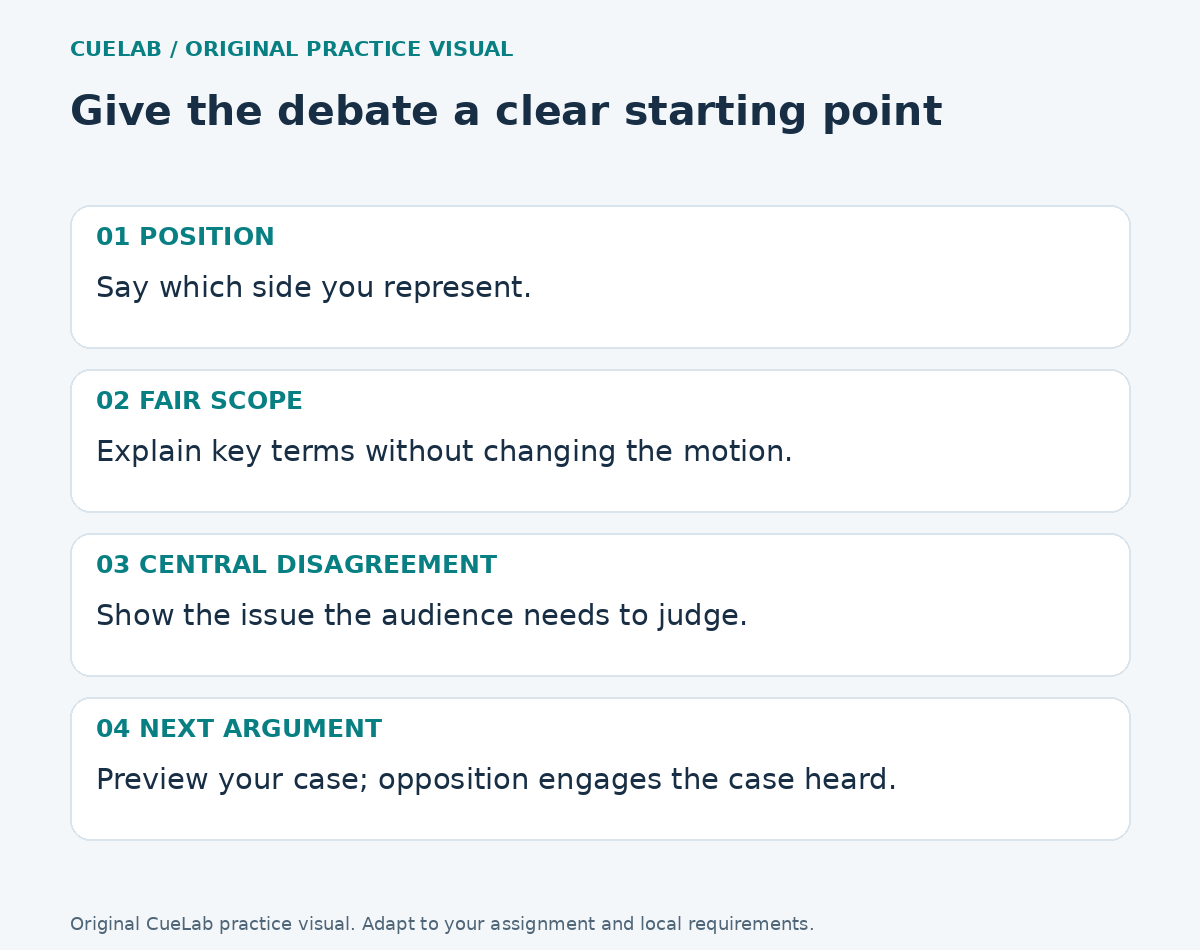
A useful first-speaker opening normally needs to identify the audience appropriately, state the side’s position, clarify the relevant scope, reveal the central disagreement, and preview the route into the case. Those jobs can fit into a short passage. They do not require five ceremonial paragraphs.
Write the position and the disagreement first, then add only the greeting and context the setting needs. If the first minute could be delivered unchanged in a debate on any subject, it is probably not yet helping the audience understand this motion. Replace general remarks about the value of debating with material that belongs to the question in front of you.
Use a short, appropriate greeting
“Chair, judges, and fellow speakers” is one possible classroom greeting when those people are present. Another setting may call for a different form of address or no formal greeting at all. Confirm titles and names where they matter, and avoid inventing a long list of dignitaries to make the opening sound important.
After the greeting, move into the debate. You can sound respectful without repeatedly thanking the chair, the organizers, your opponents, and the audience before stating your position. If the event requires a specific salutation, use it accurately and keep the rest of the introduction focused.
Worked motion: reflections in school group projects
The practice motion is: “This house would require each member of a school group project to submit a short individual reflection.” The examples assume a classroom exercise where teams explain and assess a proposed policy. They do not describe the rules of every school debate or any actual assessment scheme.
The proposition needs a clear account of what “short individual reflection” means in its proposal. The opposition needs to decide whether it accepts that interpretation and then address the case presented. Both sides should distinguish a reasoned argument from an empirical claim that would require evidence.
A first proposition opening
“Chair, judges, and fellow speakers, we support requiring a short individual reflection alongside a school group project. In our proposal, each student answers the same brief prompts about their own contribution, one decision they helped make, and what they would change next time. The reflection supplements the shared output rather than replacing it.
“The central question is whether the finished group product gives the teacher enough information about each student’s reasoning. We argue that a focused reflection can add relevant information while preserving the collaborative task. I will explain that information gap and why the proposed prompts address it. My teammate will examine the workload and how the requirement could be implemented fairly.”
The opening states the position, defines the proposed activity, identifies a question the case must answer, and divides the work between speakers. The next section still needs to support the argument. The opening has not proved that reflections produce better learning or more accurate assessment merely by describing the proposal.
A first opposition opening
“Chair, judges, and fellow speakers, we oppose making this reflection compulsory for every group project. We agree that a teacher needs a fair understanding of each student’s contribution. Our disagreement is about whether a separate reflection is the right requirement in every case.
“The proposition has argued that the reflection adds information about individual reasoning. We will ask how useful that self-reported information is, what additional workload the requirement creates, and whether a check-in or short discussion could address the same need. I will examine the information claim and the alternatives. My teammate will consider implementation and explain why the case does not yet justify a blanket requirement.”
This paired example responds to the argument made in the proposition sample. In a live debate, adapt it to what the other side actually says. Do not accuse an opponent of supporting a blanket rule, a particular assessment method, or a factual claim that they have not proposed.
Show what each part contributes
Breaking down an opening can help you revise it without memorizing the whole passage. Look for the function of each sentence rather than copying its wording. The same motion can support different cases, and your opening should fit the case your team can actually defend.
| Opening component | Question it answers | Check |
|---|---|---|
| Position | Which side are you taking? | Can a listener identify it immediately? |
| Scope or model | What exactly does the proposal include? | Is the interpretation fair and consistent with the format? |
| Central disagreement | What must the debate resolve? | Does it distinguish the teams’ actual positions? |
| Case preview | How will your side support its position? | Do the promised arguments appear later? |
| Team division | Who will explain which part? | Have teammates agreed that division? |
Choose an opening approach that fits the motion
You can begin directly with the position, with a question that reveals the disagreement, or with a brief hypothetical situation. The choice should make the motion easier to assess. An unrelated joke or an impressive quotation can consume time without establishing any useful part of the case.
Begin with the decision
“This debate asks whether the school should require an extra individual reflection for every group project. We support a limited, clearly defined requirement because…” This approach is useful when the audience needs orientation more than surprise. Complete the sentence with a reason you will develop and support.
Begin with the central question
“How should a teacher understand an individual’s contribution to a product created by several people?” Follow the question with the motion and your answer. Do not leave the audience to guess whether you support the proposed reflection, prefer another method, or simply want to discuss group work generally.
Begin with an explicitly hypothetical situation
“Imagine two groups submit equally polished displays, but the teacher still needs to understand the decisions each student made.” This can illustrate an information problem without inventing an incident. State that the situation is imagined, then connect it to the actual policy being debated.
Define what changes the argument
Not every word in the motion needs a dictionary definition. Focus on terms whose interpretation affects what the teams must prove, such as whether the requirement applies to every project, what the reflection contains, or how it relates to existing assessment. A definition should make fair engagement possible rather than remove the difficult part of the motion.
If you are on opposition and believe the definition is unfair, follow the format’s procedure for challenging it. Otherwise, engage with the proposal as defined instead of spending the whole opening on a minor wording dispute. Ask your teacher or coach how definition challenges work in the particular exercise.
Respond to the strongest relevant point
An opposition opening becomes more useful when it identifies the part of the proposition’s case that matters to the decision. In the paired example, that is the claim about information on individual reasoning. Responding only to an incidental phrase would leave the main case untouched.
Write a brief note of what the opposing speaker actually claimed before choosing your response. Distinguish agreement about the goal from disagreement about the proposed method. That allows the debate to develop around a real difference rather than an exaggerated version of the other side.
Keep evidence out of the realm of invention
A statistic, quotation, or study should appear only when you can identify and represent its source accurately. Do not attach an invented percentage to the reflection example or claim that research proves a policy works when you have not checked the underlying finding. An opening can establish a clear issue without using a dramatic number.
When preparation rules allow research, plan where the evidence will enter the main argument and how you will attribute it. When the exercise restricts outside research, follow those rules and distinguish reasoning or hypothetical examples from factual evidence. The purpose is to make the case assessable, not to imitate the appearance of a researched speech.
Move from the opening into an argument
The final opening sentence should give you somewhere specific to go. For proposition, that might be: “Our first argument concerns what the finished product leaves invisible.” For opposition, it might be: “First, we need to distinguish a student’s description of their work from evidence of that work.”
Then develop the point rather than announcing another preview. Explain the claim, show its support, and connect it to the motion. If you cannot continue after the introductory wording, your team may have written an opening before deciding what the case actually contains.
Cut ceremony before cutting clarity
Time the opening within the complete speech and use the organizer’s limit. There is no single opening duration that suits every debate format. If it takes too much of the available time, remove repeated greetings, general observations about debate, and previews of points you will not develop.
Keep the information listeners need to understand the case. Removing the scope of a policy to preserve an elaborate quotation usually makes the argument harder to assess. Rehearse the shortened version aloud to check that the opening still leads naturally into the first point.
Practise with a changed motion
Try the same opening functions with a different classroom motion, such as whether a club should rotate its meeting chair. State the position, define only what matters, identify the disagreement, and preview the case. If your wording remains almost identical apart from the subject, make it more specific.
Next, ask a practice listener to summarize your side’s position and name the question separating the teams. Revise any part they could not identify, then practise responding to a slightly different opposing case. Prepared structure should support listening and adaptation rather than force every debate into the same memorized speech.
Test the opening with a listener’s summary
Read only the opening to a practice partner, then ask them to state your position, the meaning of the key terms, and the question your case will answer. Give them the motion as well, so they can notice a definition that changes the task. If the summary differs from your intention, revise the unclear phrase before making the language more dramatic.
For opposition practice, let the partner deliver a short proposition opening first. Write a response to what they actually said, including one point of agreement and one important disagreement where appropriate. This helps prevent a memorized opposition introduction from answering an argument the other side never made.
Prepare the case behind the first paragraph
Use the teen persuasive-topic prompts to explore arguable classroom questions, the cue-card guide to preserve the route through your case, and the rehearsal timer for a complete timed run.
Reference: English-Speaking Union: Debating Guidance for Students. The group-project motion, paired openings, and revision exercises are original CueLab illustrations.