Extemporaneous Speech Outline: From Preparation to Cue Cards

An extemporaneous speech outline gives you a prepared route through a talk while leaving room to choose the wording as you speak. You decide what the audience needs to understand, develop and check the supporting material, and practise the explanation. The notes then remind you of that work rather than becoming a script you must reproduce perfectly.
This guide shows how to build the outline, reduce it to usable cue cards, and rehearse without memorizing every sentence. It includes an original classroom example about handing a project to another group member. If you are entering a competitive extemporaneous speaking event, check its rules separately: research access, preparation time, speaking time, note use, and question formats can differ between organizers.
What makes the outline extemporaneous?
The important distinction is between preparing the message and fixing every spoken sentence. In the extemporaneous delivery method described in the University of Minnesota’s communication text, the speaker establishes the structure and main ideas beforehand while developing much of the phrasing during delivery. This is compatible with careful research and repeated practice; it does not mean arriving with a topic and hoping an argument appears.
You may keep an exact definition, quotation, technical term, or short opening line in your notes when accuracy requires it. What matters is that the whole talk does not depend on recalling one uninterrupted string of words. If a listener asks for clarification or you need to explain an example differently, the underlying route remains available.
Build the answer before building the cards
Write the question your speech answers and the answer you intend to develop. “Project handovers” is too loose to guide a short talk, while “What does a teammate need to continue a project after someone leaves?” creates a useful planning problem. A possible answer is that the handover needs a clear account of the current state, an actionable next step, and a reliable route to the materials.
At this stage, test the answer instead of searching for an elegant opening. Are those three parts genuinely distinct? Does the audience need background information before the first point? If the question asks for an evaluation, a list of features may not answer it; if it asks for an explanation, an enthusiastic recommendation may leave the mechanism unexplained.
An extemporaneous speech outline you can adapt
| Outline field | Write during preparation | Keep in the speaking notes |
|---|---|---|
| Question and answer | The precise task and your central response. | A short reminder of the destination. |
| Opening | A relevant situation, the audience’s reason to care, and any necessary context. | The starting image or question, plus wording that must be exact. |
| First point | A complete claim, its support, and what that support establishes. | A meaningful prompt, key evidence, and source details. |
| Connection | Why the next idea follows from this one. | A few words that preserve the relationship. |
| Further points | The remaining explanation or argument, without repeating the first point. | Prompts that distinguish the sections at a glance. |
| Limits | What the evidence does not establish, or where the example stops applying. | Any qualification the listener must hear. |
| Ending | A synthesis that answers the original question. | The final destination and an optional closing line. |
The number of main points follows the task, not the size of the card. Three are convenient for the example below, but a short comparison might need two and a longer explanation may require more. If you keep adding sections because you found more interesting material, return to the question and decide what actually belongs.
Worked outline: a handover another teammate can use
The following scenario is hypothetical. A four-person student group is preparing an exhibition, and one member needs to hand over an unfinished display board. The speech explains a possible handover method; it does not report measured improvements in group performance or pretend that a real student team was observed.
Question: What information helps the next person continue unfinished work without guessing?
Central answer: Describe the current state, name the next action, and identify the materials needed to take it.
Opening: show the missing information
Start with a message that sounds complete until someone tries to use it: “The board is nearly done; the files are in the folder.” Ask what the next teammate still needs to know. The phrase “nearly done” does not distinguish approved text from draft text, and “the folder” may be obvious only to the person who created it.
Use that situation to introduce the three-part answer. You do not need to invent a dramatic failure, a lost mark, or an argument between teammates. The uncertainty in the message already gives the explanation a practical purpose.
Point one: describe the current state
Separate what is finished, what is provisional, and what has not started. In the classroom model, the images have been selected, the captions are drafted, and the final layout is still awaiting a size check. This lets the next person see which decisions are already settled and which ones can still change.
A useful illustration is a short status note with those three categories. If you use an actual project, verify the status with its owner rather than assuming the newest-looking file has been approved. The point concerns the information a handover needs, not a particular project-management product.
Point two: name the next action
Replace “finish the board” with an action the recipient can recognize and complete. For example, “Check the caption lengths against the printed panel size, then flag any caption that will not fit.” The task becomes clearer when its owner, expected output, and any real deadline are agreed rather than implied.
This is the place to explain the difference between a vague outcome and a usable instruction. You can vary the wording during delivery while keeping that distinction fixed. The supporting example should stay consistent with the scenario established in the opening.
Point three: make the materials findable
Identify the working file, the relevant version, and any permissions or background information the next action requires. A handover that names a task but points to an inaccessible file has not supplied everything needed to begin. In the exhibition example, the note can identify the approved-image folder and the current caption document without exposing private files to the class.
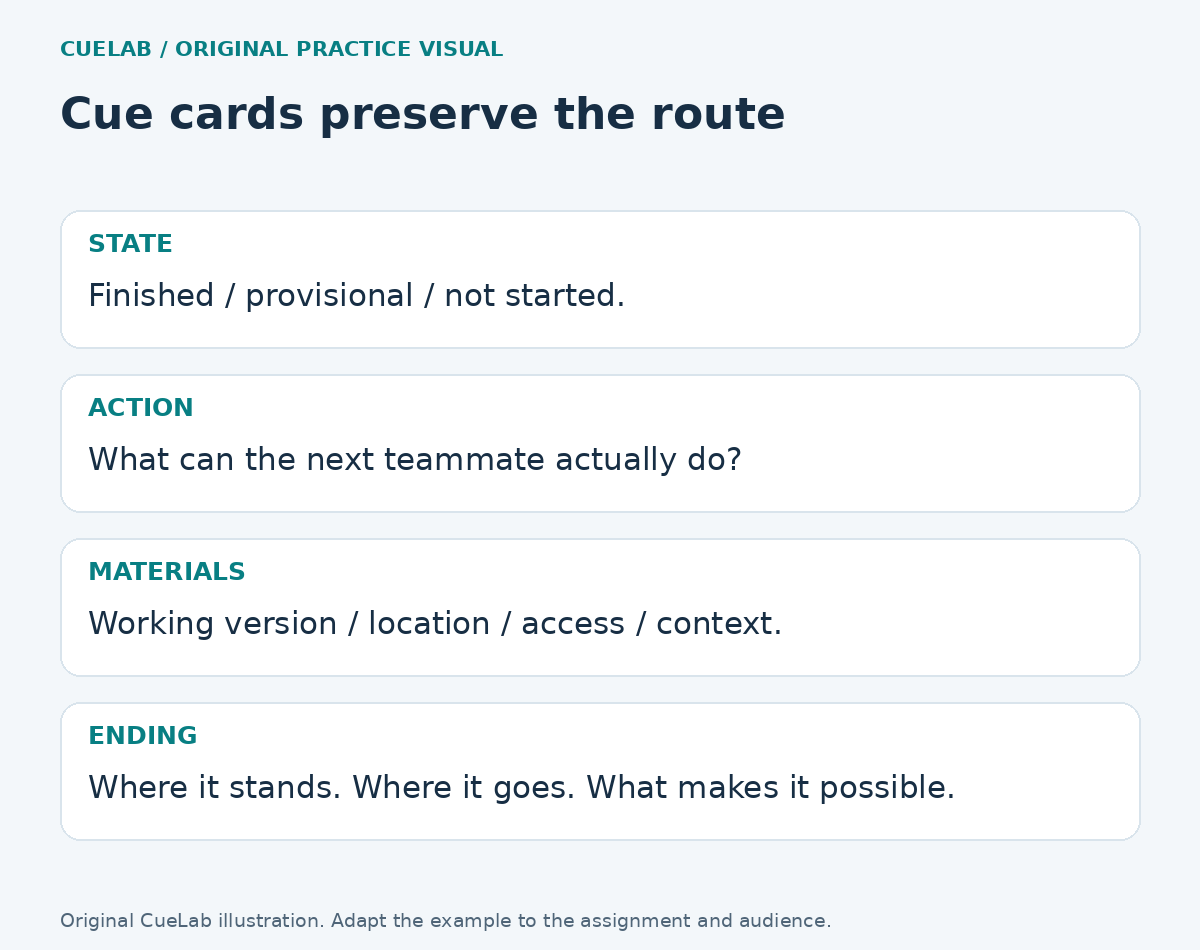
Close the section by connecting the parts: the status describes where the work stands, the next action says where it goes, and the materials make that action possible. These relationships are more useful to retain than an exact paragraph of polished language.
Reduce the explanation without removing its meaning
A weak cue card might contain only “status, action, files.” Those words are short, but they may be too general to trigger the actual explanation when you are under pressure. A stronger card carries the distinction you need to express, along with any precise detail you are likely to lose.
| Card | Useful prompt | Detail worth preserving |
|---|---|---|
| Opening | “Nearly done” message: what is missing? | Question: what lets someone continue without guessing? |
| State | Finished / provisional / not started. | Images selected; captions drafted; size check pending. Illustrative only. |
| Action | Outcome becomes a task someone can complete. | Check caption length against panel size; agree who does it. |
| Materials | Can the next person actually begin? | Working version, file location, access, necessary context. |
| Ending | Where it stands / where it goes / what makes it possible. | Return to the vague message and improve it. |
Use whatever note format you can handle comfortably and that the assignment permits. Number separate cards, leave space between prompts, and make exact evidence easy to find. If your notes contain quoted material, preserve the quotation and attribution accurately rather than improvising a version that merely sounds similar.
Test the notes in the position you will use, including any lectern, handheld cards, or screen. A card that is readable at a desk may be awkward when held farther away, and a digital note may be difficult to navigate during a live explanation. If an access need affects how you use notes, discuss an appropriate arrangement with the instructor or organizer early instead of treating a particular card size as compulsory.
Two possible deliveries from the same point
Consider the second point, about naming the next action. One rehearsal might sound like this:
“Saying ‘finish the board’ tells your teammate the destination, but it doesn’t tell them where to begin. In our example, the immediate job is checking whether the draft captions fit the printed panel. Name that check, agree who owns it, and say what should happen if a caption is too long.”
A later rehearsal can explain the same idea in different words:
“The next person needs an action they can actually take. For this display, that means comparing the caption length with the available panel space. The handover should identify that task and its owner, instead of leaving the teammate to discover what ‘nearly done’ means.”
Neither version is a required script. Both retain the claim, the example, and the practical implication. If a change in wording alters the task, removes an important qualification, or introduces a new unsupported claim, it is no longer just a harmless variation in delivery.
Rehearse the route in more than one order
First explain the talk from beginning to end so you can hear whether the structure works. On a later pass, start at the second main point, or explain the ending before returning to the opening. This practice checks whether you understand the sections independently instead of relying on the previous sentence to trigger the next one.
Keep the content stable while trying natural variations in phrasing. You do not need to replace every word on every rehearsal, and a useful transition may remain almost unchanged. The aim is to become less dependent on exact recall while staying responsible for the accuracy and order of the explanation.
Give evidence a protected place in your notes
Flexible wording does not make figures, names, dates, quotations, or causal claims flexible. Record those details precisely, check them against the source, and plan enough attribution for listeners to understand what is being claimed. Where a source reports uncertainty or a limited population, keep that boundary with the finding.
The handover model above is a practical illustration, so it does not require imaginary statistics to look credible. If your assignment requires research, use real evidence suited to your actual subject rather than attaching unrelated figures to the model. Distinguish what the source found from your own interpretation or proposed application.
Recover by finding the next idea
If you lose your place, pause and look for the section prompt rather than trying to reconstruct the missing sentence. A brief return to the main question can also restore the route: “The next piece of the handover is the action someone needs to take.” That is usually easier to follow than a long explanation of why you forgot a line.
If time is running short, use a cut you identified during rehearsal. You might shorten an illustrative detail while preserving the central distinction and ending. Do not quietly remove a qualification that changes the meaning of the evidence just because it occupies a few seconds.
Test the outline with a listener
Ask someone to state the main answer and explain one connection between the points. Then ask which part felt unsupported or difficult to follow. This gives you more useful revision information than asking only whether you appeared confident, because a smooth delivery can still conceal an incomplete explanation.
Revise the card where the problem occurred, rehearse that section, and run the whole speech once more under the real time limit. You are ready when the notes support an accurate explanation even when the wording changes. Perfectly identical performances are not the goal of this delivery method.
Continue with a focused practice run
Use the rehearsal timer for a complete run, and the pause-marking exercise if transitions become rushed. For a task with almost no preparation time, the impromptu speech examples provide a separate practice approach.
Reference: University of Minnesota, Communication in Practice: Delivery Modes. The project scenario, sample wording, and cue-card exercises above are original CueLab practice material.