6 Elevator Pitch Examples for College Students, with Revision Notes

Useful elevator pitch examples for college students show how a short introduction can open a real conversation. The listener needs enough context to understand what you are studying, what you can discuss or contribute, and why you approached them. A pitch becomes harder to answer when it tries to compress an entire résumé into one breath.
The six examples below cover a first career fair, a class project, volunteering, a change of direction, a research enquiry, and a virtual employer session. All names, projects, and experiences are fictional illustrations. Use the structure to identify your own relevant experience, and replace every detail with something you can explain honestly if the listener asks about it.
Give the pitch a conversational destination
Before drafting, decide what you want this particular conversation to accomplish. You might want to learn whether an organization offers early-year placements, understand how a team uses a skill you are developing, or ask about the preparation needed for a research role. Those are different purposes and should not all compete inside the same introduction.
Princeton’s career guidance describes the elevator pitch as a short professional introduction, commonly around 30–60 seconds, and emphasizes adapting it to the person and setting. Treat that range as a planning reference rather than a target you must fill. A busy recruiter may invite only a brief introduction, while a quiet information session may leave room for a fuller exchange.
Example 1: a first-year student without an internship
This example is for an early conversation at a career fair. The student has not held a professional role and therefore uses a real learning activity as the basis for a specific question. There is no need to apologize for being at the beginning of a degree.
“I’m Maya, a first-year business student exploring how operations teams organize day-to-day work. In a class exercise, I helped map the steps in a student-club registration process, and I enjoyed finding where instructions became unclear. I’m still building my experience, so I’m here to understand what entry-level work in your team actually involves. Which kinds of projects help an early-year student prepare for that work?”
The useful detail is the student’s contribution to a defined exercise. “Helped map the steps” is more informative than “I’m passionate about business,” and it does not inflate classroom work into professional consulting. The final question gives the listener a manageable way to respond even if no internship is currently available.
Example 2: an engineering student describing a team project
A group project can provide good material, but the pitch needs to distinguish the team’s output from the speaker’s own contribution. This version identifies both, while making the student’s current level of experience clear.
“I’m Omar, a mechanical engineering student interested in product testing. Our design class built a small adjustable stand, and my part was documenting the test setup and comparing what changed between prototypes. That made me want to learn more about how engineers decide whether a test is reliable enough to guide a design change. I noticed your team works on physical products. What do you usually expect a student intern to understand before joining a test project?”
The student can now answer follow-up questions about the setup, the comparison, and the limits of the exercise. The wording makes no claim that the prototype was commercially successful or that a classroom test met an industry standard. It also connects the example to a relevant feature of the organization that the student would need to verify beforehand.
Example 3: a humanities student using volunteer experience
Relevant evidence does not have to come from a job with the same title as the one you want. The connection is stronger when you explain a task you performed and why it led to your present interest.
“I’m Leena, studying history and looking at work that involves explaining information to the public. As a library volunteer, I helped turn event details into short visitor notices, including checking which information people needed first. I liked the editing decisions involved more than I expected. I’m interested in how your communications team develops clear public-facing material. Could you tell me what kinds of writing samples are most useful when students apply?”
This pitch develops a specific bridge between volunteering and communications work. It avoids assuming that every history student has the same skills, and it does not claim that a few notices amount to a professional portfolio. The question can lead to a practical next step: choosing appropriate samples or learning which tasks to practise.
Example 4: a student changing academic direction
A change of direction is easier to explain when the listener can see what prompted it and what you are doing next. You do not need a long account of why an earlier subject was wrong for you, particularly at a first meeting.
“My name’s Daniel. I began in accounting and am now taking information-systems courses because I became interested in the tools behind reporting workflows. In a recent class project, I organized a small dataset and documented the checks I used before building a summary. I’m looking for opportunities where I can keep developing those practical data skills. How does your team divide work between business understanding and technical preparation for junior roles?”
The student’s earlier study becomes relevant context without dominating the introduction. The current project offers something concrete to discuss, and the question acknowledges that the student is still learning how the field works. Before using this approach, make sure you can explain the actual checks or tools you mention rather than relying on broad technical labels.
Example 5: asking a faculty member about research work
A faculty enquiry benefits from a clear connection to the person’s actual work. Read the relevant project description first, choose a question you genuinely have, and avoid presenting a vague interest in “research” as though every laboratory or research group does the same thing.
“I’m Sara, a second-year psychology student. Your project description about how people interpret visual information connects with a methods topic I’m studying, particularly the way instructions can affect a task. In our course, I helped prepare a small practice dataset and write a clear record of its variables. I haven’t worked on a formal research team yet. Are there undergraduate roles where those documentation skills would be useful, and what preparation would you recommend?”
This illustration does not imply that a real faculty member runs the described project. In your version, name only a project you have actually checked and keep the connection accurate. The pitch makes the student’s experience and limitations visible, which gives the researcher a fair basis for explaining what might be possible.
Example 6: a brief introduction in a virtual employer session
Online sessions may have queues, time limits, or shared microphones. Prepare a short version that gives the host room to direct the conversation, and check whether questions should be spoken or entered in the chat.
“Hello, I’m Ravi, a final-year design student interested in accessible digital content. My recent coursework included revising a student-service page, where I focused on clearer headings and instructions rather than the site’s technical build. I’m hoping to understand how design interns work with writers and developers in your organization. If there’s time, could you describe one kind of task a new intern might begin with?”
The phrase about the technical build prevents the listener from assuming responsibility the student did not have. A focused question is also easier to answer in a shared session than a request to explain the whole recruitment process. If the host has already answered it, use what you learned to ask a more specific follow-up rather than reading the prepared ending unchanged.
Build your version from an evidence note
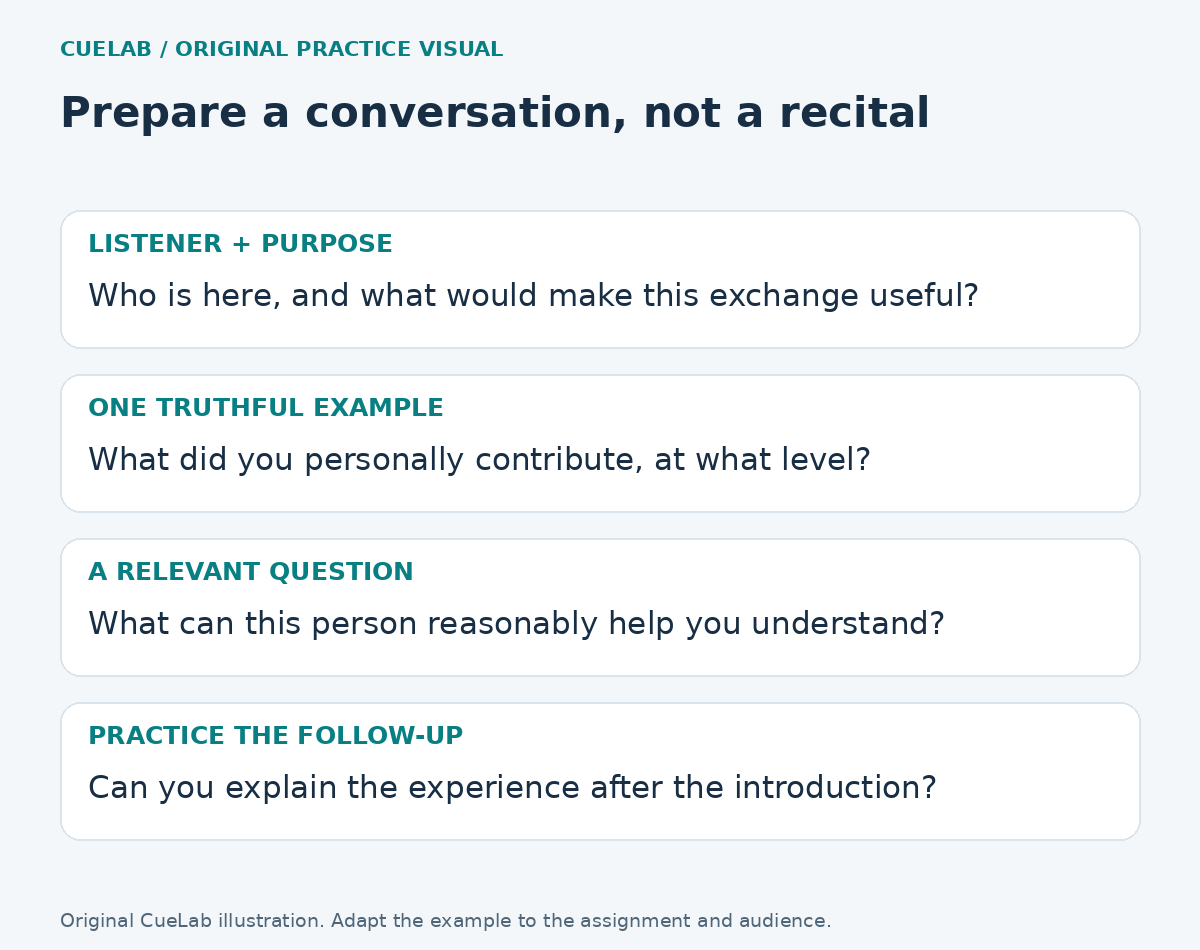
Start with the experience, not the flattering adjective. Write what the situation was, what you personally did, what you can show or explain, and what you learned or became curious about. You can use coursework, a society role, paid work, caring responsibilities, volunteering, or independent projects when the connection is relevant and you are comfortable discussing it.
Then decide which detail gives this listener the clearest picture. Organizing a stockroom at a part-time job may be relevant to an operations conversation, while preparing clear instructions for new volunteers may support an interest in training or communications. The value lies in the actual task and your understanding of it, not in finding the most prestigious label.
| Draft claim | Question to ask yourself | More useful direction |
|---|---|---|
| “I’m a strong leader.” | What did I organize, decide, or help others complete? | Name the responsibility and your own contribution. |
| “I improved efficiency.” | Was a change actually measured, and what else could explain it? | Describe the change accurately; omit unsupported impact claims. |
| “I know data analysis.” | Which tools or tasks can I discuss competently? | Identify the level and one relevant example. |
| “I’m interested in anything.” | What would I most like to understand from this person? | Choose a direction for this conversation, even if you are still exploring. |
Keep team results and personal contributions separate
If your team created a prototype, say that the team created it and identify your part. “Our group built the model; I documented the testing” lets the listener ask a precise question. Saying “I built and tested the model” may suggest responsibility you did not have, even if you contributed something important.
Use numbers only when you can explain what they represent and where they came from. A percentage in a pitch is not automatically more persuasive than a clear description, and an invented result creates a problem as soon as someone asks how it was measured. Confidential work, private customer information, and details you are not permitted to disclose should stay out of the introduction.
Choose a question the listener can answer
The final question should fit the person’s role and the information already available. A recruiter can usually explain application routes, a team member may describe everyday work, and a faculty member can discuss preparation for a particular research area. Asking a question answered clearly on the event page can make the conversation less useful for both of you.
Prepare alternatives rather than a single compulsory ending. If a recruiter has already explained eligibility, ask what distinguishes a useful project example. If the person says there are no current openings, you can ask about preparation or another appropriate information source without pressing them to invent an opportunity.
Practise the short version and the follow-up
Say the introduction aloud at a pace you can sustain comfortably. Remove details that require a long explanation before they make sense, then time a fresh run instead of merely estimating from the page. The sample scripts above have not been audio-tested to promise a particular duration; your delivery and the listener’s response determine the actual exchange.
Next, practise answering one question about your example: what was your task, what was difficult, or what would you change? This is where a truthful, specific pitch becomes easier to sustain. You are preparing for a conversation about the work, not just a polished first paragraph.
Let the prepared pitch change during the conversation
If the listener interrupts with a useful question, answer it rather than returning mechanically to the next sentence. If they appear short of time, offer the brief version and give them room to end the exchange. Preparation should help you notice the situation, not make you ignore it.
Afterward, record the relevant advice or agreed next step while it is fresh. If the person has invited a follow-up, refer to the specific conversation and respect the route they provided. A strong first introduction opens a sensible next exchange; it does not guarantee an interview, placement, or research role.
Prepare one pitch for the next real event
Choose the listener, select one truthful experience, and decide which question would make the meeting useful. For broader introductions outside a career setting, see the self-introduction speech examples. Use the speech time calculator as an initial estimate, then practise with the rehearsal timer to check your own delivery.
Reference: Princeton University Center for Career Development: Developing Your Elevator Pitch. All six scripts and the revision examples are original CueLab illustrations.