Persuasive Speech Outline: Build a Claim You Can Defend

A persuasive speech outline should make the argument visible before it makes the wording polished. It identifies the claim you want listeners to accept, the support for that claim, the connection between the support and your proposal, and the objections a reasonable audience may raise. If one of those parts is missing, adding a stronger opening will not repair the reasoning.
The framework below includes a copyable outline and a worked student-society proposal. The proposal is hypothetical: it shows how to plan a bounded trial of one shared event-information page. It does not claim that CueLab observed a real society, measured missed messages, or established that a particular communication tool improves attendance.
Write a claim the audience can actually decide
“Communication should be better” expresses a preference, but it leaves the decision unclear. A more useful proposition is: “Our student society should trial one shared event-information page for four weeks, with a named editor and a review before deciding whether to continue.” The audience can now ask what the trial includes, who would maintain it, and how it would be judged.
Identify who has authority to take the action. If you are speaking to society members, asking them to approve a university-wide software purchase may be outside their role. Match the request to the real audience, and make any assumptions about money, access, or permission visible.
Choose an organizational pattern that fits the argument
Towson University’s public-communication guidance describes patterns including problem–solution, problem–cause–solution, and Monroe’s motivated sequence. The useful choice depends on what your audience still needs to understand or accept. A familiar set of headings does not establish that your proposed solution addresses the problem.
If listeners agree on the problem but disagree about the response, compare plausible options against the same criteria. If your proposal depends on a particular cause, show support for that cause instead of jumping from an undesirable situation to your preferred solution. If the goal is immediate action, make the requested action specific enough to carry out.
A persuasive speech outline template
Use complete thoughts while planning the argument. Short headings such as “problem” and “benefits” are useful labels, but they do not tell you what you are claiming. Keep the sources and qualifications beside the point they belong to so they are less likely to disappear during rehearsal.
| Part | Planning question | What to record |
|---|---|---|
| Audience and decision | Who can act, and what are you asking them to decide? | The specific request and any limits on the audience’s authority. |
| Central claim | What position will the whole speech support? | One defensible proposition, including its scope. |
| Opening | Why does this question matter to these listeners? | A relevant starting point and a clear route into the claim. |
| Main point | What reason supports the claim? | A complete statement, evidence, and an explanation of the connection. |
| Alternative or objection | What might a reasonable listener disagree with? | The strongest relevant concern and a fair response. |
| Proposal or application | What exactly would happen if the audience agreed? | Owner, scope, practical steps, costs to check, and relevant conditions. |
| Ending | What should the audience now believe, consider, or do? | A synthesis and a specific next action. |
| Reference and accuracy notes | What needs checking before delivery? | Source details, spoken attribution, uncertainty, and unsupported gaps. |
Keep claim, evidence, and reasoning distinct
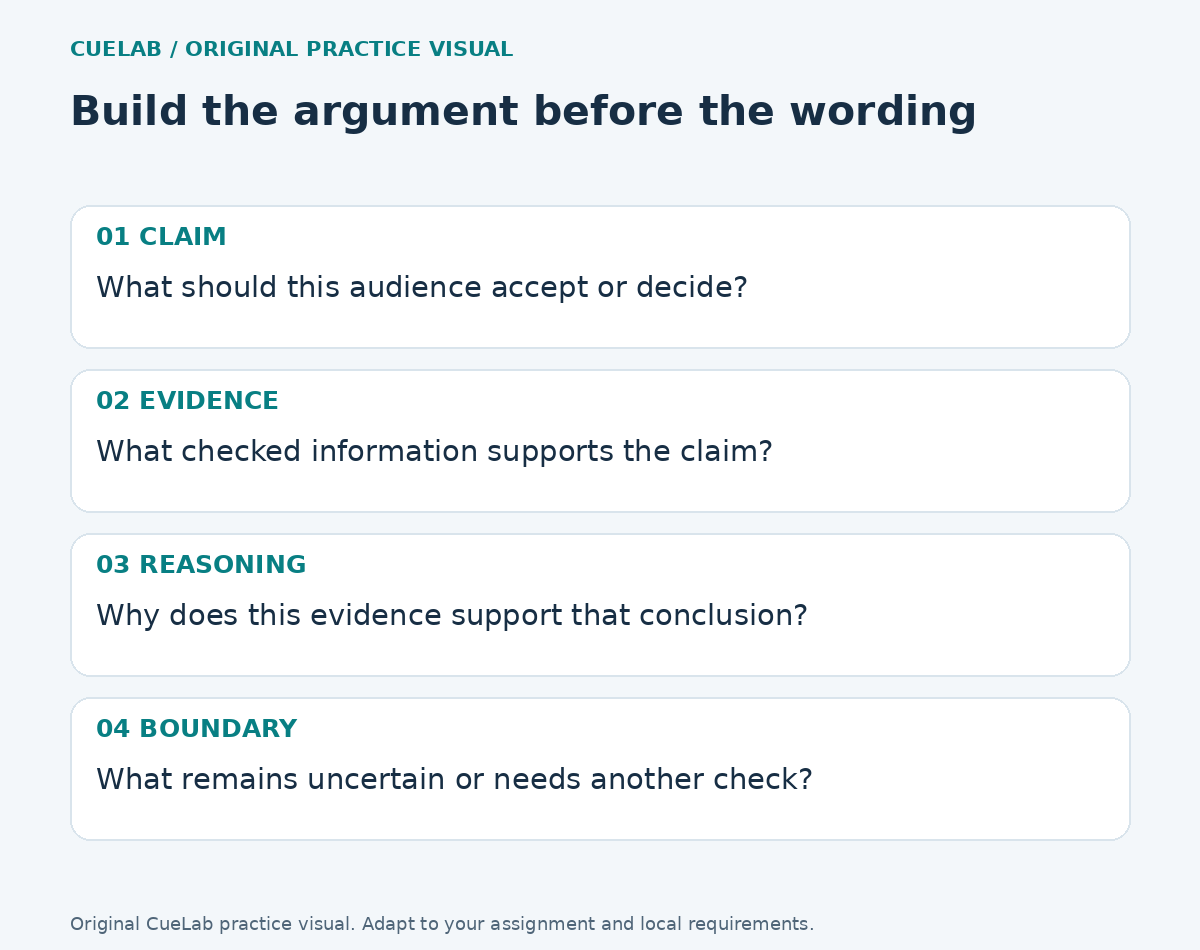
A claim states what you want the audience to accept. Evidence supplies relevant information, while reasoning explains why that information supports the claim. A speech can contain several impressive facts and still have a weak argument if the connection is missing.
For example, a record showing that members asked where an event would take place may establish that questions were asked. It does not, on its own, prove that a new webpage would solve the problem. You would still need to examine what caused the uncertainty, whether the proposed page addresses it, and whether members could find and use the page.
Worked proposal: test one shared event-information page
Assume a student society is considering how to publish event details. The worked outline proposes a four-week trial with a named editor and an agreed review. Chat remains available for conversation and urgent updates, while the trial page would hold the current event details. These are conditions of the illustrative proposal, not facts about an existing organization.
Specific purpose: Persuade the society’s committee to consider and, if the local evidence supports it, authorize a bounded trial.
Central claim: A small, reviewed trial can test whether one maintained event-information page makes current details easier to locate without creating an unreasonable maintenance burden.
Opening: give the audience a concrete decision
“Imagine checking a message for an event location and then finding a later correction somewhere else in the conversation. The question for our committee is whether members can reliably find the current details. I propose a four-week trial of one maintained event-information page, followed by a review before we decide whether to keep it.”
The opening labels its scenario as imagined and introduces a testable proposal. In a real speech, replace or support the scenario with checked local information where appropriate. Avoid presenting an invented incident as something that happened to a member of the audience.
Main point one: establish the actual information problem
The first point should explain what is difficult to locate and why that matters for the society’s activities. Review a suitable sample of existing event announcements with permission, identify where corrections appear, and check whether questions concern missing details, unclear wording, or something else. Remove private information from anything shown publicly.
The outline should name the evidence you actually have and its limits. If an audit has not happened, write “evidence to collect” in the preparation notes. Do not turn a proposed check into a completed result just because the speech would sound stronger with a number.
Connection: “Once we know what members cannot find, we can judge whether this proposed page addresses that particular gap.”
Main point two: describe a practical response
Explain what the trial page would contain: the current date, time, location, contact route, and any relevant change notice for each event. Identify who would update it and how a member would recognize that it is current. The proposal needs a maintenance process as well as a place to publish information.
Check whether the society is allowed to use the chosen platform and whether members can access it comfortably. A page that requires an unfamiliar login or is awkward on a phone might create a different obstacle. Present these as questions to resolve before approval, not minor details the audience should ignore.
Connection: “A central page is only useful if it remains accurate and does not create more work than the society can sustain.”
Main point three: give the trial a fair review
Define what the committee will inspect after four weeks. That could include whether event details were kept current, whether members could locate a specified detail in a small usability check, and how much work the editor recorded. The measures should fit the actual decision instead of promising an attendance increase the trial was not designed to assess.
Agree what would count against continuing. If maintenance is unreliable, access is poor, or the original problem turns out to come from unclear event names rather than scattered updates, the committee may need a different response. A proposal becomes more credible when it admits what evidence could change the recommendation.
Objection: this adds another place to check
State the objection in a form its supporter would recognize. A member might reasonably ask whether the page duplicates existing announcements, who will keep two channels consistent, and why a clearer pinned message would not be enough. Those are practical concerns, not evidence that the person dislikes improvement.
A fair response compares the options. Explain why a pinned message, a shared calendar, or an edited event page might fit the society’s actual needs, and retain the option that the evidence supports. If your preferred approach has no meaningful advantage, revise the proposal rather than weakening the objection.
Ending: request a bounded next action
“I am asking the committee to agree the trial’s scope, name an editor, and set a review date before we begin. If the access and maintenance checks are satisfactory, we can test the page for four weeks. The review should tell us whether to keep it, revise it, or return to a simpler approach.”
The ending specifies what agreement would authorize and keeps the outcome open to evidence. It does not introduce a new claim that the page will solve every communication problem. The audience can see the decision it is being asked to make.
Use an evidence ledger while preparing
A small ledger can expose gaps before they become confident sentences in the script. Separate what has been observed from what is inferred, proposed, or still unknown. A useful speech can acknowledge all four, provided the distinctions remain clear.
| Proposed statement | Check needed | Safe planning response if unverified |
|---|---|---|
| Members miss corrections. | Review actual messages and relevant member feedback. | Describe it as a concern to investigate, not a measured frequency. |
| A shared page would be easier to use. | Compare a realistic task across the options. | Present it as the trial’s question. |
| Maintenance will be manageable. | Confirm ownership and record the work required. | Include maintenance as a review condition. |
| The trial will improve attendance. | Consider whether the design can support that conclusion. | Do not promise an outcome the trial does not establish. |
Decide where an objection belongs
Place a concern where the audience needs it to assess the proposal. Access restrictions belong with the explanation of how members will use the page, while uncertainty about maintenance belongs with ownership and review. Saving every limitation until the last sentence can make the earlier description misleading.
You do not need to answer every imaginable objection in a short speech. Prioritize the ones that could change the decision, and keep supporting details available for questions. If a concern requires a specialist or an official policy check, identify that next step instead of improvising an assurance.
Make transitions explain the relationship
“My second point is” announces order, but it does not explain the connection. A transition such as “That identifies the problem; now we need a response that addresses its cause” helps listeners follow the reasoning. Write the relationship first, then find wording you can say naturally.
Read only the claim and transition lines aloud as a quick structure check. If the argument does not make sense without its examples, some connections may still be missing. The supporting material should strengthen a route that the audience can already recognize.
Rehearse accuracy as well as timing
Time a complete run with the actual notes and visuals, then inspect any section that repeatedly expands. Cut a secondary illustration before cutting a qualification that changes the meaning of the evidence. A shorter speech should still support the same claim within the same boundaries.
Ask a listener what action you requested and which reason most clearly supported it. Also ask what they would need to know before agreeing. Their uncertainty may reveal a missing cost, an unclear mechanism, or an assumption you have treated as settled.
Write the decision sentence beside the final draft
After revising the outline, ask a practice listener to describe the proposed decision in their own words. If they remember the problem but cannot say what you are requesting, examine the proposal and ending. If they describe a larger commitment than you intended, restore the trial period, review condition, or other limit that disappeared during editing.
This check concerns clarity, not proof that the argument is persuasive. A listener can understand a proposal and still disagree with it. Record that disagreement separately and decide whether it identifies an evidence gap, a value difference, or a practical objection your outline should address.
Take one defensible claim into the next run
If you still need a topic, use the college persuasive-topic prompts to find a researchable question. Divide the available time with the presentation time planner, then turn the completed plan into delivery notes using the extemporaneous outline and cue-card guide.
Reference: Towson University: Organization Patterns for Persuasive Speeches. The society proposal, evidence ledger, sample wording, and review conditions are original CueLab illustrations.