Nonverbal Communication: Types, Examples and a Context-First Practice Guide
Nonverbal communication includes the vocal and non-vocal cues through which people convey meaning alongside, or sometimes without, words. Tone, pauses, gestures, personal space, touch and the arrangement of a room can affect how an interaction is understood. The meaning depends on the situation and the people involved.
This guide explains the main types, gives everyday examples and offers a practical way to check an interpretation. CueLab’s existing body language in communication guide focuses on bodily cues. This page takes a broader view, with particular attention to voice, space, time, environment and the limits of interpreting another person’s behaviour.
A useful nonverbal communication definition
Think of nonverbal communication as the layer of meaning carried by how an interaction happens, beyond the literal words. The same sentence can be spoken quickly while someone turns away, or slowly after a thoughtful pause. A meeting can be arranged so everyone can see the shared material, or so some participants have to lean around a screen. Those choices influence the exchange.
“Nonverbal” does not simply mean silent. Vocal qualities such as pitch, volume, pace and pauses are commonly discussed as paralanguage. Conversely, a signed language is a language with its own grammar, not merely a collection of gestures. A person using a communication device is also communicating linguistically, even when their spoken output is assisted.
Types of nonverbal communication
| Type | What it concerns | Everyday example |
|---|---|---|
| Kinesics | Body movement, posture and gesture | A hand movement that marks a contrast between two options |
| Facial expression and gaze | Facial movements and looking behaviour | Looking towards a shared diagram while considering it |
| Paralanguage | Vocal features beyond the words | A pause before an important qualification |
| Proxemics | Space and interpersonal distance | Moving a chair so another person has more room |
| Haptics | Touch in interaction | Offering a handshake and respecting a declined invitation |
| Chronemics | Time, timing and waiting | Allowing thinking time after asking a difficult question |
| Appearance and objects | Visible presentation and surrounding objects | A role badge that identifies who can answer an event question |
| Environment | The physical arrangement of interaction | Seating that lets everyone see and hear one another |
Different textbooks group these channels differently. The table is an organising aid, not a claim that there is one universally agreed number of types. The Virginia Commonwealth University course text discusses several of these channels in an intercultural context. The examples here are original CueLab applications.
1. Voice: what changes when the words stay the same?
Try the sentence, “We can discuss that after the meeting.” Read it once as a calm scheduling suggestion and once as a hurried attempt to end a conversation. Notice which features you change: pace, stress, pitch, volume or the pause before “after.” A listener might interpret the versions differently even though the words are identical.
You cannot determine the speaker’s intention from sound alone. A quiet voice may reflect a noisy connection, fatigue, a vocal difference or a deliberate effort not to disturb others. Address the practical difficulty first: “The audio is faint. Would you like me to turn up the volume, or can you put the key point in the chat?”
When you are speaking, use vocal choices to support a specific task. Slow down where the audience needs to understand a condition. Pause while they inspect a figure. Emphasise the difference between two options. You do not need to manufacture an energetic personality or vary your pitch constantly.
2. Space: arrange the interaction before judging the person
A person leaning away may want more space, may be trying to see a screen, or may simply be sitting comfortably. Instead of assigning a motive, check the arrangement. Can everyone see the material? Is the room crowded? Is someone blocking the route to the door? Would a different seat make the conversation easier?
There is no single distance that is comfortable in every relationship and culture. Ask when it matters, and respond to a request for more space. At a workshop, leave a clear route and offer seating options. In a one-to-one meeting, avoid treating proximity as a technique for pressuring someone to agree.
For remote interaction, the equivalent problem may be framing, screen sharing or the absence of a visible cue. A participant looking away from the camera may be reading your document on another screen. Check understanding through a question rather than an eye-contact rule.
3. Time and silence: leave room for an answer
Silence can indicate thinking, uncertainty, disagreement, a technical delay or many other things. If you ask a complex question and immediately answer it yourself, you may remove the opportunity for someone else to contribute. Explain whether you want an immediate response or whether people can take time.
“Take a moment to consider the two options. You can respond aloud or write your main concern. We will compare the reasons before deciding.”
This instruction reduces ambiguity about the pause. It also gives more than one route to participation. The aim is not to interpret silence as a hidden message with a fixed meaning. The aim is to make the interaction clearer for everyone involved.
Response time in digital communication needs similar care. A slow reply does not, by itself, prove disrespect. When a deadline matters, state it explicitly. “Please confirm by 3 pm because the booking closes at 4” is easier to act on than expecting another person to infer urgency from your typing style.
4. Touch, gesture and gaze: respect individual boundaries
Gestures can point, illustrate size, regulate turns or have a conventional meaning. Some meanings vary across communities. A familiar gesture can be misunderstood elsewhere, and an individual’s comfort may differ from a general cultural norm. If a gesture matters to the task, pair it with clear words or a labelled visual.
Touch requires attention to consent and context. Do not assume a handshake, pat on the back or guiding touch is welcome because you intend it positively. An offered greeting can remain optional. You can communicate warmth through respectful wording and attention without requiring physical contact.
Likewise, do not demand eye contact as proof of honesty, respect or attention. Disability, neurodivergence, culture, visual access and ordinary thinking habits can affect gaze. A person can demonstrate understanding by asking a relevant question or accurately summarising the next step.
Five nonverbal communication examples with better checks
| Observation | Unsupported conclusion | A more useful check |
|---|---|---|
| A colleague folds their arms | “They reject my idea” | Ask what concern they have about the proposal |
| A student looks at the desk | “They are not listening” | Offer thinking time and check the instruction |
| A participant pauses before answering | “They are hiding something” | Allow time and ask whether the question needs clarification |
| A person speaks loudly | “They are angry” | Consider noise, hearing access and the person’s explanation |
| A teammate replies briefly in chat | “They dislike me” | Check the task and add missing context if needed |
These checks do not prove a positive interpretation either. They help you gather information instead of treating your first impression as fact. If someone says they are uncomfortable or asks you to stop, respect that direct information rather than searching for a contradictory nonverbal cue.
What percentage of communication is nonverbal?
There is no universal percentage that describes all communication. A number often repeated online is that only 7% of meaning comes from words and 93% from nonverbal cues. That is not a valid rule for explaining instructions, teaching a concept, reading a contract or communicating every kind of message.
Albert Mehrabian’s own clarification states that the well-known figures came from experiments concerning feelings and attitudes, especially inconsistent messages. They should not be applied as a general formula for all communication. A map, a spoken safety instruction and a facial reaction do different jobs.
For practical purposes, ask which information the audience needs and whether the available channels convey it clearly. If an important instruction exists only in a gesture, put it into accessible words or another usable form. If your spoken and visible actions seem inconsistent, explain the discrepancy instead of relying on a percentage.
A context-first observation method
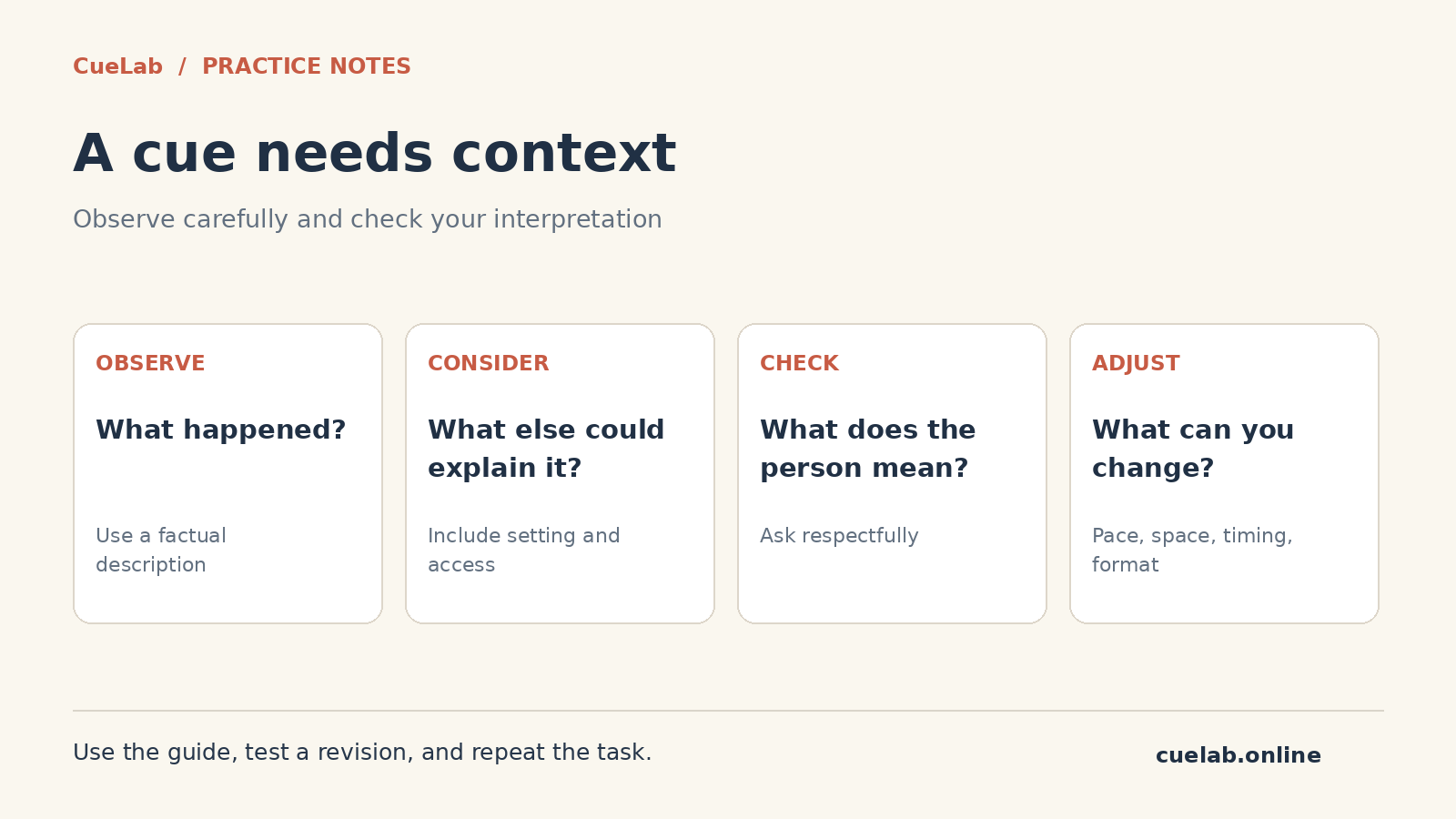
- Describe what you noticed. Write “paused for several seconds” rather than “was evasive.”
- Record the task and setting. Note the question, noise, time pressure and communication channel.
- Consider more than one explanation. Include a practical or access-related possibility where relevant.
- Ask a respectful checking question. Let the person explain what they need or mean.
- Adjust your own communication. Change pace, space, format or timing when it helps.
Use the method on a low-stakes interaction first. You are learning to separate observation from interpretation, not conducting a covert test of someone else’s feelings. Avoid recording private conversations or making a collection of behavioural judgements about classmates or colleagues.
A worked example: the quiet meeting participant
During a planning meeting, Lina contributes only one short comment and looks at her notes. A colleague decides she is disengaged. The observation is narrower: Lina has spoken once and looked down frequently. The conclusion about disengagement has not been established.
The chair asks, “We have moved quickly through three options. Would a written summary or another minute help before we choose?” Lina explains that she is comparing the cost assumptions and needs to check a figure. The group adds a short pause, then asks for her findings.
This does not mean quiet participation always indicates careful analysis. It shows why a respectful check is more useful than a fixed decoding rule. In another meeting, the person might be confused, tired, excluded by the format or ready to agree. The checking question opens a way to find out.
Practice for speakers, teachers and teams
For a speaker: Record a short explanation if you wish. Watch once without sound to observe movement, then listen without watching to hear pace and pauses. Finally, review both together. Choose a change because it improves the explanation, not because a gesture looks unfashionable.
For a teacher: Give an instruction verbally and in a readable written form. Let learners ask questions or explain the task back in their preferred mode. Notice whether room layout, visibility or waiting time makes participation easier.
For a team: Agree how people can request a pause, signal a question or contribute in writing. Make the agreement explicit. Do not assume everyone recognises the same hand signal or can comfortably use the same mode.
Turn an observation into a small communication experiment
Choose a change you control and make its purpose explicit. If listeners have difficulty following a diagram, you might say, “I will pause after each stage so you can inspect it.” Then ask which stage still needs explanation. This tests the usefulness of the pause without making claims about what a listener’s expression means.
Change one feature at a time when practical. Moving the seating, replacing the diagram and doubling the speaking pace at once makes it difficult to identify what helped. Keep a brief record of the setting, your adjustment and the feedback received. A successful change in one room may need revision in a video call or a different group.
Do not turn the exercise into surveillance. Ask permission before recording, use fictional or low-stakes situations for practice, and avoid storing identifying details about another person’s behaviour. The worksheet is designed to improve your own communication choices. Its most useful question is often not “What does this person secretly feel?” but “What can I clarify or adjust so that we understand the task better?”
Common questions
Is body language the same as nonverbal communication?
Body language commonly refers to bodily cues such as posture, facial movement and gesture. Nonverbal communication is broader and can include voice, time, space, touch, objects and environment.
Can nonverbal cues reveal lying?
No single gesture, gaze pattern or pause reliably establishes that someone is lying. Use evidence relevant to the claim and ask clear questions. Treat a behavioural impression as an interpretation that may be wrong.
How can I improve my nonverbal communication?
Choose a real task and ask what helps others follow it. You might make the material easier to see, pause after an important question, check personal-space preferences or explain a vocal difficulty. Work on an observable change rather than attempting to imitate one ideal style.
For a related application, read where to look during a video call and how to use vocal variety. Both focus on what supports understanding in a particular situation.