30 Two-Minute Speech Topics for Students, with Outlines and Examples

The best 2-minute speech topics for students are small enough to explain, illustrate and finish in one short talk. “Technology” is a subject area. “Why I check the original source before sharing a screenshot” is a speech topic. The second gives you a claim, an example and a useful ending.
Below are 30 topics for school and college practice, a flexible 120-second outline, two original sample speeches and a downloadable planning sheet. The topics work in English, but you can adapt them to another language or age group. Follow your teacher’s instructions when the task specifies an informative, persuasive or personal speech.
How many words are in a two-minute speech?
There is no word count that guarantees exactly two minutes. A planning example of 120 spoken words per minute, with 15 seconds reserved for pauses, leaves about 210 words. That is an adjustable starting assumption, not a required pace or a claim that every speaker talks at that rate. Your measured delivery matters more than a generic estimate.
Read your draft aloud with the intended pauses and time it. If you run long, remove a point or shorten an example before trying to speak faster. If you finish early, add a necessary explanation rather than repeat the opening. Students using communication aids or working in an additional language may need a different plan and appropriate classroom accommodations.
The editable workbook lets you change the time limit, pause allowance and planning pace. It calculates a draft word budget, while the rehearsal section records actual time. You can also use CueLab’s free speaking tools while preparing.
A flexible 120-second speech outline
| Approximate time | Job | Question to answer |
|---|---|---|
| 0–15 seconds | Opening | What concrete moment or question brings listeners into the topic? |
| 15–35 seconds | Main point | What one idea should the audience understand? |
| 35–80 seconds | Example and explanation | What happened, and how does it support the point? |
| 80–105 seconds | Qualification or application | When does the idea need care, or how can listeners use it? |
| 105–120 seconds | Closing | What should listeners remember or do next? |
These times are rehearsal guides. You can change the proportions while keeping a clear beginning, development and ending. A personal story might spend longer on the example. A demonstration might need a shorter opening and more time for the audience to inspect an object.
Ten easy topics grounded in school life
- A question I was glad I asked. Describe one moment when clarification prevented a mistake.
- The most useful item in my school bag. Show how you use it instead of listing its features.
- One way to make group projects fairer. Propose a specific division of work.
- What I do when instructions are unclear. Give a three-step example.
- A book I would recommend to one particular friend. Explain why it suits that person.
- Why a short break can improve my next attempt. Describe your experience without making a medical claim.
- A school rule I would explain more clearly. Separate the purpose from the wording.
- How I prepare for a difficult question. Show one preparation habit.
- A mistake that changed how I practise. Focus on the change, not on self-criticism.
- One small improvement to our classroom. Consider cost, access and who benefits.
Choose a topic you can support with an actual observation. You do not need an extraordinary life story. A clear account of a small event usually gives you more usable material than a broad claim about success, happiness or society.
Ten informative and demonstration topics
- How to check where an online image came from. Describe the verification questions rather than claim one tool catches every fake.
- How to turn a paragraph into a cue card. Show the difference between a script and prompts.
- What makes a useful class announcement. Include the action, date, place and contact.
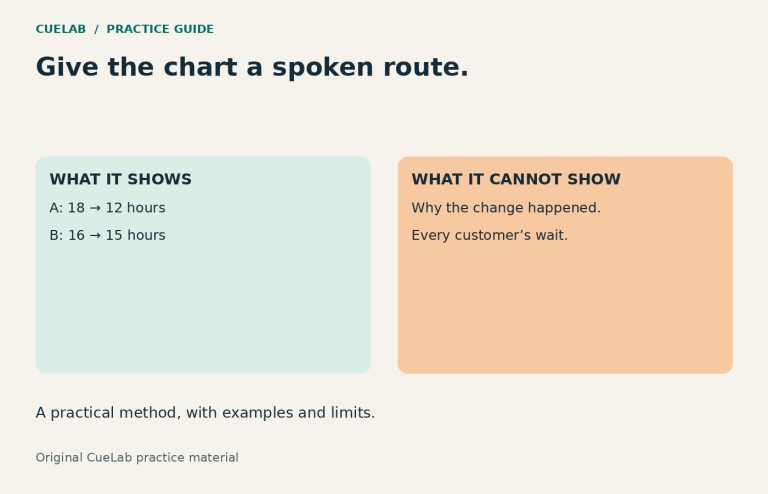
- How to explain one simple chart. Name the pattern and an important limitation.
- How to organise a five-minute revision session. Demonstrate one topic, one recall task and one check.
- Why a password should not be shared in a group chat. Explain the practical consequence without exposing real credentials.
- How to pack a reusable event kit. Use a few objects the audience can see.
- How to make a study timetable realistic. Start with available time and fixed commitments.
- How to ask for feedback you can use. Contrast a vague question with a specific one.
- How to summarise a discussion fairly. Include agreement and an unresolved concern.
For demonstration speeches, test the physical steps. An action that takes ten seconds alone may take longer when you explain it and wait for the audience to see it. Have a verbal fallback if an object, device or internet connection is unavailable.
Ten persuasive and reflective topics
- Class messages should state the required action first. Use one confusing announcement as an example.
- Every group project needs a short agreement about roles. Explain one preventable coordination problem.
- Students should be allowed to ask for instructions in writing. Discuss access and clarity.
- We should verify a surprising claim before forwarding it. Offer one realistic checking habit.
- A school event should include a low-cost participation option. Explain how the option would work.
- Listening should be visible in a discussion. Demonstrate a response that builds on another person’s idea.
- Useful feedback should name an observable change. Give a before-and-after example.
- A presentation should make one main point memorable. Explain what you would cut from an overloaded talk.
- Changing your mind can strengthen an argument. Describe the evidence that would change your position.
- A quiet participant can still contribute leadership. Show a useful clarification or summary.
For persuasive topics, include a reasonable objection. Two minutes is enough to acknowledge a condition without trying to answer every possible criticism. Avoid statistics you cannot trace to a reliable source. A modest, well-supported proposal is stronger than an impressive number you cannot explain.
Sample speech 1: Ask one more question
Original practice script. Its exact delivery time depends on the speaker.
Last month, our project group agreed to “finish the slides by Friday.” On Friday evening, one person had written notes, another had designed a title slide, and I had collected pictures. We had all worked. We had not agreed on what “finish” meant.
One extra question could have prevented the problem: what exactly should be ready, and who is doing each part?
Now, before we end a project meeting, I write a short action list. Each action has a person, a result and a time. Instead of “research the topic,” we write “Amina will find two reliable sources about the local issue and add the links by Wednesday.” That gives the next person something they can actually use.
This does not mean every conversation needs a formal document. If we are choosing a place for lunch, a quick agreement may be enough. But when several people depend on one another’s work, a vague promise can create a real delay.
The next time your group says, “Everyone knows what to do,” ask one more question. Invite each person to say their next action in their own words. You may discover a small misunderstanding while it is still easy to fix. A clear question today can save an uncomfortable explanation on Friday.
Planning notes: The opening uses one event. The main point is clarification. The action-list example makes the advice concrete. The qualification prevents the speech from sounding like a demand to formalise every conversation. The closing returns to the opening’s Friday deadline.
Sample speech 2: Make your feedback useful
After a practice presentation, a friend told me, “Be more confident.” I thanked her, but I did not know what to do differently. Should I speak louder, use fewer notes, or change my opening?
Feedback becomes useful when it describes something we can observe and revise.
Imagine that the same friend says, “Your example explained the problem clearly, but the final sentence introduced a new idea. Could you end by repeating the action you want us to take?” Now I have a change I can test. I can rewrite the ending, deliver it again and ask whether the message is clearer.
We can use this approach when we help classmates. First, name a specific moment. Next, explain its effect on you as a listener. Finally, suggest one possible revision. “At the chart, I could not read the small labels. Could you enlarge them or explain the main comparison aloud?”
Of course, a listener’s reaction is one perspective. Another person may need something different. We should ask questions and compare observations rather than treat a single comment as a final verdict.
Before your next practice session, choose one thing you want feedback on. It might be your opening, timing or explanation. Ask for an example. You will leave with something more useful than a judgement about your personality: one clear change for your next attempt.
Planning notes: This script contrasts vague feedback with an observable revision. Its examples are fictional, so present them as a practice scenario rather than claim they happened to you. Replace the opening with your own experience if you are giving a personal speech.
How to turn a broad topic into a two-minute talk
Use a three-part test: one audience, one question and one example. “Environment” becomes “How our class can reduce disposable event signs.” “Education” becomes “Why I ask a partner to explain the instructions back.” “Social media” becomes “The check I make before sharing an alarming screenshot.”
Write the sentence “After my speech, my classmates should understand ____.” If the blank needs three separate ideas, choose the most useful one. Then list what you would remove if you had only 90 seconds. That exercise reveals which material supports the point and which material merely belongs to the general subject.
A rehearsal routine that improves the next attempt
- First run: Speak from the outline without stopping to repair every sentence. Record the duration.
- Review: Identify the first place a listener could lose the main point.
- Revise: Change one section. Cut a repeated explanation or add a missing link.
- Second run: Use the revised outline and the same timing method.
- Listener check: Ask someone to state your main idea in one sentence.
Toastmasters’ preparation guidance recommends clear organisation and timed rehearsal. The topic bank, time allocations and example scripts here are CueLab’s own teaching material. They are not a Toastmasters assessment form.
Build a cue card you can actually use
A cue card should help you recover the route of the speech. Divide a small page into four prompts: the opening moment, the main point, the example and the final action. Write keywords large enough to find quickly. If a figure, quotation or name must be exact, write that item in full and retain its source in your preparation notes.
For the first sample speech, the card might read: “Friday confusion / define finished / person-result-time / ask one more question.” Those prompts preserve the argument without requiring you to read every sentence. Practise from them once, then check whether the example still supports the same message.
If you forget a line, pause and return to the next prompt. Do not apologise for a sentence the audience never knew you planned to say. If you lose the example entirely, state the main point and move to the closing action. A shorter coherent talk is usually easier to follow than a rushed attempt to recover every planned word. Keep the card as a support, not a second miniature script.
Common questions
What are some unique two-minute speech topics?
A familiar subject becomes distinctive when you choose a specific decision or experience. A speech about one misunderstood instruction can be more memorable than a speech promising to explain all communication.
Should I memorise the whole speech?
Know the opening and final message well, but practise the route between them. A cue card with the main point, example and closing action can help you recover if you forget a sentence.
Can I use these speeches as answers for school?
Use them to study structure and timing. Write an original response to your assignment, use your own experience honestly, and follow your teacher’s rules about assistance and attribution.
For a longer explanation, see the informative speech outline. For an argument, use the persuasive speech outline and keep only the evidence your two-minute limit can support.