Public Speaking for Kids: 18 Topics and 5 Practice Activities
Public speaking for kids can begin with one familiar object, one interested listener, and a short idea the child wants to share. A formal stage speech is only one possible destination. Children can also practice explaining a game, describing a picture, giving an instruction, or answering a friendly question.
The 18 topics and five activities below are adaptable starting points for parents, teachers, and small groups. Choose the task according to the child’s interests, language experience, access needs, and willingness to participate. The aim is a clear exchange of meaning, with feedback that makes the next attempt easier to understand.
Start with something the child understands
A familiar subject reduces the amount of new material a child has to manage while speaking. An object they can hold, a game they can explain, or a book they know gives the conversation a concrete center. Ask what they would enjoy showing or describing before assigning an elaborate topic.
Keep the first task small enough to finish. That may be one sentence and a follow-up question, or a short explanation with a beginning and ending. A fixed speaking duration is less useful at the start than finding a task the child understands and is willing to try.
Give the listener a job too
Explain what the listener should notice, such as the order of three steps or the reason for a choice. This turns the activity into communication rather than a performance in front of an evaluator. A child can learn something useful when a listener says which instruction helped them follow the task.
Offer choices about participation
A child might begin by speaking to one adult, a partner, or a small familiar group. They may prefer to sit, hold an object, or use a few picture prompts. Keep those supports available when they help the child communicate, and change the task if the activity becomes upsetting or too demanding.
Six topics for describing something familiar
These topics invite observation rather than specialist research. Encourage the child to choose two or three details that help a listener picture the subject. Ask a specific question afterward instead of correcting every sentence during the explanation.
- An object that has a useful job. Show the object, explain what it does, and name one detail that helps it do that job.
- A page I would show someone in a favorite book. Describe what is on the page and explain why it is worth noticing, without retelling the whole book.
- A familiar place I could help a visitor find. Choose a public or classroom place and describe the features a visitor would recognize.
- Three details in a picture. Select details in an order that makes sense, then explain which one the listener should notice first.
- Something I can observe outside today. Describe what is visible and distinguish the observation from a guess about what might happen later.
- What a newcomer needs to know about this room. Pick a few practical details, such as where an activity begins or where shared materials belong.
Six topics for explaining a short process
Choose a process the child already knows and can demonstrate safely with the materials available. Help them identify the starting point and the finished result before describing the steps. Follow the setting’s rules for equipment, movement, and shared objects.
- How I get ready for one classroom activity. Name what is needed, explain the order, and show what “ready” looks like.
- How to sort a small set of art materials. Choose useful groups and explain how another person could find an item afterward.
- How borrowing a book works in our setting. Follow the actual local routine and describe the steps a newcomer needs.
- How to play one round of a simple game. Explain the aim, a few essential rules, and what makes the round finish.
- How to make one familiar paper fold. Use an appropriate demonstrated fold and explain each movement slowly enough for a partner to follow.
- How three picture cards form a sequence. Put the cards in order, explain the connection, and describe what would change if two were swapped.
Six topics for giving a reasoned opinion
A small preference can become a useful speaking task when the child gives a reason another person can understand. The aim is not to produce the adult’s preferred answer. Encourage the child to explain a choice and listen to a different view respectfully.
- Which book should our pair look at first? Choose between two available books and give a reason connected to the activity.
- Which decoration fits a classroom event? Compare two simple options using the same question, such as visibility or ease of making.
- What rule would make this game easier to understand? Explain one proposed change and consider how another player might see it.
- Which activity should come first? Choose an order for two permitted activities and explain the practical reason for that sequence.
- What detail should we add to this poster? Identify what the reader needs and explain why the chosen detail helps.
- Which small skill would I like to learn next? Name the skill, explain its appeal, and describe a realistic first attempt.
Activity 1: the object curator
Let the child choose an ordinary object and prepare a short introduction to a pretend exhibition. Their job is to show what the object is, describe two useful details, and explain what a visitor should notice. The listener then asks one question about something the child has mentioned.
Keep the object visible so the child does not have to remember every detail at once. If the first explanation becomes a list, ask which feature matters most to the object’s job. On the second attempt, the child can put that feature first and see whether the listener understands the object more quickly.
Activity 2: the three-picture explanation
Use three appropriate pictures showing a simple sequence, or ask the child to draw three quick frames. They arrange the pictures and explain what happens between them. The listener’s task is to describe the connection they heard, not invent a better story on the child’s behalf.
You can vary the task by changing the order or removing one frame. Ask what information the listener would now be missing. This helps make the idea of a transition concrete: the speaker needs to explain how one part connects with the next, rather than simply name what appears in each picture.
Activity 3: the direction detective
Prepare a very simple drawing made from a few shapes. One person describes how to create it while the other draws without seeing the original. Choose a task where misunderstanding is harmless and expected, then compare the two versions with curiosity.
Ask which instruction was clear and which needed another detail. “Put the circle on the right” may raise a useful question about whose right is meant or how far from the edge it belongs. Let the child revise one instruction and try again. The activity works best when the difference becomes information about the explanation, rather than evidence that either person failed.
Activity 4: two possible endings
After a short explanation of an object or process, ask the child to try two endings. One can repeat the main idea; the other can tell the listener what to notice or try next. Discuss which ending fits the task and why.
For a game explanation, a useful ending might invite the listener to play one round. For an observation about a picture, it might return to the detail the speaker considers most important. Keep the exercise playful and brief. The point is to experience a clear finish, not memorize a formal closing for every occasion.
Activity 5: one friendly question
In pairs, one child gives a short explanation while the other prepares a relevant question. Agree that the question should help the speaker explain more, rather than test a hidden fact. A question such as “Which part should I do first?” gives the speaker something practical to clarify.
Then swap roles so both children practice listening as well as speaking. If the speaker does not know an answer, model a truthful response such as, “I’m not sure about that part; I would need to check.” The activity can teach that a useful exchange does not require a confident answer to every possible question.
An adaptable twelve-minute practice session
This is an illustrative session for a pair or an adult working with a child, not a required schedule for a whole class. Shorten it, add breaks, or stay with one stage when that better suits the learner. A successful session can end with one clearer explanation.
| Time | Activity | Adult or partner’s role |
|---|---|---|
| 0–2 minutes | Choose an object, picture, or small topic. | Offer a manageable choice and explain the listener’s job. |
| 2–4 minutes | Plan the beginning, main detail, and ending. | Ask a useful question without writing the speech for the child. |
| 4–7 minutes | Try a short explanation and swap roles if appropriate. | Listen for meaning and allow time to form an answer. |
| 7–9 minutes | Notice one successful part and one unclear part. | Describe what you understood using specific wording. |
| 9–11 minutes | Try one small revision. | Keep the audience and materials familiar. |
| 11–12 minutes | Let the child reflect and choose a next step. | End the activity without adding a new performance demand. |
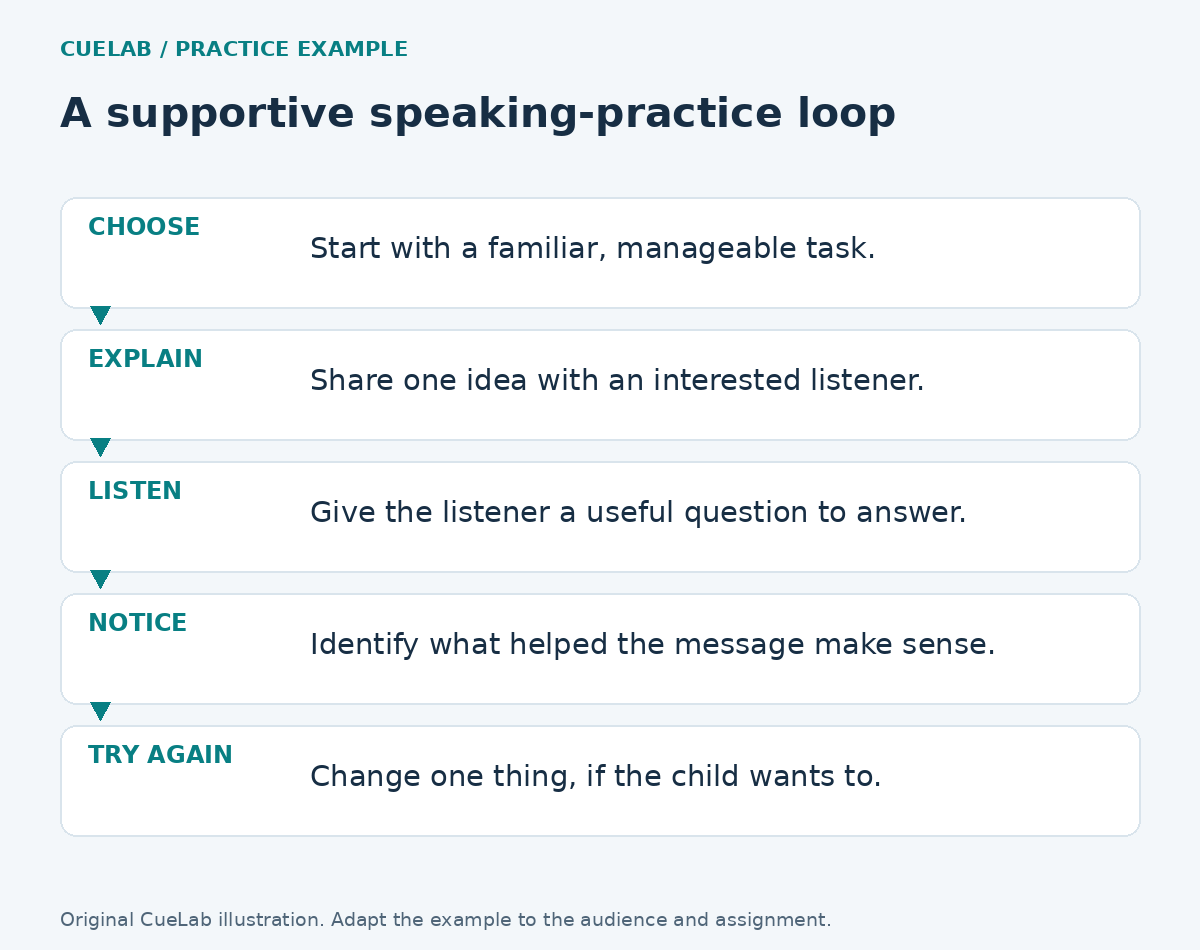
Give feedback about the message
Describe what helped you understand
Instead of only saying “Good job,” identify the useful action: “When you named the first step before showing it, I knew what to do.” This gives the child information they can use again. Keep the observation truthful rather than attach praise to something that did not happen.
Choose one next adjustment
A child cannot easily work on volume, posture, wording, timing, eye contact, and organization at the same moment. Choose the change that would most help the listener understand, such as naming the object before describing it. Let the child decide whether to try that change now or in a later session.
Keep individual differences in view
Children differ in language, communication style, comfort, and access needs. Looking directly at a listener or standing still is not the only way to show engagement. Use supports that help the child communicate and follow relevant guidance from their teacher or support team where that applies.
Make the audience larger gradually
If the child wants a new challenge, change one condition at a time. They might explain a familiar object to two listeners instead of one, or use the same audience for a slightly longer idea. Changing the topic, audience, duration, and setting at once can make it hard to know which support is needed.
Keep the purpose of the exercise clear and allow an easier version. These activities are speaking-practice ideas, not a promise about confidence or a treatment for anxiety. Their value lies in giving the child a suitable opportunity to communicate and a specific next step they can understand.
Support a child who uses more than one language
Ask which language or combination of languages fits the purpose of the activity. For a relaxed explanation at home, the child might first arrange the idea using familiar words and picture prompts. If a class task requires English, the adult can help clarify a few necessary words before the speaking attempt, within the teacher’s instructions.
Keep the feedback connected to the goal. A speaking exercise about explaining the order of steps should still notice whether the order made sense. Choose a small language adjustment separately when it will help the listener, rather than stop the explanation to correct every phrase. The child should have an opportunity to communicate an idea as well as practice its wording.
Let one clear idea be enough
Ask the child which part they enjoyed and what they would like to explain next. Keep a useful topic or object available for another short attempt, without making every conversation an assessment. A manageable task, a patient listener, and a meaningful response give practice a reason beyond simply speaking for longer.
For supporting material, see CueLab’s guide to specific feedback and guide to checking understanding.
Reference: NSW Department of Education, The Arts Unit: Teaching Public Speaking. The topics, five activities, and sample session above are original CueLab practice material.