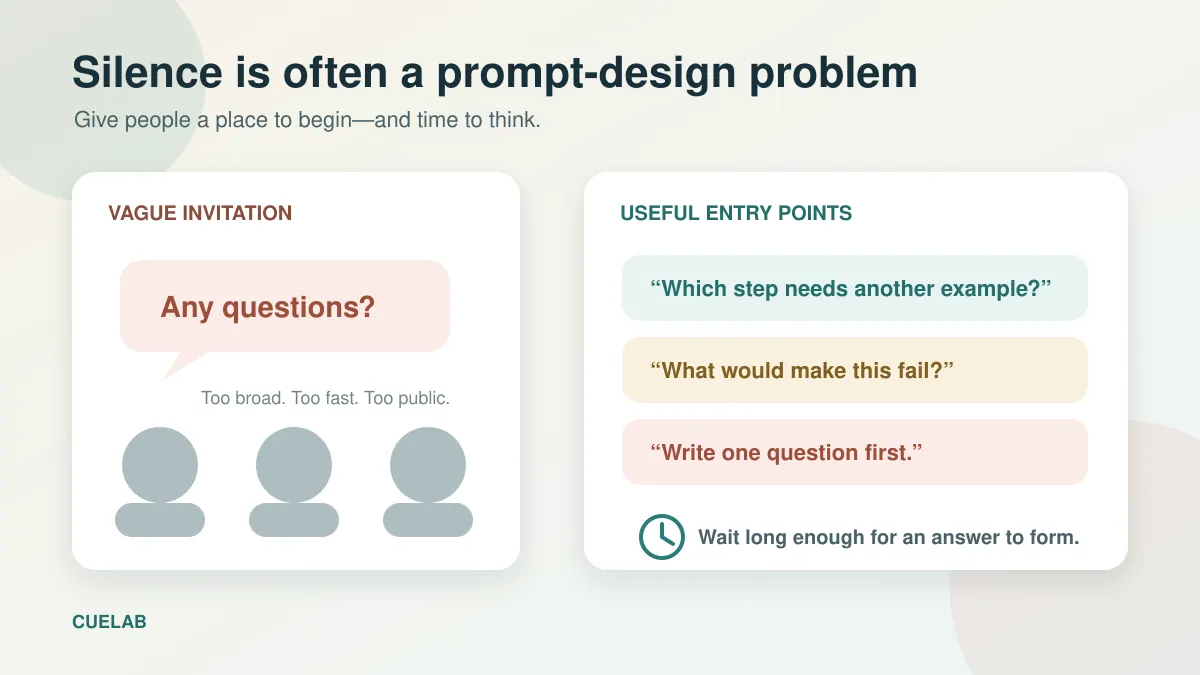
The presenter reaches the end of a careful explanation, looks around the room, and asks, “Any questions?” Nobody moves. After two seconds, the presenter says, “Great,” and advances to the final slide.
That silence is often treated as proof that the message was clear. It may mean that. It may also mean that people are still deciding what confused them, are unsure how broad a question is welcome, do not want to expose a gap in front of colleagues, or simply did not have enough time to form a sentence. Silence is an observation; “everyone understood” is only one interpretation.
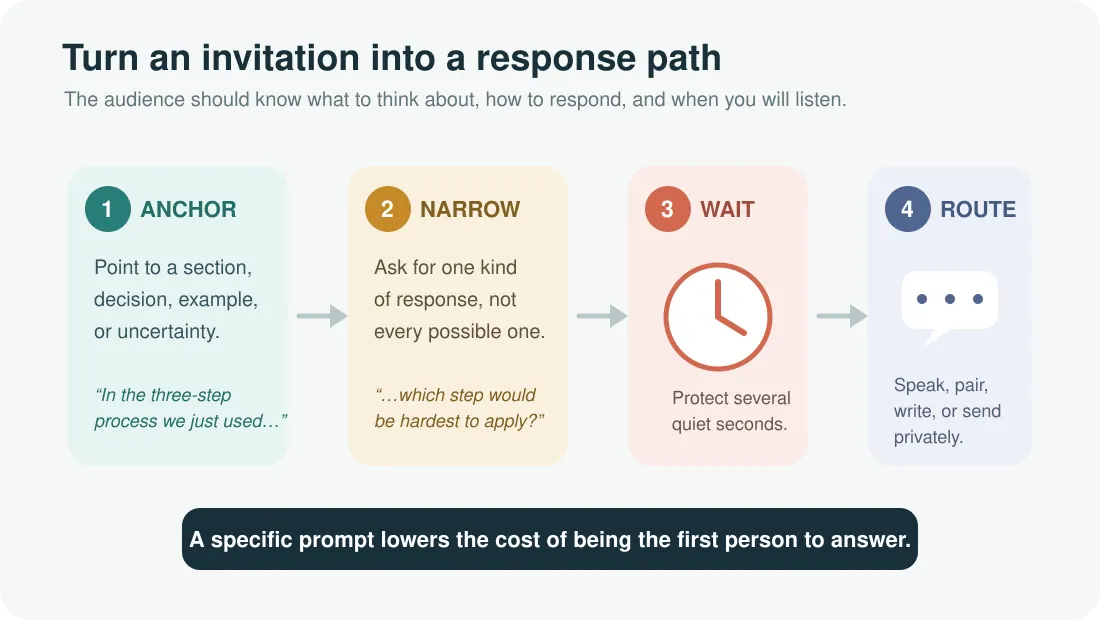
The phrase “Any questions?” is polite, familiar, and sometimes useful. Its weakness is that it gives the audience almost no help with the work of responding. A better prompt creates a starting point, narrows the kind of answer wanted, allows thinking time, and offers a realistic way to participate.
A broad invitation can create a surprisingly demanding task
To answer “Any questions?” a listener has to search the entire talk, identify something incomplete, decide whether it is relevant to everyone, phrase it clearly, predict how the speaker will react, and volunteer to speak first. That is a large cognitive and social task hidden inside three short words.
The prompt also leaves the standard unclear. Does the speaker want a request for clarification, a challenge to the evidence, a practical application, or a question about what happens next? Experienced audience members may infer the local norm. Newer, quieter, or less confident people must guess.
In a meeting, status adds another layer. A junior employee may notice a problem but hesitate to raise it in front of the person who designed the plan. In a classroom, a student may worry that the question will reveal they missed something obvious. On a webinar, participants may be unsure whether the chat is monitored or whether questions will interrupt the recording. A silent room can contain several unspoken questions.
Silence does not diagnose understanding
Comprehension is not directly visible. People can nod because the explanation feels familiar, because they understand the general direction, or because they want the session to keep moving. They may not discover a gap until they try to explain the idea, choose between alternatives, or apply the process to a new case.
This is why “Do you understand?” and “Any questions?” are weak diagnostic tools. They ask listeners to assess their own understanding before testing it. The more reliable approach is to ask for a small piece of evidence: a prediction, a restatement, a choice with a reason, or the step that remains least clear. CueLab’s guide to telling whether students understand an explanation develops this distinction between apparent fluency and demonstrated understanding.
Anchor the invitation to something the audience just encountered
A useful prompt gives people a location from which to think. Instead of asking them to search a forty-minute presentation, point to the model, decision, example, or uncertainty you want them to inspect.
- “Which step in the three-step process needs another example?”
- “What would stop this plan from working in your team?”
- “Which assumption behind this estimate would you want to check first?”
- “Where did the chart become difficult to follow?”
- “What is one term I should define before we continue?”
Each question limits the search without dictating the answer. It also signals that uncertainty, objections, and requests for clarification are legitimate contributions. The prompt does some of the organisational work that “Any questions?” leaves entirely to the listener.
Choose a prompt that matches your real purpose
Speakers often ask for questions out of habit, but different moments require different information. If you want to know whether the audience followed a process, ask them to identify the next step. If you want criticism, ask what condition would make the recommendation unsafe or impractical. If you want a decision, present the options and ask what information is still missing.
A clarification prompt might be, “Which word or step should I explain differently?” An application prompt could be, “Where would this approach break in a small team?” A comparison prompt might ask, “What is the most important difference between option A and option B?” A transfer prompt could be, “What would you change if the budget were cut by half?”
The wording should be open enough to permit a genuine response but specific enough to define the task. A question such as “You all agree this is the best route, right?” is not an invitation; it tells people which answer is socially safe. Replace it with, “What is the strongest reason not to choose this route?” if you actually need to test the decision.
Wait time begins after the question, not before it
Mary Budd Rowe’s work on classroom questioning distinguished two useful pauses: the pause after an instructor asks a question and the pause after a learner finishes responding. Her review noted that teachers commonly allowed less than a second in both places. That pace rewards the person who can produce an answer immediately and encourages the questioner to fill silence before other people have organised a thought.
Three to five seconds is a practical starting range for many spoken prompts, not a magic number. A factual check may need less; a question about risk, interpretation, or application may need much more. The point is to match the pause to the thinking demanded rather than to the presenter’s discomfort.
Ask the question once, stop talking, and keep a receptive expression. Do not immediately paraphrase it three ways, answer it yourself, or scan the room as if someone is already late. A sip of water or a quiet look at the relevant slide can help the pause feel intentional. The difference between useful and uncomfortable silence often lies in whether the speaker appears to expect thought.
When someone answers, protect a second pause before evaluating or redirecting. Other people may still be processing the contribution, and the speaker may add an important final sentence if not interrupted. CueLab’s article on the difference between a thinking pause and a nervous pause explains how posture, gaze, and timing change the way a silence is read.
Give people a lower-pressure route into the conversation
Public speaking is not the only way to reveal a question. Ask everyone to write one concern before inviting comments. Let pairs compare which step they found least convincing. Use a simple poll, shared document, question card, or moderated chat. In a small meeting, invite people to mark a slide or add a note beside a decision.
Think–pair–share is useful because it separates forming an idea from announcing it to the whole room. People first think privately, then test the idea with one person, and only then may share more widely. Research and practice also show that the whole-group “share” stage can reintroduce pressure for some learners, so it should not be treated as automatically inclusive. Sometimes collecting written responses or sampling several pairs gives a truer picture than asking each person to perform publicly.
Offer routes deliberately rather than saying, “You can ask however you like.” Tell the audience when and where: “Take thirty seconds to write one question. You can read it aloud, put it in the chat, or hand it to me at the break.” Clear logistics reduce another layer of uncertainty.
What to do when a better prompt still gets no answer
Do not punish the silence with sarcasm or assume the audience is disengaged. First, check whether the prompt is answerable. A question such as “What are the implications?” may still be too large. Narrow it: “What is one effect this change could have on customer response time?” Then provide a brief thinking period.
You can also offer two plausible starting points without turning the question into a quiz. “Some teams may struggle with training time; others may struggle with data access. Which concern is closer to your situation?” The options reduce the blank-page feeling while leaving room for another answer.
If nobody responds after a genuine wait, continue without embarrassment: “I’ll leave that question visible and return to it after the example.” Sometimes the example supplies the language people need. At the end, offer a private route and state how follow-up will work. A calm transition protects the audience’s dignity and keeps future participation possible.
Use seeded questions carefully
A presenter may say, “A question I often hear is…” and answer it. This can model the desired level of specificity and cover a predictable concern. It becomes unhelpful when every supposed audience question is merely another rehearsed point or when the speaker pretends that a question came from the room.
Be transparent. “While you think, I’ll answer one question that came up in the earlier session” is honest and gives people time. Then reopen the floor with a focused prompt. The seeded question should create space, not consume the entire question period.
Remote and hybrid rooms need an explicit turn-taking rule
Online silence has extra causes. Audio delay makes people wait to avoid speaking over someone else. Participants may be muted, searching for the raise-hand control, or deciding whether a question belongs in chat. In a hybrid room, people joining remotely may assume that those physically present have priority, while the people in the room cannot see the chat at all.
State the sequence before asking: “I’ll give everyone twenty seconds to think, then I’ll take one question from the room and one from chat.” If there is a moderator, name that person and explain what they will do. A moderator can group duplicate questions, bring a quiet chat contribution into the spoken discussion, and tell the presenter when a remote hand has been waiting.
Avoid watching only the wall display or only the camera. Scan the room, the participant list, and the chat in a predictable order. If the technology makes that impossible while presenting, say so and collect questions for a scheduled checkpoint. A channel that nobody monitors is not a genuine participation route.
Broad questions work better after the first response
There is nothing inherently wrong with an open invitation. It becomes useful when people already know the topic, the acceptable level of challenge, and the way turns will be handled. After one person asks about implementation, “What other implementation questions are coming up?” can widen the conversation without returning to a blank page.
Broad prompts can also suit a small, psychologically safe team that meets regularly and has an established discussion rhythm. Even there, the speaker should wait. Familiarity reduces the social uncertainty, but it does not eliminate the time needed to retrieve and phrase a useful thought.
Design the Q&A before you reach the final slide
Question quality improves when the session includes several small invitations rather than one high-stakes opening at the end. After a complex model, ask what assumption needs checking. After an example, ask what would change in the audience’s setting. Before the recommendation, ask what evidence they would need to act. These pauses also help the presenter notice confusion before later slides depend on it.
Reserve enough time to respond properly. Asking for questions with thirty seconds remaining tells the audience that participation is ceremonial. If a useful question arrives and you do not know the answer, say what you do know, identify what must be checked, and agree on a realistic follow-up. The method in how to handle questions you cannot answer during a presentation keeps uncertainty from turning into bluffing.
Seven replacements for “Any questions?”
- “Which part should I show with another example?”
- “What is one risk I have not addressed?”
- “Where would this process be hardest to use in your work?”
- “What would you need to know before choosing between these options?”
- “Which assumption seems least secure?”
- “Take twenty seconds: write the first question you would ask the project owner.”
- “What should we revisit before we move on?”
You can still finish with “What other questions do you have?” once the conversation has begun. At that point, the room has heard the expected level of detail and the cost of being first has disappeared. The broad invitation works better as an opening-out move than as the only doorway.
A good question period is not measured only by how many hands rise. It is measured by whether the speaker learns what the audience needs, whether participants can test the idea safely, and whether uncertainty becomes clearer. A quiet but usable written response may be more informative than a lively exchange dominated by two confident voices. Replace the vague ritual with a designed response path: anchor the topic, narrow the task, wait, and make participation possible.