Microteaching Skills: A Focused Ten-Minute Lesson Plan
Microteaching skills are teaching actions you can practise in a short, focused lesson and review with feedback. The purpose is to make a manageable part of teaching visible: explaining one distinction, asking a useful question or checking a learner’s application. A miniature lecture on an entire chapter is usually too broad for that purpose.
This guide offers an original ten-minute practice lesson and a printable plan. Ten minutes is the example’s design choice, not a universal duration or an official B.Ed assessment requirement. Follow your programme’s instructions if the required timing, skills or observation criteria differ.
Choose one skill as the main focus
You can notice several teaching actions in a session, but choose one as the main target for feedback. “Improve teaching” is too broad. “Ask a question that shows whether learners can distinguish a claim from a topic” identifies an action and the learner evidence you want to inspect.
| Skill | Observable practice target |
|---|---|
| Opening a lesson | State the learning task and connect it to a usable example. |
| Explaining | Make one distinction clear without adding unnecessary terms. |
| Questioning | Ask a prompt that reveals understanding of that distinction. |
| Responding | Use the answer to clarify, extend or correct the explanation. |
| Sequencing | Move from a worked example to supported practice and a new application. |
| Closing | Return to the intended skill and inspect a final response. |
Plan the learning evidence before the activities
For the example lesson, the objective is: “Given a broad subject, write a speech topic that makes one claim for a particular audience.” The final check uses a new subject that was not part of the demonstration. This lets the teacher inspect whether learners can apply the distinction rather than repeat the example.
Prepare two likely difficulties. A learner may write another broad label, such as “sports,” or write several claims that cannot fit one short talk. Plan a question for each difficulty. “What should this audience understand after the talk?” can help narrow the first; “Which one idea matters most here?” can help narrow the second.
A worked ten-minute microteaching lesson
| Time | Teacher action | Learner action or evidence |
|---|---|---|
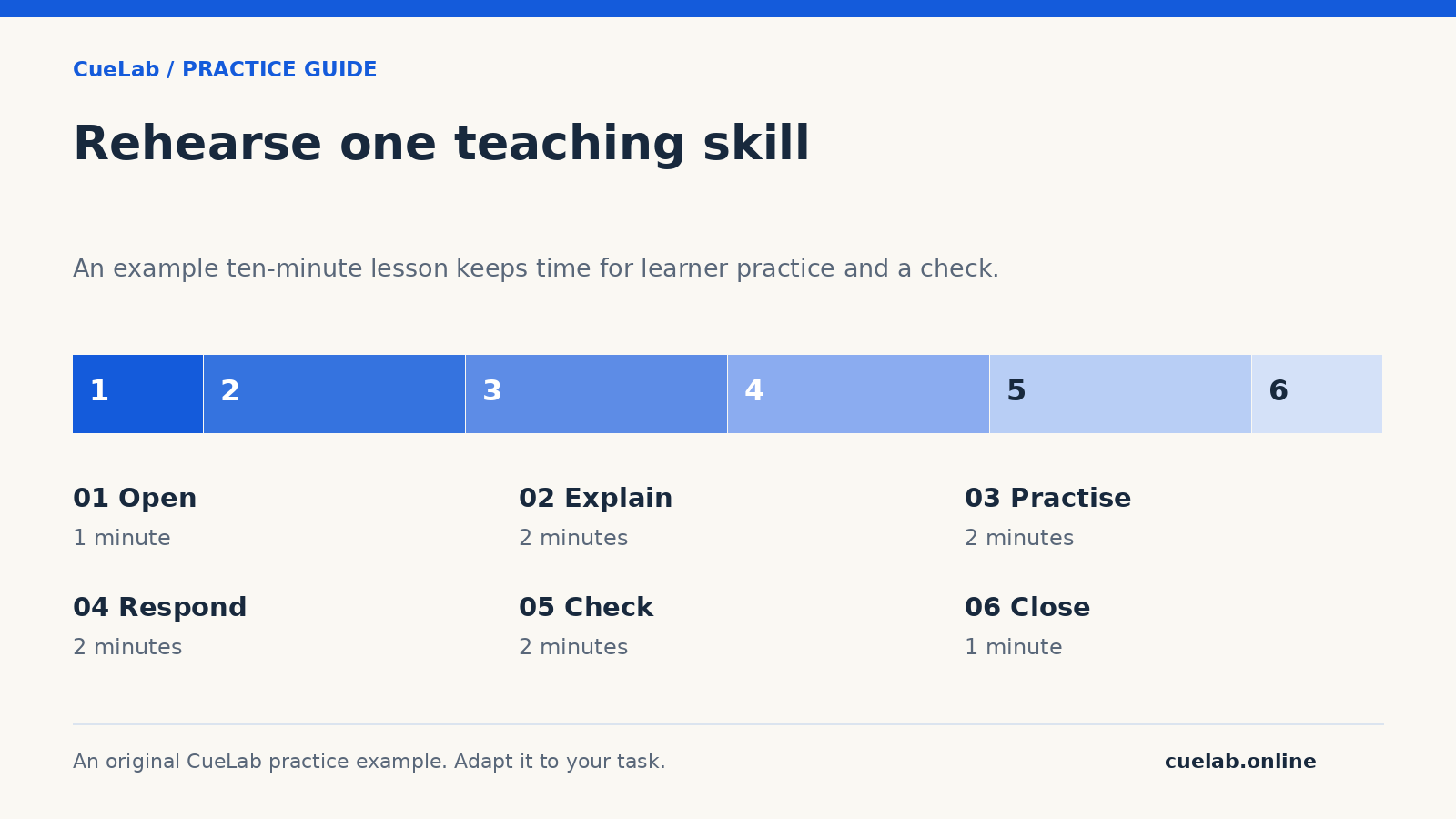
| 0:00–1:00 | State the task and show “technology” beside a focused speech topic | Identify which example gives a speaker a direction. |
| 1:00–3:00 | Explain subject versus claim using one worked example | Explain the difference in their own words. |
| 3:00–5:00 | Ask learners to narrow a broad school-life subject | Write a topic for a named audience. |
| 5:00–7:00 | Invite a reason and respond to one difficulty | Revise the topic and explain the change. |
| 7:00–9:00 | Give a new subject for an independent check | Write one claim without copying the worked example. |
| 9:00–10:00 | Compare outputs with the objective and close | Name the next revision or confirm a usable topic. |
The time allocations are a rehearsal plan. If the explanation takes longer, remove a repeated example rather than eliminate the independent check automatically. A lesson that ends with no learner evidence gives observers less information about whether the explanation supported the intended task.
Give observers a narrow evidence brief
Ask an observer to record the exact question you asked, a sample response and what you did with it. This is more useful than asking whether you looked confident. A possible note is: “At minute five, the teacher asked for one main claim. The learner named a broad subject. The teacher supplied a complete answer before asking another question.”
That observation suggests a specific rehearsal target: allow the learner to revise after a clarifying prompt. It does not establish that the teacher is generally poor at questioning. Keep feedback connected to the session and avoid inferring personality or motivation from one moment.
Debrief, revise and teach again
- The teacher describes the intended skill and the moment they want to review.
- The observer shares a concrete event and its effect on their understanding.
- The teacher chooses one change to test.
- The teacher rehearses the relevant segment again.
- The group checks what changed in the question, explanation or learner response.
If peers act as learners, their subject knowledge may differ from the real audience’s. Ask them to respond honestly to the task instead of pretending that every explanation worked. Later classroom use may require more preparation, different examples and access arrangements. A successful peer rehearsal is useful information, not a guarantee of success with every learner group.
Prepare materials and consent arrangements
Use a short brief, the example and a way for learners to respond. Avoid spending most of the practice session setting up technology. If a slide or recording is essential to your chosen skill, include its setup and a fallback in the plan.
Recording can support review, but agree on permission, access, storage and deletion before recording anyone. A written observer note may be sufficient for the learning goal. Do not require a participant to share a recording publicly as the price of receiving feedback.
Plan the next attempt
Record your objective, focus skill, lesson sequence, likely difficulty, observation evidence and one reteach change. Complete the objective and final check first. Then allocate time to the explanation and practice that prepare learners for that check.
After the session, write what the learner actually did. “Learners wrote a claim” is more useful than “the lesson was engaging,” especially if you keep one anonymous example. Select a single change for the next run so you can inspect its effect without redesigning every part at once.
Common questions
What is the difference between microteaching skills and a full lesson plan?
The skills are teaching actions being practised. The plan organises the content, timing and evidence for a particular session. A focused microteaching plan usually narrows the task so one action can be reviewed closely.
Is microteaching only for trainee teachers?
No. Experienced teachers and other instructors can use short practice sessions to examine a specific teaching action. The purpose and feedback process should fit their context.
Can I use this plan for a B.Ed assignment?
Use it as an original planning example and adapt the content to your assignment. Your institution’s required timing, format and assessment criteria take priority.
Related guides: questioning techniques and follow-ups; evidence-based feedback examples.