Direct and Indirect Speech: Rules, Examples and Chart
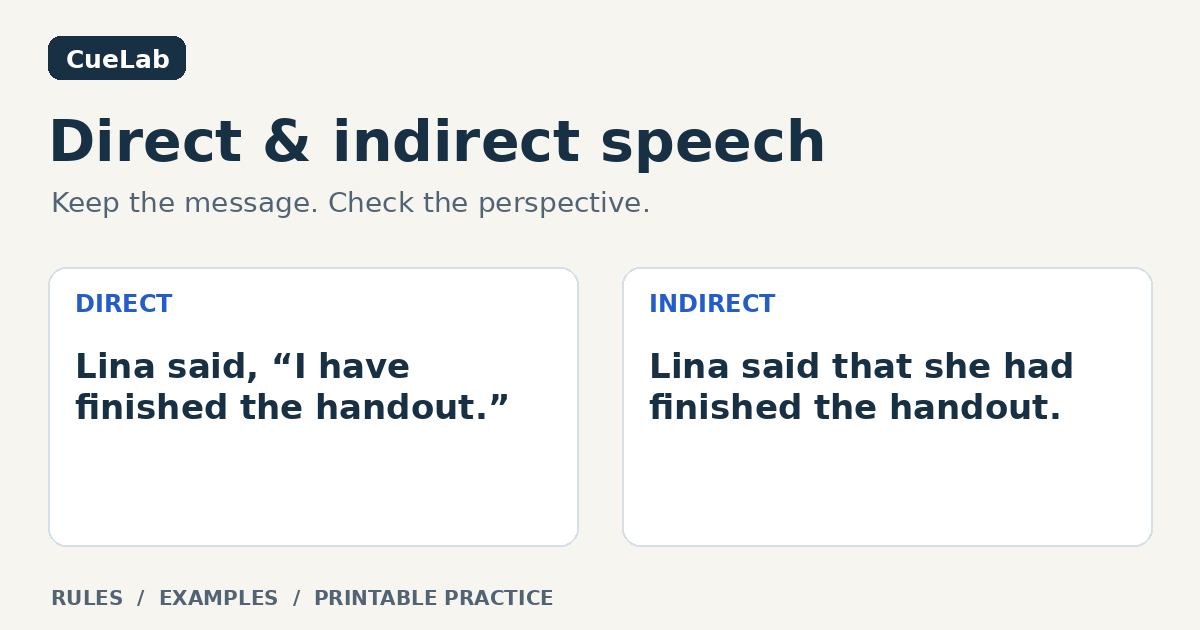
Direct and indirect speech are two ways of reporting what someone says. Direct speech presents their words in quotation marks; indirect speech reports the message within your own sentence. To change between them accurately, check the speaker, the sentence type, the time reference and the verb pattern. Changing the tense alone will not fix a sentence with the wrong pronoun or question order.
For example, imagine that Amina says on Monday, “I will send the notes tomorrow.” When Bilal reports this on Wednesday, he can write: “Amina said that she would send the notes the following day.” The report keeps Amina as the person sending the notes, while placing her promise in its original time frame.
This guide includes a direct and indirect speech rules chart, original worked examples and three printable worksheets with a complete answer key. The exercises distinguish conventional classroom backshift from situations where the original tense or time word can remain.
Get the free seven-page worksheets with answers (PDF) if you want to practise as you read.
What is the difference between direct and indirect speech?
In direct speech, the quoted wording is presented as what the speaker actually said. A reporting clause identifies the speaker: Hira said, the teacher asked or the guide explained. In indirect speech, the wording becomes part of the reporter’s sentence, so quotation marks are normally removed.
| Form | Example | What the reader receives |
|---|---|---|
| Direct speech | Hira said, “I need another example.” | Hira’s quoted words. |
| Indirect speech | Hira said that she needed another example. | A report of Hira’s message. |
Indirect speech is also called reported speech in many school lessons. More broadly, reporting someone’s speech can include either direct quotation or an indirect report. A grammar exercise asking you to “change into reported speech” will usually mean the indirect form.
The distinction matters outside a worksheet too. When you summarise a discussion or introduce someone’s opinion in a presentation, make clear whether you are quoting their exact wording or reporting its meaning. Do not put a rewritten summary inside quotation marks as if it were an exact quotation.
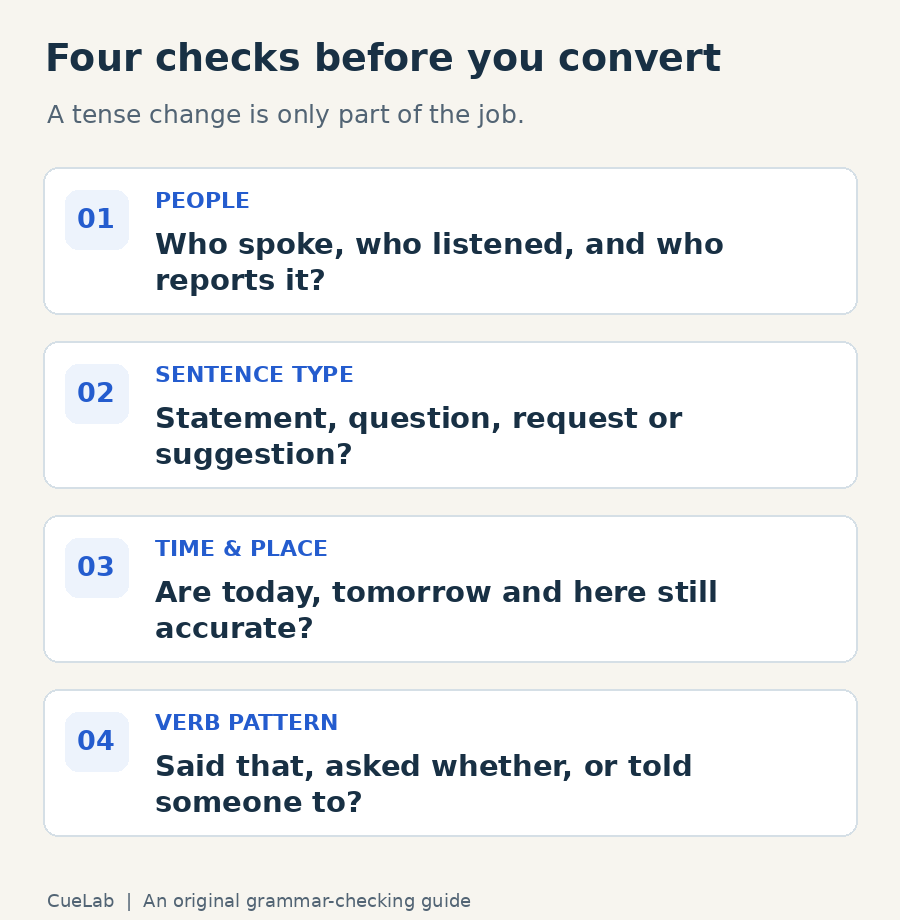
Use four checks before changing a sentence
Start by identifying who spoke and who listened. In “I will help you,” neither pronoun can be converted reliably until you know who I and you refer to. Write the names beside the sentence if the relationship is easy to lose.
Next, decide what the speaker was doing. A statement, a question and a request need different structures. “You have the file,” “Do you have the file?” and “Please send the file” cannot all be reported with the same pattern.
Then locate when and where the report happens. If you report a Monday conversation on Wednesday, tomorrow may need to become the following day or an explicit date. If you report it a few minutes later on Monday, tomorrow may still be accurate.
Finally, choose the reporting verb and its grammar. Said that, asked whether and told someone to lead into different kinds of clauses. Once that structure is right, check the remaining verb forms, pronouns and punctuation.
Direct and indirect speech rules chart
Use the first chart to choose the sentence structure. The tense chart underneath applies when you are backshifting after a past reporting verb such as said or asked. It is a conventional conversion guide, rather than an instruction to change every verb in every context.
| Original sentence | Indirect speech pattern | Original example and report |
|---|---|---|
| Statement | said + (that) + clause | “The room is quiet.” → She said that the room was quiet. |
| Statement to a named listener | told + listener + (that) + clause | “I need the key.” → He told Sara that he needed the key. |
| Yes/no question | asked + if/whether + subject + verb | “Is the room open?” → She asked whether the room was open. |
| Wh-question | asked + question word + subject + verb | “Where is the key?” → He asked where the key was. |
| Command or request | told/asked + listener + to + verb | “Bring the key.” → She told me to bring the key. |
| Negative command | told/asked + listener + not to + verb | “Do not enter.” → He told us not to enter. |
| Suggestion with “Let’s” | suggested + -ing form | “Let’s practise outside.” → She suggested practising outside. |
Tense and modal changes when backshifting
| Direct form | Usual backshifted form | Example |
|---|---|---|
| Present simple | Past simple | “I keep a notebook.” → He said he kept a notebook. |
| Present continuous | Past continuous | “I am checking the slides.” → She said she was checking the slides. |
| Present perfect | Past perfect | “I have saved a copy.” → He said he had saved a copy. |
| Present perfect continuous | Past perfect continuous | “I have been waiting.” → She said she had been waiting. |
| Past simple | Usually past perfect | “I lost the receipt.” → He said he had lost the receipt. |
| Past continuous | Usually past perfect continuous | “I was making notes.” → She said she had been making notes. |
| Past perfect | No further backshift | “I had checked it.” → He said he had checked it. |
| Will / can / may | Would / could / might | “I can explain it.” → She said she could explain it. |
| Would / could / should / might | Usually unchanged | “I should leave.” → He said he should leave. |
Must depends on its meaning. Past obligation can be reported with had to: “I must return the badge” becomes “She said she had to return the badge.” A deduction such as “The office must be empty” normally keeps must. Do not apply one replacement to both meanings.
Time and place expressions
| Original expression | Common later or more distant reference |
|---|---|
| now | then / at that time |
| today / tonight | that day / that night |
| yesterday | the day before / the previous day |
| tomorrow | the next day / the following day |
| last week / next week | the previous week / the following week |
| two days ago | two days before / two days earlier |
| here | there |
| this / these | that / those, when the reference requires it |
These are context choices. “I left it here” can still be reported with here if you are standing in the same place. In a report that might be read much later, a named place or date can be clearer than either here or there.
How to report statements with said and told
For a straightforward statement, use said followed by a clause: “Raza said that the printer was working.” The word that is often optional: “Raza said the printer was working” is also grammatical.
When you use told in this pattern, identify the listener: “Raza told me that the printer was working.” Avoid “Raza told that the printer was working” and “Raza said me that the printer was working.” If you use say and mention the listener, the listener normally follows to: “Raza said to me that the printer was working.”
Choose the reporting verb for the message you have evidence for. If Raza simply gave information, said is sufficient. Changing it to admitted, complained or promised adds an interpretation that the original wording may not support.
Change pronouns by following the people
Suppose Noor tells Hamza, “I will send you my outline.” If Hamza reports this himself, he can say: “Noor said that she would send me her outline.” If another person reports the same conversation, the wording could be: “Noor told Hamza that she would send him her outline.”
The original you became me in one report and him in the other. Its grammatical person did not supply the answer; the identity of the reporter did. The same check applies to we, our, us and possessive forms such as your.
When several people could fit the same pronoun, repeat a name. “Noor told Sara that she would bring her notes” might leave the ownership unclear. “Noor told Sara that Noor would bring her own notes” is less elegant but more explicit; you can then edit the wording while preserving that meaning.
When the tense does not need to change
A past reporting verb does not automatically mean that every reported verb must move into the past. If a situation remains true or relevant, a present form can be appropriate: “The tutor said that the library opens at nine.” That wording presents the opening time as current information.
A general fact can also remain in the present: “The teacher explained that a triangle has three sides.” In a classroom exercise, read the instructions before deciding whether the task expects conventional backshift or a report that emphasises continuing truth.
With a present reporting verb, there is normally no reason to backshift merely because you are reporting words: “Hina says that she needs a quieter room.” The need may be current. Past perfect forms also do not move to a further past tense, and modal forms such as would and should generally remain as they are.
Backshifting a still-true statement does not, by itself, declare that it has become false. It can simply describe what was said at the earlier time. The reporter’s intended time frame is part of the meaning.
Report questions using statement word order
Yes/no questions
Introduce a question that can be answered with yes or no using if or whether. For example, “Are you carrying the attendance sheet?” becomes “The tutor asked me whether I was carrying the attendance sheet.”
The reported clause places the subject before the verb: I was, not was I. A question using do, does or did loses that question-forming auxiliary: “Do you need a pen?” becomes “She asked if I needed a pen.”
Questions with a question word
Keep where, why, when, what, who or how when it carries the original question. “Where did you put the folder?” can become “He asked where I had put the folder.” The clause is I had put, not had I put.
Be careful with subject questions: “Who took the marker?” becomes “She asked who had taken the marker.” Here, who is already the subject. You do not add an extra subject simply to imitate another question pattern.
Report commands and requests with to or not to
Use a reporting verb, the person addressed and a to-infinitive: “The organiser told the volunteers to check the doors.” For a negative instruction, put not before to: “The organiser told the volunteers not to block the entrance.”
A polite request often uses asked: “Please check the spelling” becomes “She asked me to check the spelling.” A question-shaped request such as “Could you move the chair, please?” can be reported as “She asked me to move the chair.” It is functioning as a request for action.
Distinguish that from a genuine question about ability: “Could you read when you were four?” asks about someone’s past ability. Its indirect report needs the meaning of that question, rather than an instruction to read.
Keep suggestions, offers and reactions accurate
“Let’s compare the two drafts” can be reported as “Mariam suggested comparing the two drafts.” Another option is “Mariam suggested that we compare the two drafts.” Avoid the pattern “suggested me to compare.”
An offer can use offered to: “I will carry the display board for you” becomes “He offered to carry the display board for me.” A promise can use promised to when the original words genuinely make a commitment.
For exclamations, report the content or reaction without inventing extra emotion. “What a clear explanation!” could become “She said that the explanation was very clear.” Exclaimed with delight makes a stronger claim about her manner, so use it only when that reaction belongs to the context.
Check punctuation after the grammar
In a common direct-speech pattern, a comma introduces the quotation: Sana said, “The lesson starts at ten.” A quoted question keeps its question mark: Sana asked, “Does the lesson start at ten?” Single or double quotation marks can be used according to the writing style you are following.
An ordinary indirect report has no quotation marks or comma between the reporting verb and its clause: Sana said that the lesson started at ten. A reported question is not itself a direct question, so write Sana asked whether the lesson started at ten.
The whole sentence can still be a question if you are asking one yourself: Did Sana ask whether the lesson started at ten? In that case, the question mark belongs to your complete question, not to the embedded reported clause.
Direct and indirect speech examples in a short report
Imagine this conversation taking place in a classroom on Thursday:
Hiba said, “I have finished the handout.” Omar asked Hiba, “Can you send it to me today?” Hiba said to Omar, “Please check the final paragraph.”
A classmate reporting it on Friday could write:
Hiba said that she had finished the handout. Omar asked her whether she could send it to him that day. Hiba asked Omar to check the final paragraph.
The report makes three different structural choices. Hiba’s information becomes a that-clause, Omar’s question becomes a whether-clause, and Hiba’s request becomes asked Omar to. The pronouns still point to the same people, and that day means Thursday, when Omar asked the question.
If Omar’s question were clearly a polite request rather than an enquiry, “Omar asked Hiba to send him the handout that day” would also be a reasonable report. A useful answer key should acknowledge that distinction when the context allows it.
Common mistakes and how to repair them
| Mistake | Repair | What to check |
|---|---|---|
| She said me that she was ready. | She told me that she was ready. | Use the listener after told, or use said to me. |
| He asked where was the hall. | He asked where the hall was. | Restore statement word order. |
| She asked did I have a copy. | She asked if I had a copy. | Add if/whether and remove question-forming did. |
| He told us to not enter. | He told us not to enter. | Use the standard classroom negative-infinitive pattern. |
| She suggested us to wait. | She suggested waiting. | Check the pattern after suggest. |
“To not enter” is possible in English, but not to enter is the usual pattern taught for these conversion exercises. Keep a distinction between a useful classroom target and a claim that every other construction is impossible.
Try six conversions before opening the answer key
For questions 1–4, use a past reporting verb and conventional backshift. For question 5, report the instruction. For question 6, keep the general fact in the present. The names identify the speaker and listener.
- Iman said, “I am preparing a question.”
- Arif said, “I have printed the checklist.”
- The coach asked me, “Do you need more time?”
- Laila asked me, “Where did you leave the notebook?”
- The teacher said to us, “Do not write on the chart.”
- The teacher said, “A square has four equal sides.”
Suggested answers:
- Iman said that she was preparing a question.
- Arif said that he had printed the checklist.
- The coach asked me if I needed more time.
- Laila asked me where I had left the notebook.
- The teacher told us not to write on the chart.
- The teacher said that a square has four equal sides.
Check the reporting structure before looking at the tense. If your answer to question 3 begins “The coach asked me did…”, changing need to needed cannot repair the question order. For questions 1–4, the exercise specifies backshift; a different real-life context could allow another tense choice.
Download direct and indirect speech worksheets with answers (PDF)
The free printable pack contains three worksheets, 30 original questions, a rules reference page and a complete answer key. It is seven A4 pages, with writing space on the exercise pages and answers kept separately. It is designed for students who already recognise basic verb tenses and for teachers who want a short practice set.
Download the direct and indirect speech worksheets with answers (PDF)
Worksheet 1 covers statements and backshift. Worksheet 2 covers questions, requests and instructions. Worksheet 3 asks you to repair errors and choose forms using context, including cases where a tense or time word can remain unchanged. The answer key explains the intended choices and notes acceptable alternatives where needed.
Use the answers to find the rule you missed
After checking the worksheet, label each mistake as structure, person, tense, time/place or punctuation. A page of incorrect answers can look discouraging even when most of them come from one repeated mistake, such as leaving question word order inside the report.
Rewrite two examples from that group, then create one of your own with named speakers and a clear reporting time. If you are explaining the rule to a class, the CueLab guide to explaining a difficult idea can help you separate one change at a time. Use the Resources collection for other teaching and rehearsal materials.
Source and further reading
British Council LearnEnglish: Reported speech. The examples, charts and downloadable questions on this page are original CueLab teaching material. They are not an official examination paper or a British Council worksheet.