How to Improve Listening Skills: Six Drills You Can Check
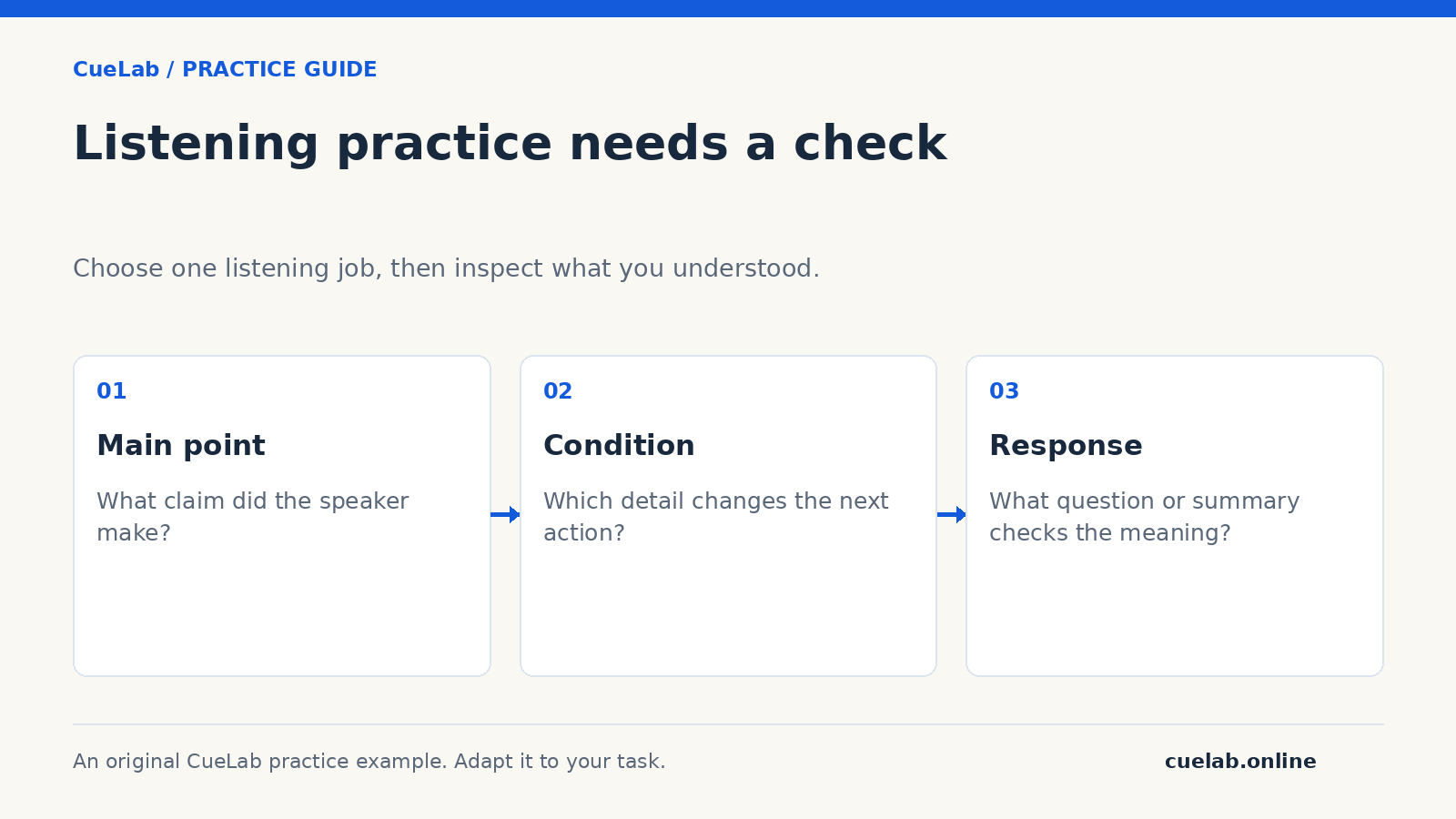
To understand how to improve listening skills, choose a specific listening job. Following a spoken instruction, understanding a colleague’s concern and identifying the argument in a talk require related but different actions. “Pay more attention” is too vague to tell you what to practise next.
The drills below use short, low-stakes material and visible checks. They are communication practice, not a test of intelligence, hearing or a clinical condition. Use a transcript, captions, a written version or another access support when it helps. The aim is useful understanding, not proving that you can manage without support.
Choose a listening target before pressing play
Write the question you want the material to answer. For a short announcement, the target may be the action, place and deadline. For an explanation, it may be the main claim and one supporting reason. For a conversation, it may be the problem the other person wants to solve.
Use material that you can inspect afterward, such as a short recording with a transcript or a practice instruction written by a partner. A checkable source lets you distinguish what was actually said from what you assumed. Avoid using a private conversation as a recording exercise without permission.
Drill 1: separate the main message from supporting detail
Listen to a short explanation once, then write its main point in a single sentence. Add one example the speaker used. Compare your sentence with the material: does it describe the speaker’s claim, or only name the topic? “The talk was about meetings” is a topic. “The speaker argues that each meeting should end with a named next action” is a claim.
Replay only the part needed to check the claim. Revise your summary and identify which word changed the meaning. A good practice result is not an exact copy of the speaker’s sentence; it is a fair account that preserves the point and any important qualification.
Drill 2: capture an instruction as actions
Ask a partner to read a three-step practice task. Write the actions in order, including a condition or deadline if one is stated. Then explain your next action back to the partner. Ask them to identify one difference between their instruction and your interpretation.
Practice instruction: “Choose one paragraph, underline its claim, then add a question about the evidence. Submit the marked paragraph before the discussion starts.” A useful note preserves both the sequence and the submission condition. Merely remembering “paragraph” and “evidence” would not establish that you know what to do.
Drill 3: ask a question that repairs a specific gap
Replace a general “What?” with a question about the missing part. You might ask, “Which version should I use?” or “Does Friday mean before the morning meeting?” The question should help you act or interpret, rather than make the speaker repeat an entire explanation without knowing what was unclear.
In practice, pause a short recording at an ambiguous phrase and write the question you would ask. Check whether the next part answers it. This trains you to notice a gap while preserving the speaker’s route, instead of inventing a meaning and treating it as settled.
Drill 4: check a conversation summary without adding advice
Use a fictional exchange with a partner. One person describes a planning difficulty for a minute. The listener summarises the situation and asks whether the account is accurate. For example: “You have two deadlines on the same afternoon, and you need to decide which can move. Is that the main problem?”
The speaker corrects the summary before either person proposes a solution. This creates a useful distinction between understanding and helping. Advice can be sensible but mistimed when it answers a problem the other person did not actually describe.
Drill 5: distinguish a claim, a reason and a qualification
| Listen for | Example | Check |
|---|---|---|
| Claim | “We should use a shorter briefing.” | What action or position is proposed? |
| Reason | “The current briefing repeats the written update.” | Why is that proposal being made? |
| Qualification | “Except when the team needs to resolve a disagreement.” | When does the proposal need adjustment? |
Choose a short talk and make three notes under those labels. If the speaker does not provide a reason or qualification, record that absence rather than invent one. You can then ask a useful follow-up question. This drill is particularly helpful when a confident delivery makes an incomplete argument sound finished.
Drill 6: improve listening in an additional language
Choose a short segment with a readable transcript. First listen for the overall message. Next, inspect the transcript and mark the phrase that changed your interpretation. Listen again to connect that wording with its spoken form. Use the same segment to explain the meaning in your own words.
Do not judge progress only by the speed or length of material. A shorter segment with unfamiliar vocabulary may require more work than a longer familiar one. Select material that lets you practise one challenge, such as a contrast word, a sequence or a stated condition.
Use a four-session practice record
- Session 1: write the main claim and one example from a short explanation.
- Session 2: convert a spoken task into an ordered action list.
- Session 3: practise a summary and accept a correction from a partner.
- Session 4: repeat one earlier task with comparable material and note the difference.
Record what you missed and what repair helped. “I omitted the condition after ‘unless’” gives you a target for the next session. “I am a bad listener” does not. Progress may vary with fatigue, noise, language familiarity and the task, so compare the conditions as well as the result.
Common questions
How can I improve listening skills in communication?
Practise a specific action: summarising meaning, recording an instruction, checking an unclear condition or distinguishing a claim from its evidence. Use material or a partner that allows you to check the result.
Should I take notes while listening?
Take notes when they support the task. Short labels may help you retain a sequence, while extensive transcription may distract you from the main point. Try one method and inspect what you understood.
Does good listening require eye contact?
No. Check understanding through the exchange rather than impose a fixed gaze or posture. People can listen effectively while using different communication and access strategies.
Related guides: six active listening conversations; why instructions can be missed.

