Formal and Informal Communication: Differences, Channels and a Worked Case
Formal and informal communication differ in how an exchange relates to an organisation’s recognised arrangements. A manager’s approved task instruction follows an official route. A colleague’s spontaneous conversation may travel through personal working relationships. Both can carry useful information, and either can be spoken, written, helpful or misleading.
The distinction matters when someone needs to act, approve a change or find a reliable record. A friendly message can still be an official instruction; an elegantly worded rumour is still unconfirmed. This guide uses an original, fictional student-event case to show the difference between the route, medium and tone of a message.
What makes a communication route formal?
A formal route exists because the group has recognised roles or procedures. Examples include a supervisor assigning work, a committee recording an approval and a student representative submitting a request through an agreed process. Formal does not mean that every message must pass through the most senior person. An authorised working group may exchange routine information directly.
Informal communication develops through relationships rather than the designated reporting arrangement. Two volunteers might discuss a confusing instruction after a meeting. That conversation can expose a problem quickly, but it does not automatically authorise a budget change. The practical question is what the exchange establishes and whether the people involved have authority to establish it.
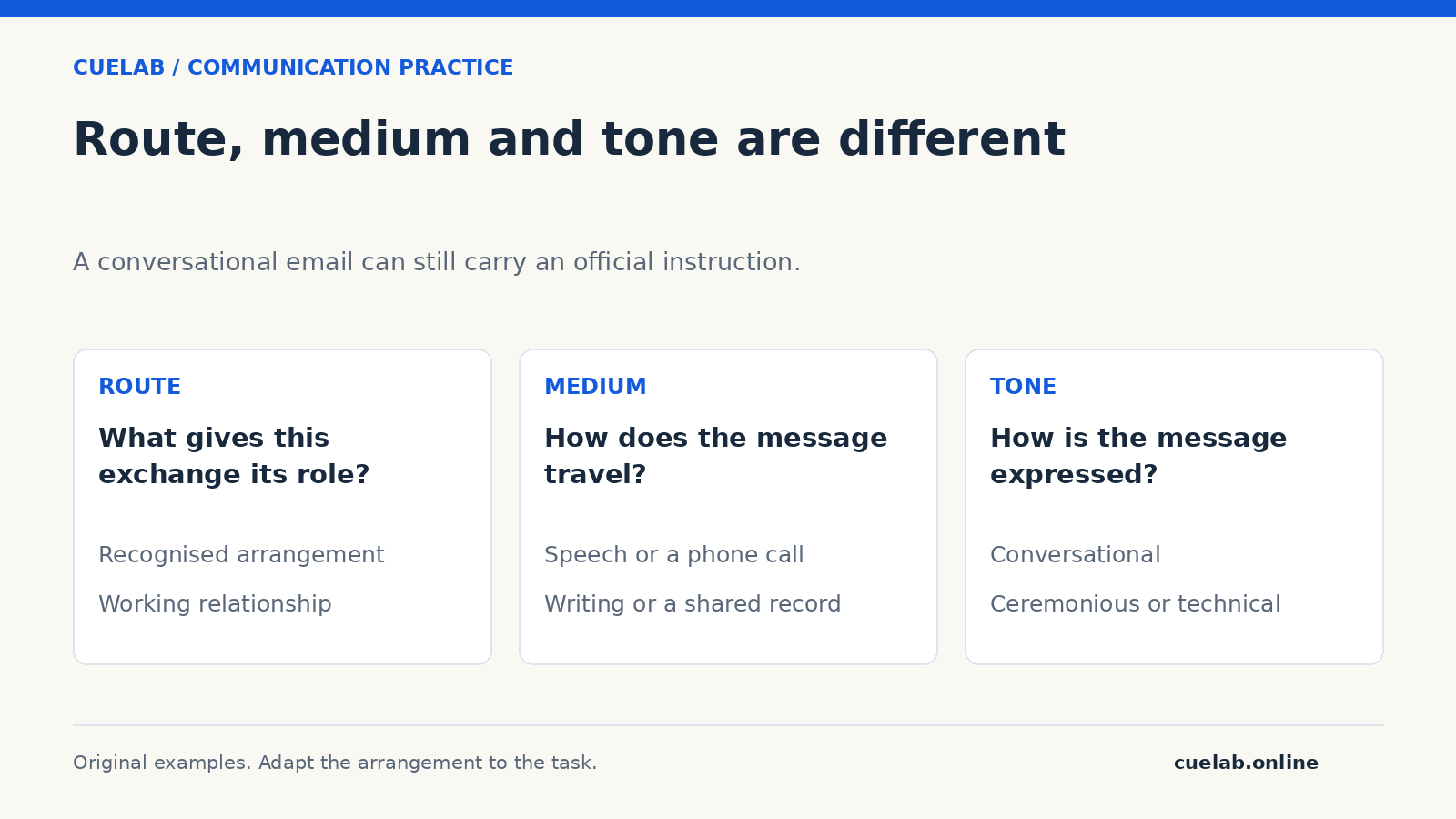
Keep route, medium and tone separate
| Dimension | Question | Example |
|---|---|---|
| Route | Does this follow a recognised role or procedure? | The event coordinator confirms the agreed opening time. |
| Medium | How does the message travel? | A conversation, phone call, email or shared notice. |
| Tone | How is the message expressed? | Conversational, ceremonious, direct or technical. |
| Record | Where can the current decision be checked? | An approved run sheet with an owner and revision date. |
Suppose the coordinator writes, “Hi everyone, the opening is now at 10. Please use run sheet B.” The relaxed greeting does not make the instruction informal if changing the schedule is part of that person’s role. Conversely, “It has been determined that the opening may move” is not an official decision when nobody can identify who determined it.
Types of formal communication: look at the direction
One common way to describe types of formal communication is by direction. These labels describe the relationship between roles; they do not tell you whether the wording is courteous or the information is accurate. Organisations may use different names, especially for cross-functional work.
| Direction | Working meaning | Event example |
|---|---|---|
| Downward | From a role with responsibility for directing work to the people carrying it out. | The coordinator gives stewards the approved entry procedure. |
| Upward | From people carrying out work to a role responsible for a decision or response. | Stewards report that the entry queue blocks an accessible route. |
| Horizontal | Between people or units at a comparable organisational level. | The seating and registration leads coordinate the same arrival time. |
| Diagonal or cross-functional | Across both department and role boundaries where the arrangement permits it. | A volunteer checks a room requirement directly with the venue technician. |
The diagonal example is formal only if that direct contact is permitted within the event’s arrangements. Otherwise, it may be a useful informal enquiry that still needs confirmation. Do not use a direction label as a substitute for checking responsibility.
A worked case: an informal warning becomes a recorded change
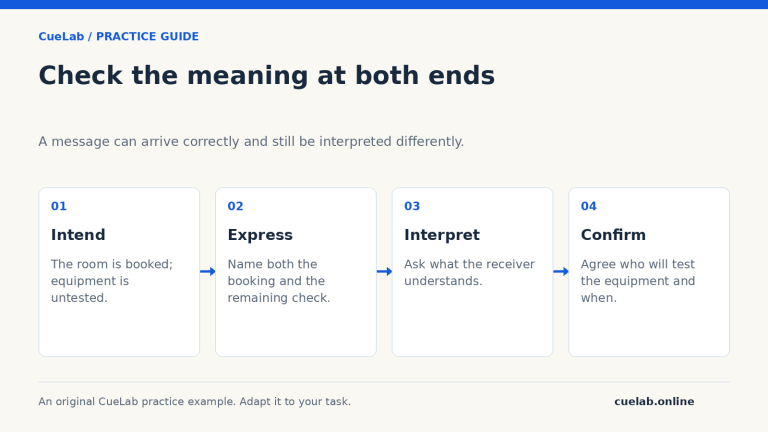
During a break, one volunteer says the side entrance is difficult to find. Another explains that a delivery vehicle may occupy the usual sign position. The information is useful, but neither volunteer knows whether the delivery time is confirmed. Treating the conversation as a final instruction could create two competing entry plans.
- Capture the issue: “The usual sign position may be unavailable during arrival.”
- Separate known from unconfirmed: A vehicle was seen there; its arrival schedule still needs checking.
- Route the question: Ask the venue contact to confirm the available location.
- Record the authorised response: The coordinator updates the sign location in the run sheet after the check.
- Reach the affected people: Tell the stewards which version to use and ask whether the new position is clear.
This process preserves the value of the informal observation while making the eventual instruction traceable. It also avoids implying that volunteers should keep quiet until they can prove a complete solution. An early warning and an approved change perform different jobs.
Advantages and limits of each route
Formal arrangements can make responsibilities and decisions easier to locate. They can also be slow or incomplete when a procedure sends a simple question through several unnecessary steps. Informal exchanges can surface uncertainty and connect people quickly, but information may lose its context as it is passed on. Neither description guarantees a particular outcome.
Choose the route according to the consequence. Exploring an idea may begin with a conversation. Changing an agreed deadline needs an identifiable decision and a record accessible to the people affected. A sensitive concern may require a designated reporting route rather than a public group chat. Follow the organisation’s actual process instead of inventing authority for yourself.
Handle the grapevine without repeating a rumour as fact
The grapevine is a common name for informal organisational communication. It can carry accurate information, partial information, speculation or a mixture. If someone says, “I heard the event is cancelled,” ask what has been confirmed and where the current announcement can be checked. Avoid forwarding the claim simply because it came from several people who may all share one source.
A useful response is, “I have heard the same concern, but I have not seen a cancellation notice. The coordinator is checking the venue; the next update will be in the event channel.” This makes uncertainty visible and gives people a place to look. Do not promise an update time that the responsible person has not agreed to meet.
Practise choosing a route
For each situation below, name the information you need, who can provide it and what needs a record. More than one route may be useful at different stages.
- A colleague spots a typo in an approved poster: send the evidence to the poster owner, check the correction and make the current version identifiable.
- A volunteer suggests a better welcome phrase: explore it informally, then agree it with the person responsible if the team needs consistent wording.
- Two departments give different room times: ask the authorised contact to reconcile them and issue one confirmed time to both groups.
Explain why your route fits the consequence. “Email is formal” is not enough: the same app can carry an official decision, a personal conversation and an unverified claim. For the handoff itself, use CueLab’s team communication agreement guide.
Common questions
Is informal communication always unofficial or unreliable?
It is outside the designated formal route, but that does not make every statement false. Check the evidence and the speaker’s authority separately. An informal exchange may lead to a reliable formal decision.
Can formal communication happen face to face?
Yes. An authorised instruction or review can be spoken. When people need to act later, confirm the important decision, owner and timing in an appropriate record.
Is horizontal communication the same as informal communication?
No. Colleagues at a similar level can coordinate through an official procedure or an informal relationship. Direction and formality are different dimensions.
For the wording of the message, see the seven-Cs editing examples. For a decision that needs comparable options, use the decision communication guide.