7 Cs of Communication With Examples: A Practical Message Editing Lab
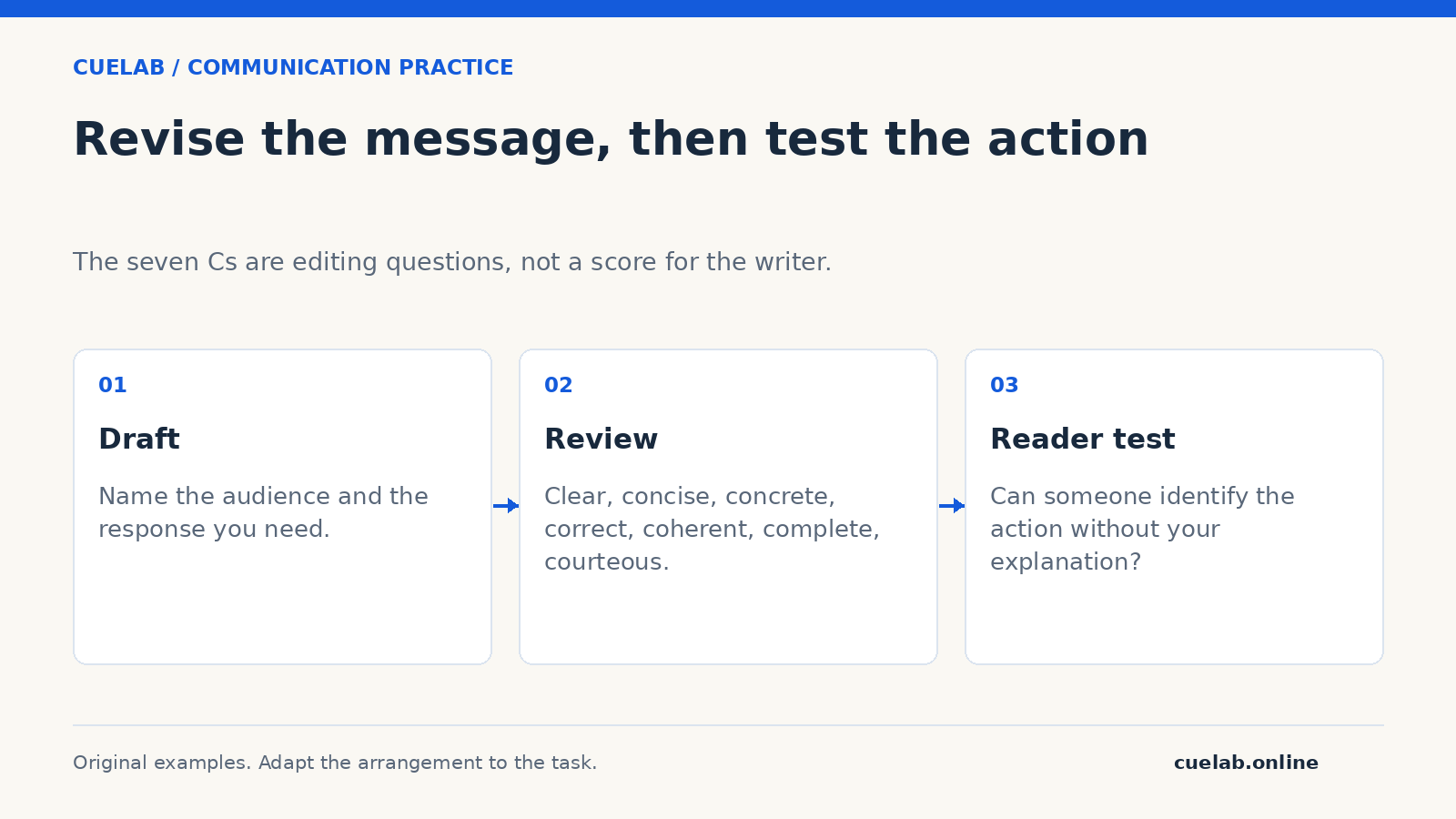
The 7 Cs of communication offer seven questions for revising a message: is it clear, concise, concrete, correct, coherent, complete and courteous? Their value is practical. A reader should be able to identify what the message means, what information supports it and what response is needed.
This guide gives original examples of each check, then applies the checks to one fictional message. Treat the framework as an editing aid, not a scientific score or a guarantee that everyone will agree. A well-written request can still be declined, and a polished sentence cannot repair a fact that has not been checked.
What are the principles of communication in this framework?
Here, the seven principles concern the quality of a message. They do not replace listening, consent, accessible formats or a suitable communication channel. Use them after you identify the audience, purpose and situation. A schedule change and an invitation to discuss an idea need different levels of detail.
| C | Working question | What to inspect |
|---|---|---|
| Clear | Can the reader identify the purpose? | Name the task, decision or main point. |
| Concise | Does each part earn its place? | Remove repetition while preserving useful conditions. |
| Concrete | Are the important details specific? | Replace vague references with identifiable facts or examples. |
| Correct | Are the information and language accurate? | Check names, figures, dates, links and wording. |
| Coherent | Do the parts connect logically? | Group related points and explain the relationship. |
| Complete | Is the information needed to respond present? | Include the relevant action, context and constraints. |
| Courteous | Does the message respect its recipient? | Make requests without insults, blame or assumed motives. |
Some courses use “consideration” in a seven-C list, while this guide uses “coherence.” Follow the terminology required by your course. The presence of different versions is a reason to explain your chosen list rather than mark a reasonable alternative wrong without checking the syllabus.
1. Clear: identify the job of the message
Draft: “There are a few things regarding the display.” Revision: “Please check the dates on the display labels before printing.” The revision names the task. It does not require the recipient to infer whether you are announcing, requesting or complaining.
Read the opening on its own. If a new reader cannot say why they received it, move the main purpose earlier. For a message with two unrelated actions, consider separate messages or clearly labelled sections so that one request does not disappear behind the other.
2. Concise: remove repetition without removing meaning
Draft: “At this point in time, we are currently waiting for your response.” Revision: “We are waiting for your response.” The shorter version preserves the meaning. Cutting “by noon, so we can submit the booking” would be a different choice because that condition helps the reader act.
Concise does not always mean the fewest possible words. “Send it” is short but may be unusable. A longer sentence naming the file and destination can save a follow-up exchange. Judge brevity against the audience’s task.
3. Concrete: replace a vague reference with something identifiable
Draft: “The instructions need improvement.” Revision: “The instructions name the starting point but omit the return location.” The second statement identifies a feature someone can inspect. It also leaves room to disagree about the proposed solution.
Use detail that matters to the decision. A precise-looking number is not automatically accurate. If an estimate is uncertain, label it as an estimate and explain which condition could change it. Specific language should clarify evidence rather than disguise a guess.
4. Correct: check the claim as well as the spelling
A message can be grammatically tidy and factually wrong. Before sending a schedule, compare its date and time with the current approved record. Before attaching a document, check its version and whether the intended recipient can access it. Correcting a typo does not confirm the underlying arrangement.
Example: a fictional draft says “Room 6, 2 pm,” while the booking record says “Room 4, 2 pm.” The necessary revision is the room number. Do not invent a different date to make an example look more complete; use the actual information available to you.
5. Coherent: connect information in a useful order
Draft: “We need your choice today. The room has limited capacity. There are two layouts. The reply address is below.” A coherent revision groups the reason and the decision: “The room holds fewer seats in the discussion layout. Please choose discussion or theatre seating today so we can confirm the capacity.”
Look for unexplained jumps, competing terms and a conclusion that does not follow from the preceding detail. Useful order depends on the task. A quick action request may put the action first; a sensitive explanation may need a brief acknowledgement before the request.
6. Complete: provide enough information for the next step
Draft: “Please review the plan.” A more complete version identifies which plan, what kind of review, how to respond and any real deadline: “Please check the access arrangements in version B and add comments beside the relevant step by 3 pm.” The message does not need every detail of the project’s history.
Ask a reader to attempt the task using only the message. Where do they have to guess? That gap may be a missing condition, an inaccessible reference or a decision you have not actually made. Add what is needed, or state what remains unresolved.
7. Courteous: make a request without assigning a motive
Draft: “You ignored the changes again.” Revision: “The latest copy still uses the earlier room. Please change it to Room 4 before sending the invitation.” The revision identifies the problem and request without asserting why it happened.
Courtesy does not require pretending a serious issue is harmless. You can state a consequence and a boundary directly: “We cannot print until the dates are confirmed.” Avoid adding a polite opening to an accusation and assuming that fixes the tone. CueLab’s assertive request guide develops that distinction.
A worked editing exercise with an answer
“Hi, please sort that thing for next week urgently. Everyone already knows the details. Send it back when you can.”
First list the missing facts instead of guessing them. What is “that thing”? Which part needs work? Is there an agreed date? Where should the response go? After checking those facts, suppose the task is to review the session titles in programme B by 3 pm on Thursday so that printing can begin.
One possible revision: “Hi Sam, please check the session titles in programme B and put corrections in the comments by 3 pm on Thursday. We need the approved titles before printing. If that timing is not workable, please tell me today so we can agree the next step. Thank you.”
The answer is not unique. It is clearer about the action, more specific about the object and complete about the response. It replaces an unexplained urgency label with a reason. Correctness still depends on whether the file, deadline and printing arrangement are true.
Use the checks without turning them into a score
Choose a recent message of your own. Write the intended response in one sentence, check the seven questions, then revise only the parts that block that response. Ask someone to identify the action without your explanation. Record the remaining uncertainty rather than awarding yourself seven points because each label appears on the page.
For a broader revision vocabulary, see communication skills notes. For a complete workplace email, apply these checks alongside the professional email examples.