24 Thesis Defense Questions, with Answer Planning Notes

Thesis defense questions ask you to explain the decisions behind your research: why the problem matters, how you investigated it, what the findings support, and where the work stops. Preparing a polished summary helps, but preparation becomes more useful when you can move from a direct answer to the specific passage, figure, or decision that supports it.
The 24 questions below are practice prompts, with notes for building answers from your own thesis. They are not a prediction of your examiners’ questions. Oral examinations differ across institutions, subjects, and degrees, so check your department’s requirements and your supervisor’s guidance before planning a presentation, bringing notes, or arranging a mock session.
Prepare an answer route, not a memorized performance
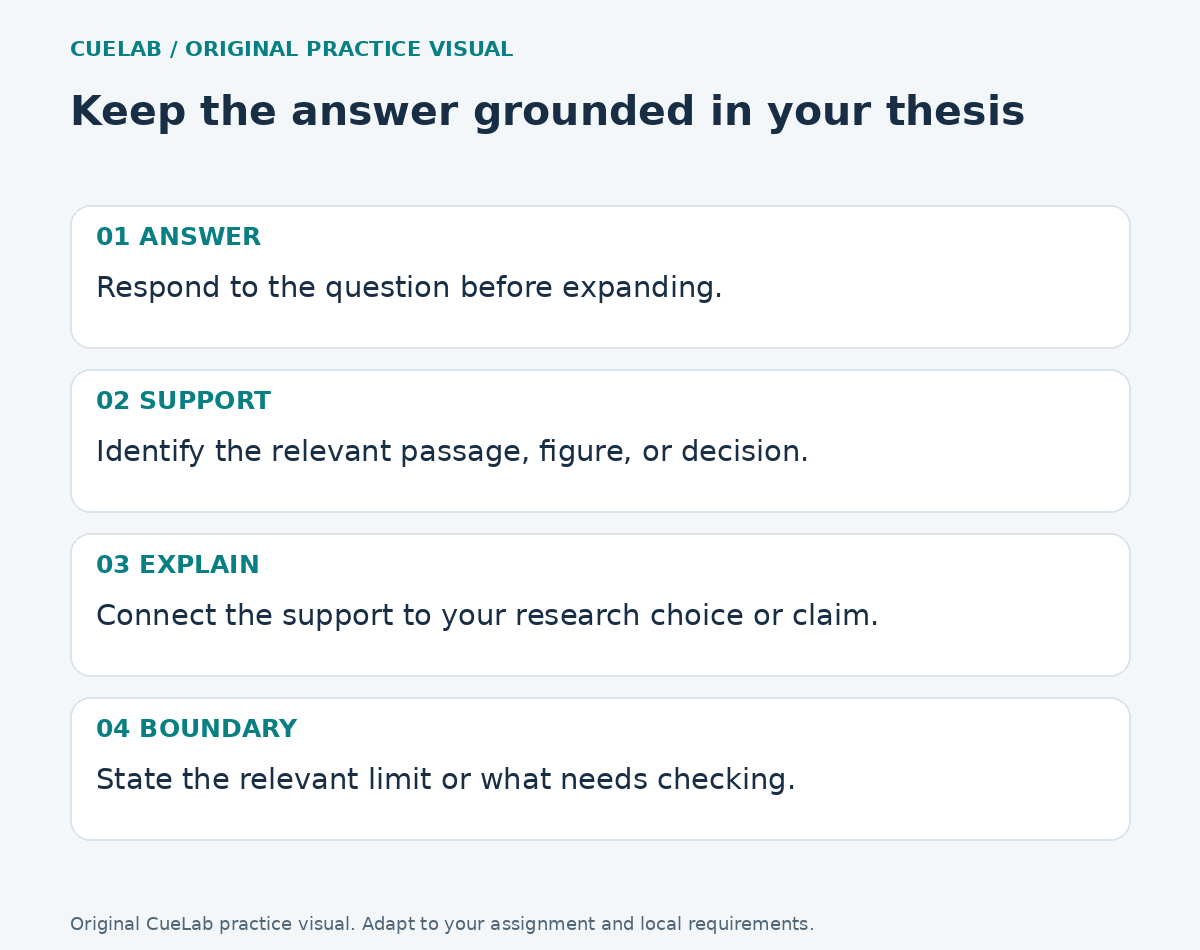
A useful answer has four parts: answer the question, identify the relevant support, explain the connection, and state a boundary where one matters. You do not need to announce those four parts aloud. Their purpose is to keep a response grounded when a question is unfamiliar or narrower than the explanation you rehearsed.
Suppose the examiner asks why you used interviews. Start with the research purpose and the information interviews could provide. Then explain the choice against a plausible alternative and acknowledge what the design cannot establish. Reciting the whole methods chapter delays the answer; claiming the method was simply “the best” hides the reasoning the examiner is trying to examine.
Purpose and contribution: four questions to clarify the project
1. What question does your thesis answer?
Give the research question in ordinary language before introducing specialized terms. Identify the phenomenon, population, material, or context you investigated and the kind of answer you sought. If the project contains several questions, explain which one organizes the others. Check that your spoken version matches the scope of the submitted thesis.
2. Why was this question worth investigating?
Connect the question to a specific intellectual or practical problem. Distinguish evidence that the problem exists from a general statement that the topic is important. You can discuss an unresolved explanation, a neglected setting, a methodological difficulty, or a decision that lacks adequate information, provided the thesis supports that account.
3. What is the main contribution of your work?
Name what the thesis adds and show where that contribution appears. A contribution may concern an interpretation, dataset, method, theoretical argument, or carefully bounded finding. Avoid claiming that nobody has ever studied the area unless you can defend that statement. “This study examines this question in this setting” is often more precise than “This is completely new.”
4. How did the project change from its original plan?
Choose a meaningful change and explain its reason, effect, and documentation. Perhaps access changed, an assumption proved unsuitable, or the question became more focused. Explain how you kept the final design coherent. A change is not automatically a weakness; an unexplained change that affects interpretation needs attention.
Literature and concepts: four questions about the argument
5. Which previous work most influenced your approach?
Select the work that shaped a real decision, rather than listing the most famous names in the field. Explain what you adopted, questioned, or extended. Keep the relevant reference and thesis section easy to locate so you can distinguish your position from the source’s original argument.
6. Why did you choose this theoretical or conceptual framework?
Explain what the framework helps you notice or explain and how it connects to the research question. Identify an alternative and the difference it would make to the analysis. Do not claim that a framework is neutral or inevitable if choosing it shaped the categories, questions, or interpretation.
7. How do you define the central term in your thesis?
State the definition you actually used and explain why that meaning is appropriate here. If everyday usage differs, make the distinction clear. Where the concept became a measurement, coding category, or inclusion rule, show how the definition guided that operational decision and what it left outside the study.
8. Where does your argument disagree with the literature?
Describe the disagreement accurately before defending your position. Check whether you are comparing the same question, context, and type of evidence. Different findings may reflect different methods or conditions rather than a direct contradiction. An examiner may be testing your reading of the debate as much as your ability to defend your own view.
Design and methods: four questions about your choices
9. Why was this design suitable for the research question?
Connect the design to what you needed to learn. Explain the inference it permits, the assumptions it requires, and one important alternative. For an experimental study, an interpretive project, or a theoretical thesis, the relevant justification will differ. Use the standards appropriate to your discipline instead of borrowing a generic defense of “research.”
10. How did you choose the participants, cases, or material?
Explain the selection criteria, access conditions, and exclusions. Show how the selection relates to the claim you make. If the material is limited to one setting or archive, discuss that boundary directly. A small exploratory sample needs a different justification from a claim about a population estimate.
11. How did you check the quality of the evidence or analysis?
Name checks that you actually performed and explain what each check addressed. Depending on the project, these could involve calibration, sensitivity analysis, source criticism, coding discussions, validation against another dataset, or a documented analytic trail. Avoid listing fashionable checks that do not appear in your research record.
12. What would a different method have allowed you to learn?
Compare the information available from the alternative with what your chosen method produced. Explain the practical and conceptual tradeoffs. You can recognize that another design would answer a useful question without accepting that your own design failed. The key is whether your claims remain aligned with the work you completed.
Findings and interpretation: four questions about the evidence
13. What is the most important finding?
Choose the finding that matters most to the research question, then identify its supporting analysis. Keep the finding separate from its possible application. If several results pull in different directions, explain that pattern instead of selecting only the result that makes the clearest presentation slide.
14. How does this figure, passage, or example support your claim?
Walk through the relevant evidence at the level the question requires. Explain labels, comparisons, context, and the step from observation to interpretation. Prepare to identify what the figure or example does not show. This is especially useful when a familiar visual has become so familiar that you stop explaining its logic.
15. What is a plausible alternative explanation?
Present an alternative that deserves consideration, not an obviously weak opponent. Explain whether your design or analysis helps distinguish it from your preferred account. If the evidence cannot decide between them, say what remains unresolved and what additional work could help. Recognizing an ambiguity is more useful than overstating certainty.
16. Was anything unexpected, inconsistent, or difficult to interpret?
Identify a real issue from the research and describe how you handled it. Explain whether it changed an analysis, weakened a claim, or suggested a further question. An unexpected result does not require a confident retrospective story. Distinguish an explanation supported by evidence from a possibility you would investigate next.
Limits and ownership: four questions about the boundaries
17. What is the most consequential limitation?
Choose the limitation that most affects interpretation and explain its consequence. Saying “the sample was small” is incomplete unless you explain which inference becomes uncertain. Discuss any mitigation you actually used, then state the remaining boundary. Avoid turning every limitation into a disguised strength.
18. Where could these findings reasonably apply?
Separate what you studied from a broader setting you would like to understand. Explain the similarities and differences that matter for transfer, generalization, or application in your discipline. A recommendation may require additional evidence even when the underlying finding is sound within the study’s setting.
19. What work was specifically yours?
Describe your contribution accurately, including collaboration, supervision, shared datasets, technical assistance, and previously developed methods where relevant. Prepare a clear account of who made each important decision. You can take ownership of your analysis without claiming that every part of a collaborative research environment was independently created.
20. What ethical or access issues shaped the project?
Explain the issues relevant to your actual work and the approvals or procedures you followed. Connect them to design decisions, such as what information you collected or how you reported it. Prepare examples without exposing participant identities, restricted material, or confidential records during the examination.
Implications and next steps: four questions that look forward
21. What should a reader do differently because of this work?
Make the recommendation proportional to the evidence. A study may justify reconsidering an assumption, testing an intervention, or examining a neglected condition before it justifies changing policy. State who the recommendation concerns and what would need checking before someone acts on it.
22. What would you investigate next?
Choose a next study that addresses a specific unresolved question. Explain the proposed design and the information it would add. “Use a bigger sample” is only useful if you can say why size is the relevant obstacle and what kind of additional material would improve the inference.
23. What would you revise if you were starting again?
Identify a concrete improvement and its likely consequence. You might narrow the question earlier, document a decision more clearly, choose a different comparison, or improve a measure. Show what the completed project taught you about doing the research, without pretending that a redesigned study has already produced better results.
24. What evidence would make you reconsider your interpretation?
Describe a meaningful challenge to the claim: a conflicting observation, a failed assumption, or a stronger alternative account. Explain how you would assess it. This question is an opportunity to demonstrate that your interpretation has reasons and boundaries, rather than being a position you must protect regardless of the evidence.
A worked answer: explain a method without overselling it
Consider a fictional exploratory thesis about how students interpret instructions on a campus library webpage. The following answer illustrates a response to “Why did you use interviews rather than test a redesigned page?” It does not report a real CueLab study or supply findings for your own defense.
“The question in this project concerned how students described interpreting the existing instructions. Interviews let me explore those accounts and ask follow-up questions about wording and expectations. A comparison of page designs would address a different question about performance under specified conditions. My approach cannot establish that changing the page would cause an improvement. That would need a separate design and a clear measure of the outcome.”
The answer identifies the purpose, justifies the method against an alternative, and states a limit. In your own version, add the exact support available in your methods chapter and research record. If the examiner asks about how interviews were analyzed, move to that narrower issue rather than repeating the original justification.
Build a question-to-evidence map
Use a small preparation table instead of writing a script for every question. Record the actual page or section, a short answer, and the most important qualification. The table becomes useful when it helps you find evidence quickly and recognize a gap that needs another reading.
| Practice question | Where to look | What to prepare |
|---|---|---|
| Why this research question? | Introduction and literature review | The unresolved problem and the scope of your response. |
| Why this method? | Methods chapter and decision records | The inference you sought and an alternative you considered. |
| What supports the central finding? | Relevant analysis, figure, or passage | The connection between evidence and interpretation. |
| What is the main limitation? | Methods and discussion | The claim affected and the boundary that remains. |
| What comes next? | Discussion and unresolved questions | A specific further investigation and what it could clarify. |
Rehearse follow-ups and corrections
Ask a practice partner to choose a question and then ask one follow-up based on your answer. Useful follow-ups include “Where is that shown?”, “Why does that follow?”, and “Would the same explanation fit the alternative?” Rotate across chapters so the rehearsal does not become a memorized tour of your favorite result.
If a question is unclear, ask a concise clarification. If you notice an error in your response, correct it directly. If you cannot answer, distinguish what you know from what you would need to check. A calm, limited answer gives the examiner something concrete to discuss; inventing a citation or result creates a new problem.
Finish preparation by confirming the examination arrangements, required materials, and any presentation instructions through your own institution. Cambridge’s Physics and Chemistry degree-committee guidance for MPhil oral examinations is one example of an institution describing discussion of the thesis, the broader field, the candidate’s contribution, and future work. Your local rules remain the relevant instructions for your examination.
Plan the next practice session
Choose four questions from different groups, locate their supporting material, and rehearse answering the question before expanding the explanation. Use the presentation rehearsal timer to record the session. If difficult follow-ups interrupt your flow, practice handling a question you cannot answer and explaining uncertainty clearly.
Reference: University of Cambridge: MPhil Oral Examination. The 24-question practice set, answer route, evidence map, and fictional library example are original CueLab preparation material.