Encoding and Decoding in Communication: Examples and a Repair Map
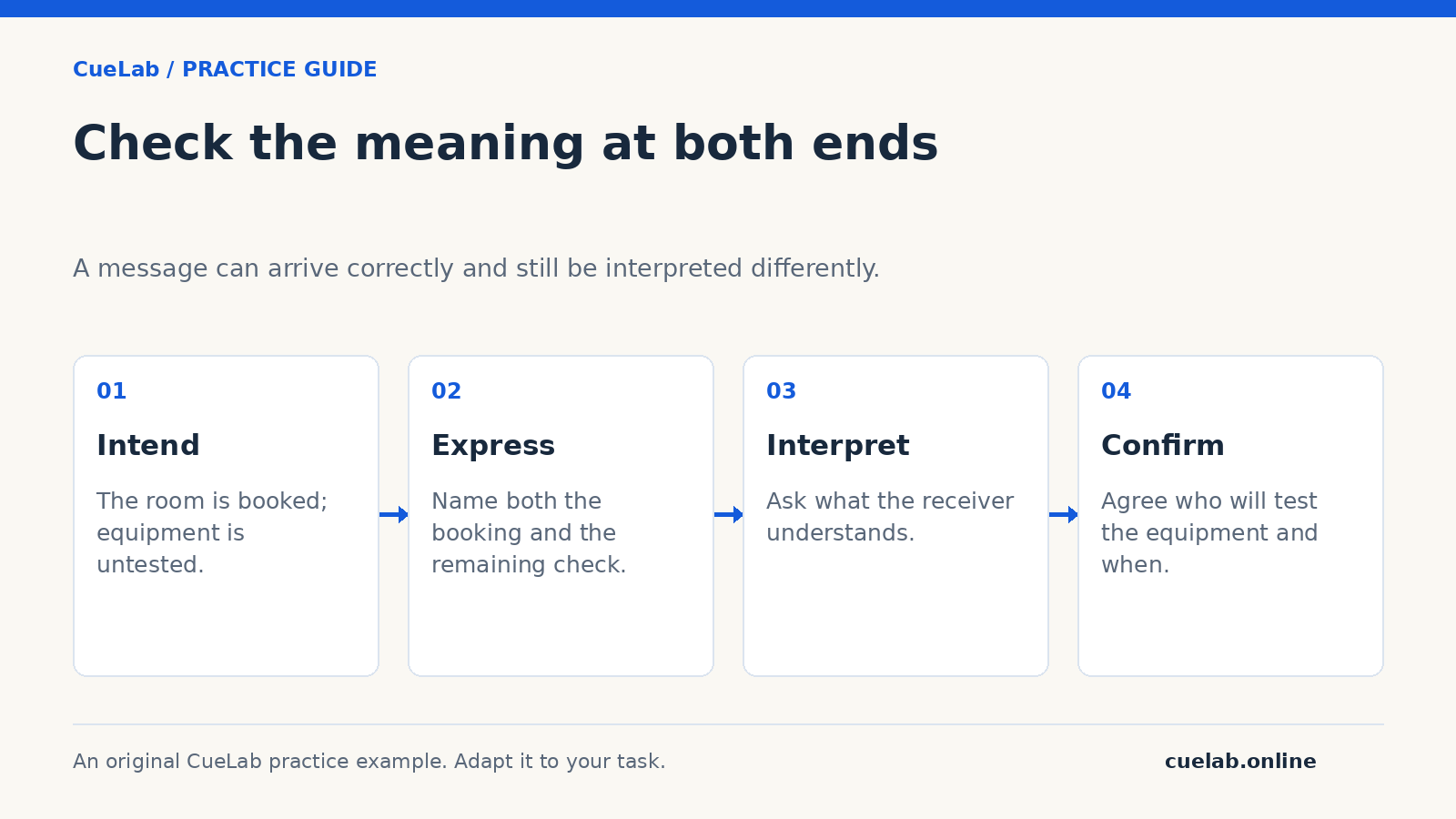
Encoding and decoding in communication describe two different jobs. Encoding turns an intended meaning into words, signs or another message form. Decoding is the recipient’s interpretation of that message. The two meanings can differ even when the message arrives exactly as sent.
Imagine sending “The room is ready.” You mean that the chairs are arranged, but the receiver assumes that the projector has also been tested. The missing detail concerns the meaning of “ready,” not necessarily the receiver’s attention. This guide uses original examples to show how to locate and repair that kind of gap.
A simple communication process map
Intended meaning → encoded message → channel → interpreted meaning → feedback is a useful diagnostic sketch. Real conversations are more interactive: people interrupt, clarify, revise and respond while the exchange is happening. The sketch helps you inspect one moment without claiming that all communication follows a neat one-way line.
Start by writing what you wanted someone to understand or do. Then record the actual words or visual they received. Ask what they understood. Comparing these three things is usually more informative than asking who “failed to communicate.” Feedback provides another message to interpret, so a brief acknowledgement can also need clarification.
Encoding and decoding: the difference in a practical task
| Stage | Question | Room-booking example |
|---|---|---|
| Intention | What do I need the receiver to know? | The room is booked, but equipment is untested. |
| Encoding | What message represents that intention? | “Booking confirmed. Please test the projector before 9.” |
| Channel | Where will the message reach the person? | The agreed event thread, with a named owner. |
| Decoding | What does the receiver take it to mean? | They understand that booking and equipment readiness are separate. |
| Feedback | What response checks the next action? | “I will test it at 8:30 and report any problem.” |
The table shows a proposed clear exchange, not proof that a particular wording always works. A new team member may need the room number, access instructions or the meaning of a local abbreviation. Encoding should take that audience knowledge into account.
Example 1: “Send it at the end of the day”
A coordinator means “before the review meeting at 4.” A teammate interprets the phrase as “before I log off at 6.” Neither person can recover the intended deadline from the phrase alone. Repeating the same sentence more loudly would not add the missing condition.
A repair is: “Please upload the review copy by 3:30 today, because the meeting starts at 4. If that is not possible, tell me by noon so we can reduce the scope.” The receiver might reply, “I can provide the text by 3:30, but the final illustration will arrive tomorrow.” That response reveals a real planning issue that an unqualified “okay” could hide.
Example 2: a colour-coded chart
A slide labels one group with a green bar and another with a red bar. The speaker says, “The green group improved.” A listener viewing a poor-quality printout cannot identify the group. The intended comparison has been encoded through colour without a reliable alternative.
Name the groups directly on the chart and in the explanation. “Group A increased from its baseline; Group B stayed near its starting value.” If the exact data matter, provide readable values or an accessible table. The repair changes the message form rather than treating a difficulty seeing the colour as a failure to pay attention.
Example 3: a familiar word with two local meanings
In one department, “reviewed” means checked for obvious errors. In another, it means approved for public release. A file named “reviewed invitation” can therefore trigger the wrong action at a handoff. The symbol arrived, but its meaning differed across the two groups.
Agree on status labels with actions attached: “draft: do not distribute,” “review copy: send comments,” and “approved: may distribute.” Introduce the labels in the shared brief. A glossary helps only if people know which version is current and what each label authorises them to do.
Example 4: a spoken instruction interrupted by noise
A teacher explains three steps while chairs are moving. A student hears the first and third steps but misses the second. This differs from interpreting a vague word: part of the message may not have been available at all. Ask which steps the learner received before deciding what to repeat.
Give the sequence in a short written form and ask the learner to identify their next action. “First choose one example; then compare it with the rule; finally write your explanation.” If the learner can repeat the words but cannot apply them, provide a worked example. Checking the next action distinguishes remembering the sentence from understanding the task.
Use the repair map before rewriting everything
- Record the intended action or meaning in one sentence.
- Copy the actual message without improving it yet.
- Ask for the recipient’s interpretation in their own words.
- Locate missing information, an access problem or a different assumption.
- Change one part of the message or channel and check again.
Avoid using the map as an interrogation. You are testing a shared understanding, not asking the receiver to prove loyalty by repeating your preferred words. In a sensitive exchange, explain why you are checking and allow the other person to correct your account of what happened.
Common questions
Does decoding mean agreeing with the message?
No. A person can understand a request accurately and still disagree with it or be unable to complete it. Check meaning and agreement separately.
Is encoding the same as encryption?
No. Here it means representing an idea in a communicative form. Encryption is a different technical process for protecting information.
What is the simplest example of encoding and decoding?
A speaker says “meet beside the main entrance,” and a listener identifies a place. If the building has two entrances, feedback is needed to establish which location both people mean.
Related guides: checks for communication barriers; why instructions can be missed.