How to Speak Slowly and Confidently
To speak slowly and confidently, give each important thought a clear ending, leave a little room before the next one, and prepare a simple way to recover when you rush. Start with a short passage you actually need to deliver. Trying to control every word of an entire presentation is a difficult first exercise.
You can still feel nervous while doing this well. A useful goal is to make your point easy to follow and know where you are going next. You do not need to sound unusually deep, remove your accent, or turn every sentence into a performance.
Find the exact moment your pace changes
Listen to a short sample of yourself explaining something familiar. Then listen to a section you find harder to deliver. Locate the first place where the words begin running together. Write down what happens immediately before it.
You might rush when a slide contains several figures, when you are unsure of the transition, or when you notice that your time is nearly up. Those situations call for different changes. A general instruction to “be more confident” does not tell you what to do at any of them.
| Where you rush | What to check | A useful change to try |
|---|---|---|
| The opening | Are you introducing yourself, the problem, and the agenda in one sentence? | Separate the purpose from the explanation. |
| A technical explanation | Does the sentence introduce several unfamiliar terms? | Define one term before adding the next. |
| A number or comparison | Does the listener know what each figure measures? | Give the label, figure, and meaning their own space. |
| A slide change | Are you planning your next words before finishing the current point? | Write a short transition cue. |
| The final minutes | Is the talk longer than the slot? | Remove a secondary example or explanation. |
Choose one row that matches your situation. It gives you a specific rehearsal task and a way to tell whether the change helped.
Put boundaries between complete thoughts
A sentence can be grammatically correct and still ask too much of a listener. Consider this illustrative project update:
We received thirty applications this week and six are incomplete so I suggest we send a checklist before the next deadline because otherwise the review team has to keep asking for missing information.
The listener has to hold the volume, problem, recommendation, and explanation in mind at once. Try delivering the same message as separate thoughts:
We received thirty applications this week. / Six were incomplete. // Before the next deadline, I suggest we send a short checklist. / That should tell applicants what to include before the review begins.
Here, `/` marks a small boundary and `//` marks the turn from the problem to the recommendation. They are rehearsal marks, not instructions to stop for a fixed number of seconds. Keep “thirty applications” together, and let the end of that thought be audible before moving on.
The change is in the organisation of the message. You can pronounce the individual words naturally while giving the listener a clearer route through them.
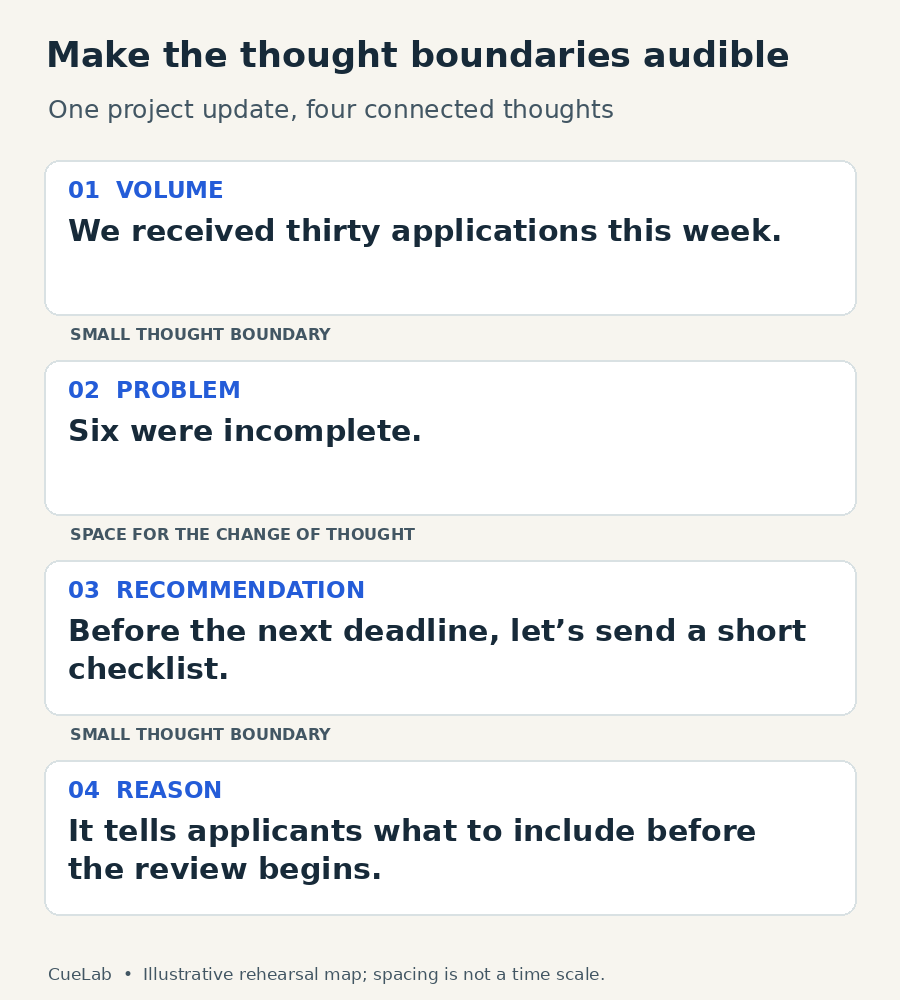
Keep connected words together. Put the space where the meaning changes.
Prepare the first twenty seconds separately
An opening often carries several jobs: get started, establish the topic, and find a comfortable rhythm. Give yourself a manageable first task by preparing two short sentences that tell the audience why they are listening.
For the application example, those sentences could be: “We need to make the next application round easier to complete. I’ll show you where applicants got stuck, then suggest one change.” Finish the first sentence before beginning the second. After that, move to the evidence.
Rehearse the opening from a standing start, including the moment when you look up from your notes. Then practise continuing in your own words. If you memorise every syllable, forgetting one phrase can feel like losing the entire route. A clear opening plus a few reliable cues gives you somewhere to go.
Give numbers and names enough room
Some words deserve more care because a listener cannot easily reconstruct them. A rushed connector such as “and then” is usually less costly than an unclear deadline, price, name, or recommendation.
In the example above, say what the figure counts: “We received thirty applications.” Then state the problem: “Six were incomplete.” If the distinction matters, add a plain-language explanation before moving to the proposed change. Avoid inserting a pause between “thir” and “ty,” or between someone’s first and last name.
Use emphasis selectively. Stressing every figure in a busy slide makes it difficult to hear which one matters. Decide which number the audience must remember and make the rest support it.
Let sentence length support comfortable breathing
Look for sentences that leave you trying to finish several extra words after you would naturally take a breath. Shorten them or divide them at a meaningful point. A comfortable breath can then fit between completed phrases.
For example, “I recommend the checklist because it gives applicants the requirements before they begin and reduces the need for repeated follow-up from the review team” can become: “I recommend a checklist before applicants begin. It would explain the requirements in one place. The review team could then focus its follow-up on individual questions.”
You do not need a rigid breathing count to practise this. If a phrase feels uncomfortable, rewrite it rather than forcing yourself through it. Sentence length, content, and delivery need to work together.
Keep your normal voice and finish the sentence
When practising slower delivery, listen especially to the last few words of each sentence. Do they remain audible, or do you hurry through them while thinking about what comes next? An otherwise clear recommendation can disappear in its final phrase.
Try saying, “My recommendation is to send the checklist on Monday.” Let “on Monday” arrive as clearly as “my recommendation.” Then stop before explaining the reason. You are giving the full message enough attention to reach its ending.
Keep a comfortable pitch and enough volume for the setting. A forced low voice, exaggerated pronunciation, or an unfamiliar accent gives you extra things to manage. Your existing voice can carry a well-structured point.
Remove the content that creates a sprint
Check whether the talk fits before treating pace as the main problem. If a rehearsal lasts twelve minutes and your slot is ten, you have a content decision to make. Speeding up may make the clock look better while making the explanation harder to follow.
Make two versions of your route: the complete version and the essential version. For the project update, the essential route might be the incomplete applications, the checklist recommendation, and the decision required. A second example and a detailed account of the review process can be held for questions.
Use the speech time calculator for an initial estimate, then time an actual rehearsal with your pauses and slide changes. Text length alone cannot show how long a demonstration or an audience response will take.
Write cues that tell you what happens next
“Slow down” is a reminder without a location. A cue such as “finish the problem; then recommend the checklist” tells you where to place your attention.
For the worked example, a small note could read:
30 received → 6 incomplete → checklist → decision needed
Put a visible break before “checklist” if that is where you tend to rush. Keep the note easy to find at a glance. A dense page of instructions can become another thing you feel obliged to get through quickly.
If you need precise wording, keep it for the sentence where precision matters. You can script the recommendation and use route cues for the explanation around it. The Speaking Rehearsal Worksheet and Timing Log has space to record pause locations and changes between rehearsals.
Build confidence around a recoverable route
Ask yourself a practical question: “If I forget the next sentence, can I still explain the next point?” If the answer is no, the presentation may depend too heavily on a memorised chain of wording.
Try starting from the recommendation rather than the opening. Explain it, give one reason, and state what the audience should do. Then start from the evidence. Being able to enter at different points gives you options when a question, interruption, or missed line changes the order.
This is a useful kind of preparedness even if you still feel nerves. You know the message well enough to deliver another clear version of it.
Use a simple answer pattern in interviews and meetings
In a conversation, you cannot always prepare a full route. You can prepare a small structure: answer the question, give the reason, then add an example if it is needed.
If someone asks, “Why would a checklist help?”, a measured response could be: “It puts the requirements in one place. At the moment, applicants have to find them across several messages. A short checklist would give them something to check before submitting.”
Finish that answer before supplying every possible detail. Let the other person ask a follow-up. If the question has two parts, name the order: “I’ll explain the timing first, then the cost.” That brief signpost gives both of you a route through the response.
When you need a moment to think, take it. You can also say, “Let me choose the clearest example.” Use the moment to decide what you mean, rather than feeling obliged to fill it with a fast opening that you then have to repair.
Recover when you notice yourself rushing
Choose a reset you can use without abandoning the message. Finish the current thought, stop, find your next cue, and begin again. If a figure was unclear, repeat the figure in a fresh sentence: “The number to keep in mind is six incomplete applications.”
A transition can help: “That explains the problem. Here is the change I’m proposing.” You have supplied useful structure while returning to a manageable pace.
If the real problem is the remaining time, switch to your essential route. You could say, “I’ll focus on the recommendation now and leave the process detail for questions.” Decide what to omit; do not try to recover the time by compressing every remaining point.
Try a five-minute practice session
Use a passage of around a minute so that you can make a change and hear the result within one short session. The timings below organise the practice; they are not a prescribed speaking speed.
- Minute one: Deliver the passage normally and keep the recording.
- Minute two: Find the one section where the message becomes hardest to follow. Mark a thought boundary or simplify a sentence there.
- Minute three: Deliver it again, concentrating on that one change.
- Minute four: Compare the difficult section in both recordings. Check whether the key words and the end of the sentence are clear.
- Minute five: Deliver the revised passage once more, then write the cue you want to keep.
If you finish early, use the remaining time to test the same point without reading. Avoid adding a new correction every time you repeat it. You need to know which change made the passage easier to deliver.
Extend the practice over a week
Use this as a flexible sequence. Repeat a day when a step needs more work, or combine steps when they are already comfortable. The aim is to transfer a useful change into the situation where you need it.
| Session | Focus | Evidence to keep |
|---|---|---|
| 1 | Find one recurring rush point. | A short baseline recording and a note about where it happens. |
| 2 | Divide the difficult passage into complete thoughts. | A marked copy with only the necessary boundaries. |
| 3 | Clarify a number, name, or recommendation. | The exact words a listener needs to remember. |
| 4 | Reduce an overlong section. | An essential route that fits your available time. |
| 5 | Practise a question or interruption. | A clear answer and a return cue. |
| 6 | Rehearse in the intended setting where possible. | A timing that includes the real actions and transitions. |
| 7 | Ask someone to listen without seeing the notes. | Their account of the main point and any unclear section. |
For a timed talk, the rehearsal timer can help you compare sections. Record a change worth keeping beside the timing, so a faster rehearsal is not automatically treated as the better one.
Check what a listener understood
“Did I sound confident?” is a broad question. Different listeners may answer it using different expectations about pitch, accent, eye contact, or personality. Ask for something more concrete: “What change was I proposing?” or “Which figure did you remember?”
If the listener remembers the recommendation but confuses the two figures, work on the comparison. If the figures are clear but the point is missing, revise the explanation. This keeps feedback connected to what the audience needs from your speech.
Words per minute can help compare two recordings of the same material. It cannot tell you whether a crucial qualification was understandable. If your pace is comfortable but people still struggle to follow, use the clear-speaking diagnostic to check wording, articulation, volume, and other possible causes.
Choose one cue for your next real conversation
Select a cue small enough to remember while you are speaking: “finish the sentence,” “separate the number,” or “answer first.” Use it in one ordinary update or conversation before trying to manage a whole presentation with it.
Afterwards, note whether it helped and where you still felt hurried. Keep the useful change for the next attempt. Speaking with more control grows out of these specific adjustments: a clearer route, enough room for the important thought, and a way to continue when the delivery becomes uneven.
Source and further reading
MIT Biological Engineering Communication Lab: Public Speaking—How to Practice Effectively. Its guidance supports recording rehearsals, selecting a specific delivery habit, and practising a concrete solution in manageable sections. The application example, diagnostic table, five-minute routine, and weekly sequence in this article are CueLab editorial exercises, not results of a study or a validated training programme.