Cross-Cultural Communication: Examples, Better Questions and a Practice Session
Cross-cultural communication involves exchanges between people whose experiences, expectations or communication practices differ. National background can be one influence, but so can a profession, organisation, language community, generation or classroom. A useful starting point is to check what a particular person means rather than predict their preference from a group label.
This guide uses original, fictional workplace and student examples. It explains practical intercultural communication skills and gives a short training activity. The cases illustrate questions you can ask; they are not claims about how people from particular countries behave.
Intercultural and cross-cultural communication: a useful distinction
The terms are sometimes used interchangeably. In some academic contexts, cross-cultural work compares practices across groups, while intercultural work examines an interaction between people with different cultural experiences. Usage varies, so define your terms when writing for a course or project.
For everyday practice, focus on the exchange: what information is being shared, which expectation is unclear and how both people can adapt. The goal is not perfect knowledge of every culture. It is a respectful process for noticing uncertainty, checking meaning and agreeing how the work will proceed.
Principle 1: separate observation from interpretation
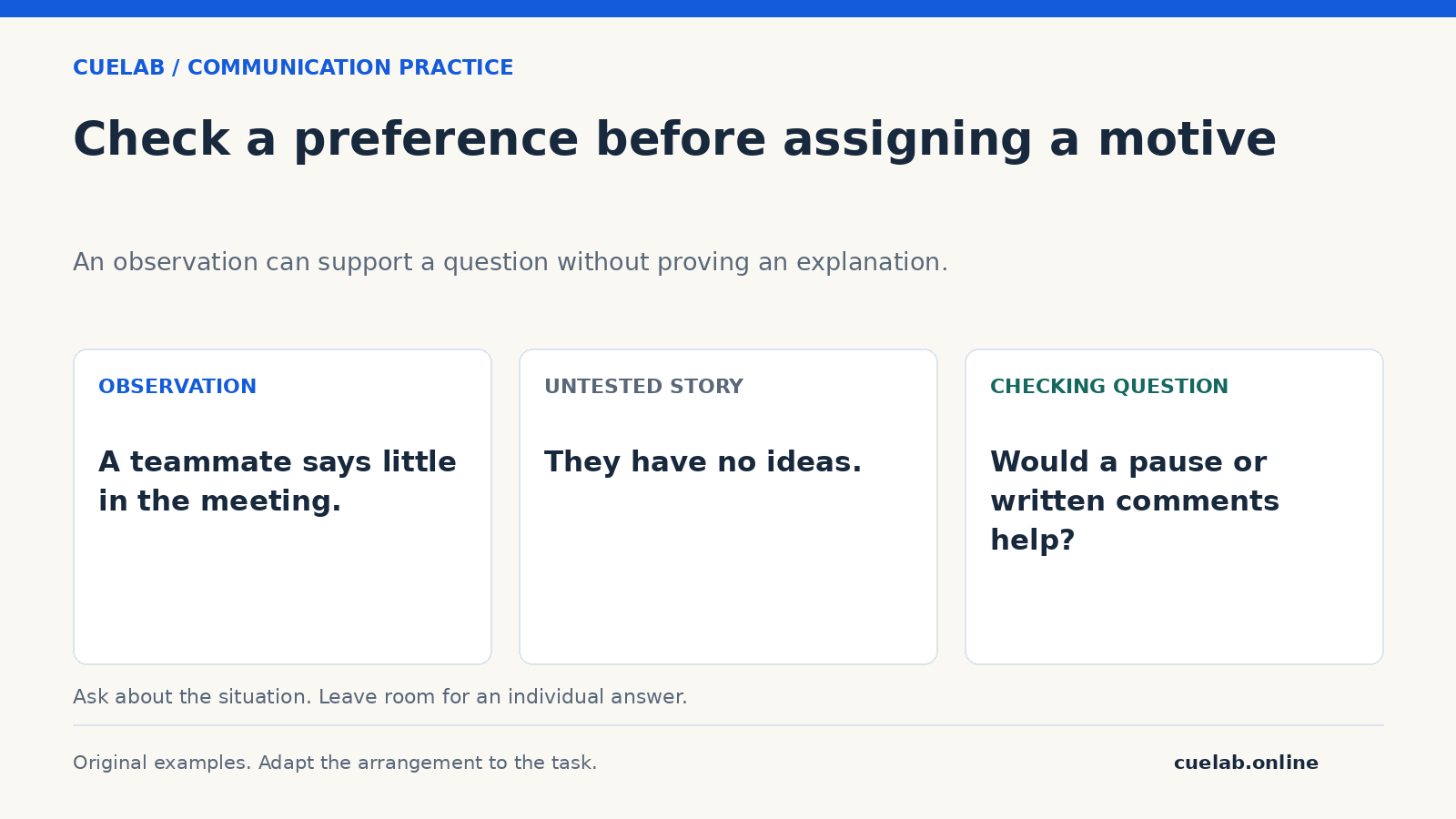
Observation: a teammate says little during the first meeting. Interpretation: “They have no ideas.” The observation does not establish that conclusion. The person may be considering the options, unfamiliar with the topic, unable to hear clearly or waiting for a different turn-taking cue.
Try: “We have discussed three options quickly. Would a short pause or written comments help before we choose?” The question offers a practical route into the discussion without asking the person to explain their entire identity. If they say they need more evidence, respond to that information rather than continuing to decode their silence.
Principle 2: notice your own default expectations
Write down what you usually expect from a meeting: how quickly people should answer, whether disagreement should be explicit and how a deadline should be confirmed. These preferences may feel obvious because you are used to them. Other people may have learned different arrangements or may simply prefer another way of working.
Self-awareness does not mean abandoning every expectation. It helps you distinguish a real task requirement from an unstated habit. “We need a confirmed room by Thursday because the invitation goes out Friday” explains a constraint. “A committed person would answer immediately” turns your preferred pace into a judgement about someone else.
Four cross-cultural communication examples with practical repairs
| Situation | Risky assumption | A checking response |
|---|---|---|
| A colleague says a proposal “may be difficult.” | They will probably do it anyway. | “Which condition is difficult, and should we plan an alternative?” |
| A student asks several detailed questions before agreeing. | They are trying to delay the group. | “Which information do you need before you can commit?” |
| An email uses a brief, direct request. | The sender is deliberately rude. | Check the task and relationship before assigning intent; clarify a practical concern if needed. |
| A teammate does not challenge the plan in a public meeting. | They have no reservations. | Invite a written concern or a later check before treating silence as agreement. |
Each repair can be useful even when culture is not the cause. A checking question should leave room for an individual explanation. Do not replace one unsupported story with a more flattering story and call it understanding.
Principle 3: make language easier to interpret
Avoid idioms when the audience may not share them. “Can we touch base after we get the ball rolling?” hides two actions behind figurative language. “Can we speak after the first task starts?” gives the listener less to decode. Explain an unfamiliar acronym at its first use and name the particular object you mean.
Plain language is not childish language. Keep the necessary technical term when it matters, but add an explanation or example. If a participant asks for repetition, change the wording or format when useful rather than repeating the same phrase more loudly. Ask which detail is unclear without making assumptions about general ability.
Principle 4: agree the working arrangement together
For a mixed team, discuss practical preferences near the start: how to raise concerns, where decisions are recorded, what a response deadline means and how people can contribute outside the meeting. Offer more than one workable route where possible. A written comment can be as relevant as an immediate spoken answer.
Make the agreement specific enough to test. “We respect all styles” is a useful intention but does not explain what happens when the group disagrees. “We will collect concerns in the document before Friday and record the decision with its reason” gives people an observable process. See the team communication agreement guide for a fuller handoff example.
A worked case: “soon” means different planning decisions
In a fictional student project, Dev asks Laila to send a draft “soon.” Dev expects it before a same-day rehearsal; Laila plans to send it in two days after reviewing the references. Neither person has stated the timing. Calling the problem a cultural difference does not establish what caused it or solve the immediate gap.
Dev can repair the request: “I did not explain the rehearsal timing. We need something to discuss at 4 pm today. Would a rough outline be possible by 3 pm, with the reviewed draft later?” Laila can say which part is feasible. The pair can then agree one version, its purpose and the later review point.
The useful learning is not that one person is “fast” and the other “slow.” They were planning different outputs. Explicit timing and scope make the disagreement discussable. The same repair applies when a professional, local or individual habit is the main influence.
A 20-minute cross-cultural communication training activity
Use three roles: speaker, listener and observer. Practise with a fictional, low-stakes situation rather than asking participants to reveal a private conflict. Participation should not depend on representing an entire nationality or answering intrusive identity questions.
- Minutes 0-3: read the “soon” case and write only the observable facts.
- Minutes 3-7: list at least two possible explanations for the gap, including one unrelated to culture.
- Minutes 7-12: rehearse a conversation that checks the output and timing without assigning blame.
- Minutes 12-16: the observer identifies the question that produced new information and any assumption that remained untested.
- Minutes 16-20: repeat one part of the exchange with a clearer question, then agree one practical lesson.
This is an example activity, not a validated assessment of intercultural competence. Evaluate the observable actions: did someone ask, clarify and adapt? Do not score a participant’s identity, accent, eye contact or similarity to the facilitator.
Common barriers and what you can change
Unexplained language, inaccessible formats, conflicting authority arrangements and assumptions about agreement can all obstruct an exchange. Choose a repair that addresses the actual difficulty. A glossary will not resolve an impossible deadline, and a friendlier tone will not make an unreadable document accessible.
When there is a power difference, an invitation to speak may not be enough. Explain how concerns will be handled and whether a private or written route is available. Respect a person’s choice not to discuss an identity detail that is unnecessary for the task. Mutual adaptation should not mean that only the less powerful person must change.
Common questions
Are country-by-country etiquette lists enough?
They may suggest things to ask about, but they cannot establish an individual’s preference. Treat broad descriptions as possible context and check the situation directly.
How can I improve intercultural communication competence?
Notice your assumptions, ask specific questions, listen to the answer and revise the working arrangement. Review one real or fictional exchange at a time rather than trying to memorise a fixed rule for every group.
Does a misunderstanding prove cultural insensitivity?
Not by itself. Identify the behaviour and its effect, seek clarification and respond to what you learn. Repeatedly dismissing a stated need is different from encountering an expectation you did not yet know.
For related practice, use listening drills and the context-first guide to nonverbal communication.