24 Persuasive Speech Topics for Teens, with Evidence Prompts
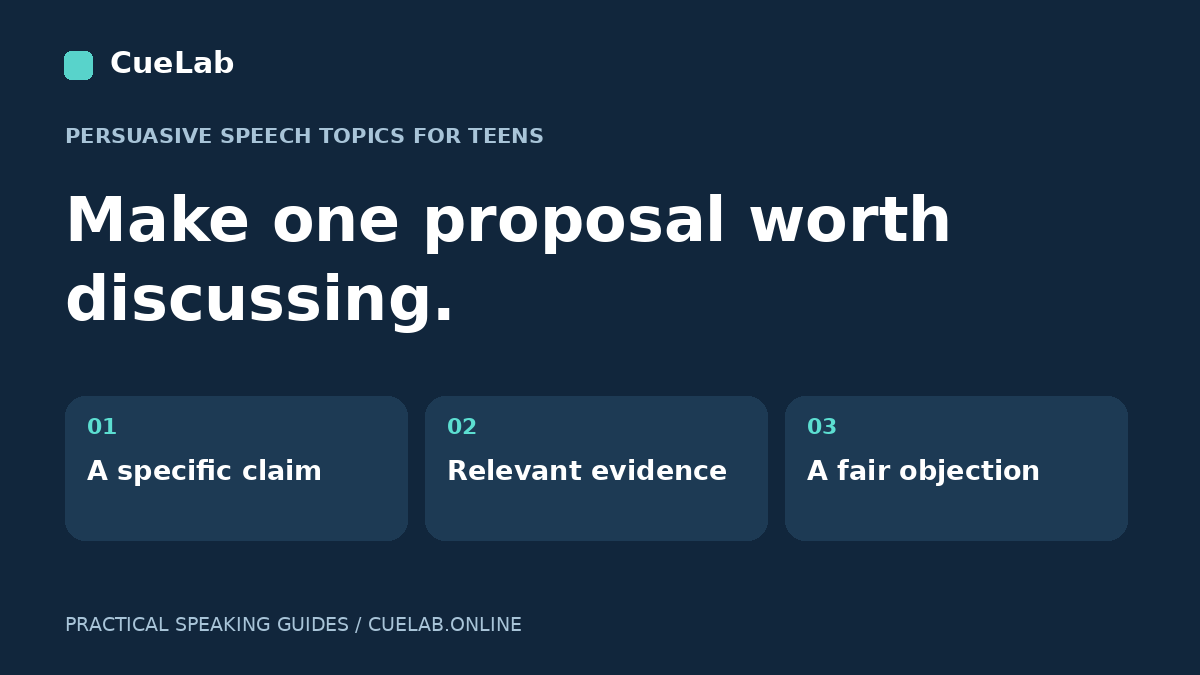
Strong persuasive speech topics for teens begin with a change that classmates can picture and a decision someone could realistically make. “Schools should improve” is too broad to argue well in a short speech. “Our school should publish one weekly deadline list for each year group” gives you a proposal, an audience, a practical problem, and questions you can investigate.
The 24 topics below are written as possible positions, not established facts or instructions that every school should adopt. Each includes a way to gather relevant evidence and a serious objection to answer. Choose a position you can support honestly, then adapt it to your assignment, school rules, and audience.
What makes a good persuasive topic for a teen audience?
A persuasive speech asks listeners to accept a claim, reconsider a view, or support a particular action. A topic becomes manageable when it identifies who should act, what should change, and why that audience should care. Your position can be modest and still give you plenty to argue.
The best choice is not always the most controversial issue in the room. A specific proposal about club information may let you build a stronger argument than a huge national policy you cannot explain fairly in five minutes. Consider your access to reliable evidence and your willingness to represent the opposing view accurately.
Turn a subject into a proposal
Start with a broad subject, such as school communication, and name the friction you want to address. Perhaps deadlines appear in several places and students are unsure which message is current. Your proposal could be a weekly summary with a named owner, while your argument would explain who would maintain it and how corrections would be handled.
This narrowing step protects you from making promises you cannot support. You do not have to prove that one summary would solve every communication problem. You need to show that the particular change is worth considering, with its likely benefits, effort, and limitations made clear.
Six topics about learning and classroom routines
| Possible position | Evidence to look for | Objection to answer |
|---|---|---|
| 1. Publish one weekly deadline summary for each year group. | Compare where current deadlines appear and ask who could maintain a summary. | A second list could become another outdated source. |
| 2. Give students a clear rubric before a major presentation task. | Compare a sample task with and without published assessment criteria. | Too much detail might make every presentation look the same. |
| 3. Let students submit one question before a revision session. | Use teacher-approved examples of unanswered questions and examine how they could be grouped. | Collecting questions may take time away from revision itself. |
| 4. Provide a short written recap after complex spoken instructions. | Choose a specific multi-stage classroom task and compare the available instructions. | Teachers may already have a heavy preparation workload. |
| 5. Include a brief practice round before an assessed group discussion. | Look at the assessment format and identify an unfamiliar part that practice could clarify. | Rehearsal could reduce spontaneity or use extra lesson time. |
| 6. Ask students to explain one piece of feedback before revising their work. | Examine anonymized sample feedback with permission and identify ambiguous wording. | An extra explanation step could delay the actual revision. |
Six topics about student voice and participation
These topics work best when you identify an actual decision-maker. A speech to classmates might ask them to support a proposal for the student council; it should not pretend they can change a school policy by themselves. Make the requested next step match the authority your listeners have.
| Possible position | Evidence to look for | Objection to answer |
|---|---|---|
| 7. Publish student-council proposals and their current status. | Review how proposals are currently submitted and how students hear the outcome. | Some discussions are private or still undecided. |
| 8. Give new club members a plain-language introduction sheet. | Compare the information newcomers need with the information they receive. | Club details may change too often for a printed sheet. |
| 9. Offer a written question route during large school meetings. | Inspect the meeting format and propose a manageable way to select questions. | Anonymous questions could be repetitive or inappropriate. |
| 10. State club costs and equipment requirements before sign-up. | Check a few current club notices and identify missing practical details. | Organizers may not know every cost in advance. |
| 11. Give event volunteers a short role description before they commit. | Compare a real or fictional volunteer request with a clear task-and-time version. | Some events require people to help flexibly. |
| 12. Make school suggestion forms available in both digital and paper formats. | Check how students currently access and submit suggestions. | Two channels create extra work and possible duplicate entries. |
Six topics about digital communication
| Possible position | Evidence to look for | Objection to answer |
|---|---|---|
| 13. Use a consistent subject-line format for school announcements. | Compare fictional or approved sample messages for clarity and findability. | A rigid format may not suit urgent or unusual messages. |
| 14. Ask permission before posting identifiable photos from a club event. | Check the school’s current photo procedures and what the proposed process would add. | Organizers may struggle to track changing preferences. |
| 15. Include captions in student-produced instructional videos. | Review the actual captioning options, editing time, and likely uses. | Automatic captions can introduce errors that need correction. |
| 16. Keep final group-project decisions in one agreed place. | Map how a sample decision gets lost across several conversations. | Everyone would have to maintain the same habit. |
| 17. Teach source-checking through one worked example before a research assignment. | Bring two contrasting sources and examine authorship, date, and support. | A short example cannot cover every kind of misinformation. |
| 18. Set an agreed response window for non-urgent project messages. | Ask what the project actually requires and distinguish deadlines from casual updates. | A fixed window may not fit everyone’s schedule. |
Six topics about shared spaces and community projects
For these proposals, the condition on the ground matters. Check who owns the space, what rules already exist, and whether a similar project has been tried. Do not assume that a visible problem has a simple cause or that a new volunteer group can maintain something indefinitely.
| Possible position | Evidence to look for | Objection to answer |
|---|---|---|
| 19. Improve the labels on existing recycling stations before adding more bins. | Review the local collection rules and compare the current labels with them. | Labels may not change behavior if the stations are poorly located. |
| 20. Try a supervised book-swap shelf for one school term. | Identify a location, a person responsible, and rules for suitable books. | The shelf could collect unwanted books and become untidy. |
| 21. Provide a clearly marked quiet activity area at a large school event. | Look at the event layout, available space, and staffing requirements. | Separating activities may make the event harder to supervise. |
| 22. Replace disposable event signs with reusable sign holders where practical. | Compare actual material costs, storage space, and likely reuse. | Reusable materials may cost more or be misplaced. |
| 23. Publish a simple map for visitors at major school events. | List the places visitors actually need to find and check the map with organizers. | Room changes could make a printed map inaccurate. |
| 24. Run a small repair-and-reuse display instead of collecting items nobody can fix. | Confirm what qualified organizers can demonstrate and which materials are permitted. | A smaller display might attract less attention than a large collection. |
Choose between your three strongest candidates
Can you name the actual audience decision?
“Agree that communication matters” is a weak destination because it asks for little that can be evaluated. “Support a four-week trial of a single deadline summary” makes the proposed decision clearer. If the listeners cannot approve the trial, ask for an appropriate action, such as discussing a draft proposal with the student council.
Can you find evidence without invading someone’s privacy?
A public policy, a published notice, or a fictional comparison may be enough to demonstrate your reasoning. If your assignment permits a small survey, agree on the questions with your teacher and avoid collecting names, private messages, grades, or sensitive experiences. Describe the sample honestly; a few classmates cannot establish what every teenager thinks.
Can you explain the strongest objection fairly?
Choose a real obstacle such as staff time, cost, fairness, or maintenance. An opponent does not have to be careless or selfish to disagree with your solution. If the objection reveals a genuine weakness, reduce the proposal’s scope or acknowledge the trade-off instead of pretending the concern does not exist.
Build an argument with evidence and reasoning
A fact does not explain its own relevance. After presenting evidence, tell listeners how it supports your claim and what it cannot establish. For example, showing three different places where a deadline appears demonstrates a fragmented information route; it does not prove that every late submission was caused by that fragmentation.
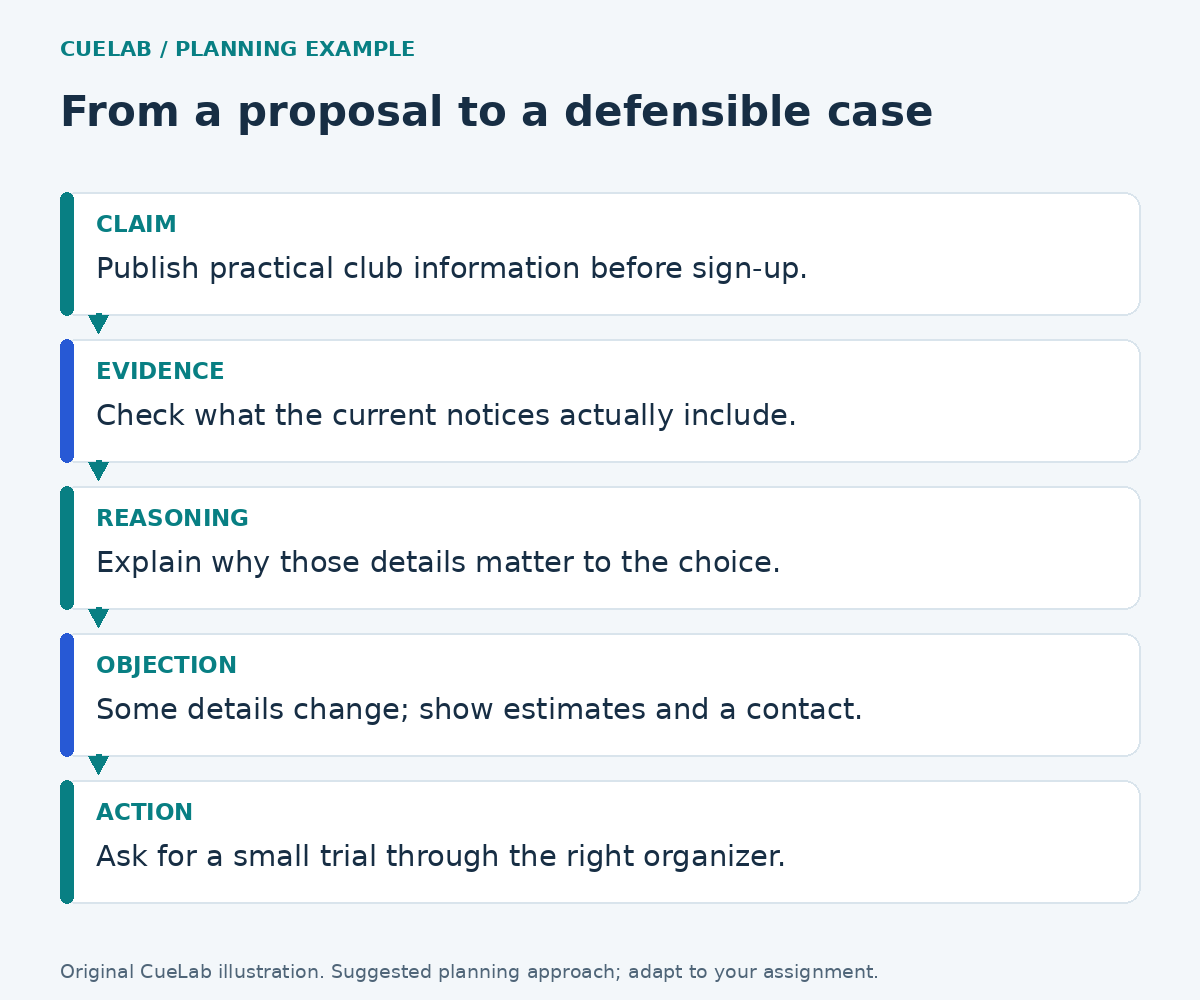
This distinction helps you avoid overclaiming. An observation can identify a possible problem, while a limited trial can test whether your proposed change helps. Presenting those as separate stages makes the argument more credible and gives the audience a practical way to respond.
Worked example: clearer information before club sign-up
The claim
An original sample claim is: “Before the next club sign-up day, every club should publish its meeting time, likely costs, and required equipment in the same short format.” This has a clear audience, a deadline, and a bounded change. It does not require identical activities, identical fees, or a new system for everything the school communicates.
The evidence plan
Review the information currently available for several clubs with permission. Record which practical details are present and which are missing, without naming individual students who struggled to find them. Ask the appropriate organizer which details can realistically be confirmed before sign-up and which need to be marked as estimates.
The reasoning
Explain that students are choosing how to spend time and, sometimes, money. Comparable practical details let them ask better questions before committing. Do not claim that the format will increase membership unless you have relevant evidence; the narrower case is that it makes the initial choice better informed.
The objection and revised proposal
A fair objection is that costs and meeting dates sometimes change. Address it by proposing a “last checked” date, a named contact, and an “estimate” label where the figure is uncertain. If maintaining the full system is too much work, suggest trying the format with a small set of clubs before expanding.
The audience action
Close by asking for support to take a one-page draft to the relevant organizer, rather than announcing that the policy has already been accepted. The speech can include a fictional sample notice, but label it clearly. Sample material demonstrates your proposal; it is not evidence that a real club currently provides poor information.
Use a five-minute outline that leaves room for disagreement
One planning option is forty seconds for the problem and proposal, eighty seconds for the strongest evidence, seventy seconds for a second supporting reason, sixty seconds for the main objection and response, and fifty seconds for the requested action and timing allowance. Adjust this to your rubric and the complexity of the claim.
Keep the objection in the speech even if it feels uncomfortable. Removing it may give you more time for positive points, but it also leaves the audience to supply a concern you never answer. A careful concession can show that you have thought about the proposal beyond its most attractive version.
Check your wording before you rehearse
Replace unsupported statements such as “everyone wants,” “this always happens,” and “there are no disadvantages” with wording that matches what you know. Attribute a published finding to its source, and identify a personal observation as a personal observation. A speech can be confident without pretending uncertain details are settled.
Read each proposed example as if someone who disagrees were listening. Would they recognize their view, or would they hear a caricature? Ethical persuasion depends on truthful claims and respect for the audience’s freedom to decide. That matters especially when classmates will continue learning and working together after the speech.
Rehearse the argument, not only the opening
Ask a practice listener to state your proposal and the reason they found most convincing. Then ask what would stop them from supporting it. Their answer can reveal a missing explanation, a weak source, or an implementation detail you overlooked.
Revise the point they actually found unclear, then time the whole speech. You do not need to add more arguments every time you practice. Often the better revision is one clearer example, a narrower promise, or a more realistic next step.
Make one proposal worth discussing
Choose a topic you can investigate, write the change in one sentence, and identify who could act on it. Find enough evidence to support a reasonable case and enough opposing evidence to understand its limits. A thoughtful short speech gives the audience a proposal they can examine, rather than a demand they are expected to applaud.
For the next stage, see CueLab’s speech structure guide and guide to questions you cannot yet answer. Older students can also explore the existing college persuasive-topic guide.
Reference: University of Minnesota, Communication in Practice: Specific Ethical Guidelines. The proposals, evidence prompts, and model argument above are original CueLab teaching examples.