Telephone Etiquette Examples: Six Conversations From Opening to Follow-Up
Useful telephone etiquette examples show what to say when a call becomes uncertain: you cannot hear a name, the right person is unavailable or a request needs a follow-up. A friendly opening matters, but accuracy and a clear next step matter throughout the call.
This guide uses original, fictional office and student-service conversations. Follow your workplace’s actual call-handling procedures and authority limits. The examples are for communication practice; they do not prescribe a universal ring count, response deadline or script for a regulated service.
What is telephone etiquette?
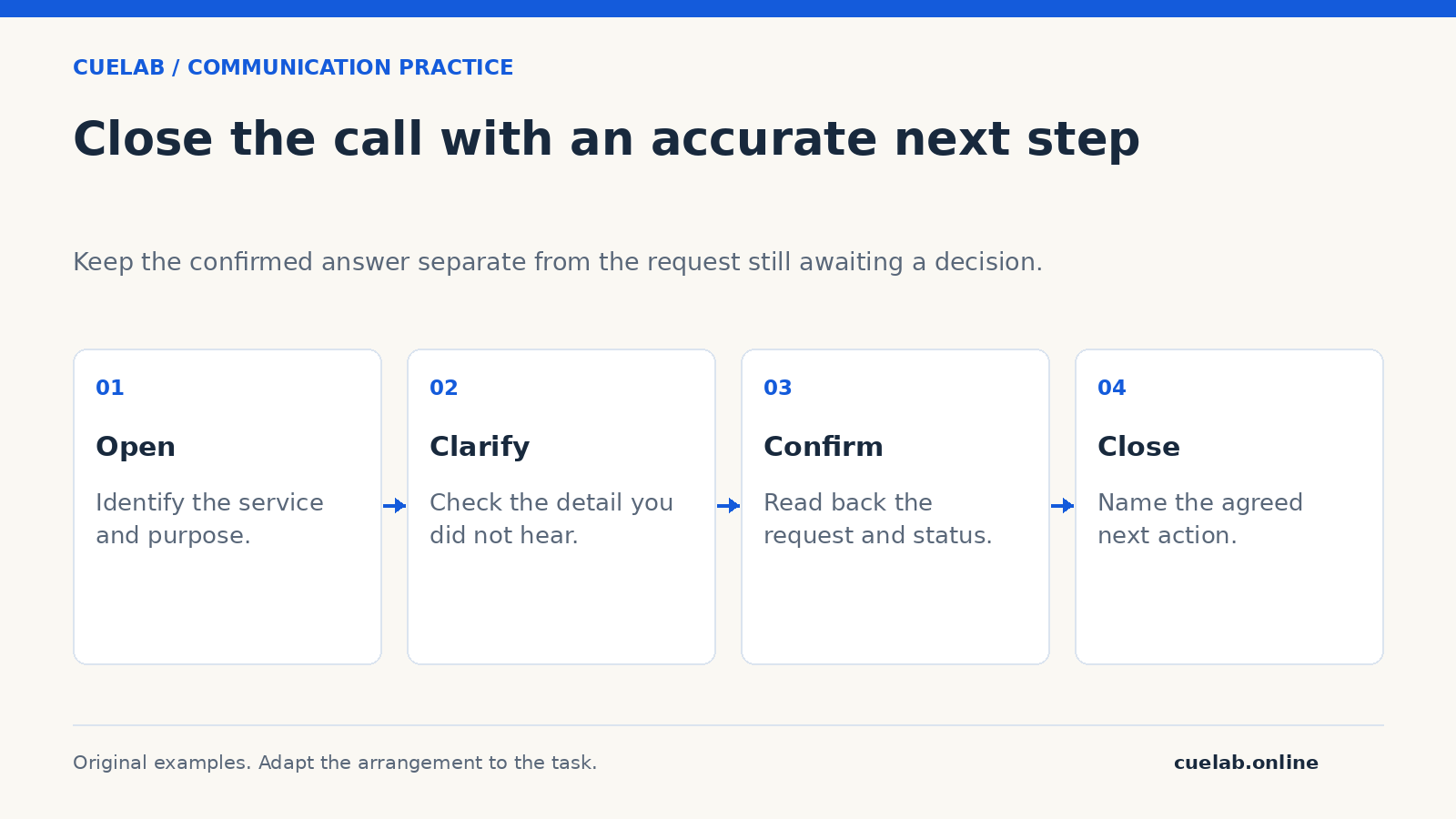
Telephone etiquette is the set of communication practices that make a call respectful, understandable and useful. It includes identifying the relevant service, finding out what the caller needs, checking important details and closing with an agreed next step. The person answering should not have to sound like one ideal personality to do those things well.
Prepare the information you are authorised to use: current contact routes, opening arrangements and a way to record a message. A pleasant voice cannot repair an outdated number. If you do not know the answer, say what you can check instead of presenting a guess as an instruction.
Example 1: open the call and establish the purpose
Staff: “Hello, workshop enquiries, this is Noor. How can I help?”
Caller: “I’m asking about tomorrow’s session.”
Staff: “Is your question about the time, location or registration?”
Caller: “The location. My confirmation has two room numbers.”
The opening identifies the service and speaker. The next question narrows the task without requiring the caller to retell unrelated background. Noor now knows that the problem is conflicting information, not a request for every session detail. The appropriate response is to check the current room record.
If you are making an outbound call, identify yourself and the reason, then check whether it is a suitable time to discuss that task. Do not begin with a long explanation before finding out whether you have reached the intended person.
Example 2: clarify a name or detail without pretending you heard it
Staff: “I did not catch the last part of your name. Could you spell it, please?”
Caller: “D-A-R.”
Staff: “Thank you. I have Dar. Is that correct?”
Ask for the particular part you missed rather than repeatedly asking the caller to start again. For a reference code, confirm it in manageable groups. Use an agreed spelling convention if one is available. A confident repetition of the wrong information can create more work than an honest clarification.
Consider an access or connection problem before attributing difficulty to the caller. Offer another suitable channel when it would help. Do not demand that someone use a speaking style that is uncomfortable or inaccessible merely to match your routine.
Example 3: ask before placing someone on hold
Staff: “I need to check the room record with the event team. Would you prefer to hold while I check, or leave a message for a reply?”
Caller: “I can hold briefly.”
Staff: “Thank you. I will return with an update if the check takes longer than expected.”
Ask, then wait for an answer. Use the phone system’s proper hold function and follow local guidance. Leaving an open microphone while discussing the caller can expose a conversation that was not intended for them. Avoid promising an exact wait when you cannot reasonably estimate it.
When you return, state what happened: “Thank you for waiting. The event team has confirmed Room 4.” If the check is unfinished, say so and offer the available next step. Do not leave the caller to infer whether the connection has failed.
Example 4: transfer with a destination and a fallback
Staff: “The registration team handles that change. With your agreement, I can transfer you to them. Their direct contact is listed in your confirmation if the call disconnects.”
Caller: “Yes, please.”
Staff: “I will explain that you need to correct the session selection, so you do not have to begin with the room question again.”
Give only a current, authorised contact route. A made-up extension or an unconfirmed promise that somebody will answer is not a useful fallback. Where the system allows it, check that the destination can receive the call and pass on the necessary context. Avoid sending someone through several teams without establishing which one owns the task.
Share only the information needed for the handoff. A caller’s unnecessary personal background does not become relevant merely because it appeared earlier in the conversation. If a transfer is unavailable, offer the actual message or contact process rather than pretending that the transfer succeeded.
Example 5: take an accurate message
Staff: “The coordinator is unavailable. Would you like me to pass on a message?”
Caller: “Please ask whether my display can arrive after 10.”
Staff: “I have a question about a display arriving after 10. You would like the coordinator to confirm whether that is possible. What contact route should they use to reply?”
Record the purpose, intended recipient, relevant timing and agreed reply route. Read back the important information. Distinguish what the caller requested from what your team has agreed to do. “Can my display arrive after 10?” is a question, not a confirmed late-arrival arrangement.
| Record | Why it matters | Check aloud |
|---|---|---|
| Name and intended recipient | Helps the message reach the right person. | Confirm the spelling or role if uncertain. |
| Reason for the call | Preserves the action needed. | “You need confirmation of the arrival time.” |
| Reply route | Makes the next contact possible. | Repeat the agreed contact detail carefully. |
| Timing or constraint | Shows what affects the decision. | “Is there a time by which you need an answer?” |
| Status | Separates a request from a promise. | “I will pass on the request; approval is still pending.” |
Keep message records according to your organisation’s handling process. Use fictional names and invented contact details for training. Do not put real callers’ details into a public practice exercise.
Example 6: close a call with the next step
Staff: “We have confirmed Room 4. The display-arrival question is still with the coordinator. I will pass on your message using the agreed contact route.”
Caller: “Thank you.”
Staff: “Is there another detail about this enquiry we should clarify before we finish? Thank you for calling.”
A summary is more useful than a closing phrase alone when the conversation covered several issues. Name the resolved item and the pending item separately. Do not say “Everything is sorted” when a decision remains outstanding.
Telephone etiquette tips you can practise
Work in pairs with a third person observing if available. Give the caller a fictional information gap, such as two room numbers or an unclear deadline. The person answering should discover the task, confirm one important detail and close with an accurate status. Switch roles after one attempt.
The observer should record evidence: which question narrowed the enquiry, which detail was read back and whether the closing matched what had actually been agreed. “Sound more confident” is not specific enough to guide a second attempt. Try one changed question or summary, then repeat the difficult section rather than the entire call.
Common questions
What if I do not know the answer?
Say what you know, what remains unconfirmed and which authorised route can check it. Offer a realistic next step. Do not promise that another person will approve a request.
How do I handle an upset caller?
Let them explain the practical problem, acknowledge it without inventing responsibility and state what you can do. Follow workplace procedures for abusive or threatening calls; courtesy does not require accepting unlimited abuse.
Do I need to memorise the whole script?
No. Learn the purpose of each stage and practise accurate wording for the parts you find difficult. A flexible outline leaves more attention for listening.
For the listening check, use worked active-listening conversations. For a written follow-up, see professional email etiquette and message interpretation and repair.